
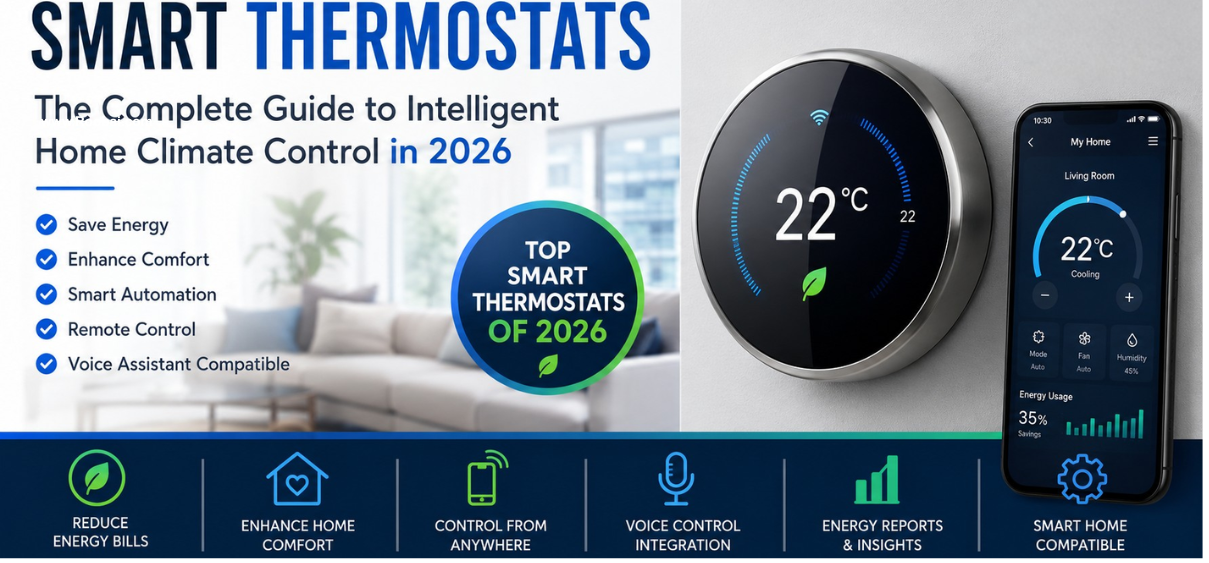
Best Smart Thermostats: Complete Buying Guide
Smart home technology continues to redefine how we manage comfort, convenience, and energy consumption. Among the most impactful smart home upgrades available today, smart thermostats stand out as one of the most effective investments for improving household efficiency while reducing energy costs.
Modern smart thermostats do much more than regulate temperature. They learn schedules, optimize heating and cooling performance, provide detailed energy reports, integrate with voice assistants, support remote access, and create personalized comfort settings based on occupancy patterns.
Whether we want to reduce electricity bills, automate home climate control, enhance comfort, or create a fully connected smart home ecosystem, choosing the best smart thermostat requires understanding the features, technologies, and compatibility requirements available in today's market.
This comprehensive guide explores everything we need to know before purchasing the best smart thermostat.
What Is a Smart Thermostat?
A smart thermostat is an internet-connected temperature control device that allows users to monitor and adjust heating and cooling systems through a smartphone app, voice assistant, or automation platform.
Unlike traditional thermostats that require manual adjustments, smart thermostats automatically optimize temperature settings based on schedules, preferences, occupancy detection, weather conditions, and energy-saving algorithms.
These devices provide greater control over indoor climate while improving efficiency and reducing energy waste.
Why Smart Thermostats Are Worth Buying
Smart thermostats offer numerous benefits beyond simple temperature control.
Key Advantages
- Remote access from anywhere
- Lower energy consumption
- Reduced utility bills
- Automated temperature scheduling
- Voice control support
- Learning capabilities
- Energy usage reports
- Smart home integration
- Occupancy detection
- Geofencing technology
- Enhanced comfort
- Environmental sustainability
For many households, a smart thermostat can pay for itself through long-term energy savings.
How Smart Thermostats Work
Smart thermostats connect to home Wi-Fi networks and communicate with HVAC systems.
They collect information from:
- Temperature sensors
- Occupancy sensors
- Weather forecasts
- Mobile device locations
- User schedules
- Energy consumption data
Using this information, the thermostat adjusts heating and cooling cycles to maintain comfort while minimizing unnecessary energy usage.
Many premium models continuously learn user habits and optimize settings automatically.
Types of Smart Thermostats
Learning Thermostats
Learning thermostats automatically adapt to household routines.
Benefits
- Minimal manual programming
- Automatic optimization
- Greater energy savings
- Personalized comfort
Ideal for busy households.
Programmable Smart Thermostats
These allow users to create detailed schedules manually.
Benefits
- Full control
- Predictable operation
- Custom temperature plans
Suitable for users who prefer precise scheduling.
Geofencing Thermostats
These thermostats use smartphone location tracking.
Advantages
- Automatically adjust temperature when leaving
- Resume preferred settings upon return
- Reduce energy waste
Excellent for families with varying schedules.
Multi-Zone Smart Thermostats
Designed for larger homes with multiple heating and cooling zones.
Benefits
- Room-specific control
- Improved comfort
- Greater efficiency
- Reduced hot and cold spots
Key Features to Consider Before Buying
Compatibility with HVAC Systems
Before purchasing, verify compatibility with:
- Central heating systems
- Heat pumps
- Furnaces
- Boilers
- Radiant heating
- Multi-stage HVAC systems
Compatibility remains the most important purchasing factor.
Wi-Fi Connectivity
Reliable connectivity enables:
- Remote monitoring
- Mobile app control
- Firmware updates
- Energy reporting
- Automation features
Strong Wi-Fi support improves overall performance.
Smart Home Integration
Choose a thermostat compatible with your ecosystem.
Popular platforms include:
- Amazon Alexa
- Google Home
- Apple HomeKit
- Samsung SmartThings
- Matter-compatible systems
Integration simplifies home automation.
Voice Control Support
Voice assistants provide hands-free control.
Examples include:
- Temperature adjustments
- Schedule changes
- System status checks
- Energy reports
Voice control enhances convenience significantly.
Learning Algorithms
Advanced thermostats learn:
- Preferred temperatures
- Daily routines
- Seasonal changes
- Occupancy habits
The more data collected, the better the optimization.
Geofencing Technology
Geofencing automatically adjusts settings based on smartphone location.
Benefits include:
- Reduced energy waste
- Increased convenience
- Improved efficiency
- Automatic comfort restoration
Energy Usage Reports
Detailed reports help identify:
- Peak consumption periods
- Cost-saving opportunities
- HVAC efficiency issues
- Seasonal trends
Data-driven insights support better energy management.
Benefits of Smart Thermostat Automation
Automation transforms climate control into a seamless experience.
Common Automation Scenarios
- Lower temperatures during work hours
- Increase comfort before arrival home
- Nighttime temperature adjustments
- Vacation mode activation
- Weather-based optimization
- Occupancy-based control
Automation reduces manual intervention while maximizing efficiency.
Best Places to Use Smart Thermostats
Smart thermostats are suitable for:
Homes
- Apartments
- Villas
- Condominiums
- Multi-story houses
Commercial Spaces
- Offices
- Retail stores
- Clinics
- Educational facilities
Vacation Properties
- Holiday homes
- Rental properties
- Seasonal residences
Remote monitoring is particularly valuable for secondary properties.
Understanding Energy Savings
One of the primary reasons consumers purchase smart thermostats is energy reduction.
How Energy Savings Occur
| Feature | Potential Savings Impact |
|---|---|
| Scheduling | Reduces unnecessary HVAC runtime |
| Geofencing | Prevents heating or cooling empty homes |
| Learning Technology | Optimizes temperature patterns |
| Weather Adaptation | Improves HVAC efficiency |
| Occupancy Detection | Reduces waste automatically |
| Energy Reports | Encourages better usage habits |
Over time, these savings can become substantial.
Installation Guide
Installing a smart thermostat is generally straightforward.
Step 1: Turn Off Power
Disconnect power to the HVAC system.
Step 2: Remove Existing Thermostat
Carefully document wiring before removal.
Step 3: Verify Wiring Compatibility
Many smart thermostats require a C-wire.
Step 4: Install Mounting Plate
Secure the new mounting plate.
Step 5: Connect Wires
Attach wires according to instructions.
Step 6: Attach Thermostat Unit
Secure the thermostat to the mounting bracket.
Step 7: Restore Power
Turn HVAC power back on.
Step 8: Configure App
Complete Wi-Fi setup and personalization.
Smart Thermostat Connectivity Options
Wi-Fi
Advantages
- Remote access
- Cloud integration
- Advanced automation
Disadvantages
- Requires network connectivity
Bluetooth
Advantages
- Fast setup
- Local communication
Disadvantages
- Limited range
Matter Compatibility
Matter is emerging as the universal smart home standard.
Benefits
- Improved interoperability
- Simplified setup
- Greater ecosystem flexibility
Future-proofing becomes easier with Matter support.
Common Smart Thermostat Mistakes to Avoid
Avoid these purchasing mistakes:
- Ignoring HVAC compatibility
- Overlooking C-wire requirements
- Buying without checking smart home support
- Skipping firmware updates
- Poor thermostat placement
- Ignoring Wi-Fi signal strength
- Choosing features you won't use
- Focusing only on price
Proper planning prevents installation issues and dissatisfaction.
Smart Thermostat Maintenance Tips
Regular maintenance improves reliability.
Best Practices
- Update firmware regularly
- Clean display surfaces gently
- Check HVAC filters frequently
- Verify sensor accuracy
- Monitor energy reports
- Inspect wiring periodically
Proper maintenance extends device lifespan.
Smart Thermostat Pros and Cons
| Pros | Cons |
| Energy savings | Higher upfront cost |
| Remote control | Installation may require wiring knowledge |
| Automation | Some features depend on internet access |
| Voice control | Compatibility varies |
| Learning capabilities | Premium models cost more |
| Enhanced comfort | Advanced settings may require setup time |
| Smart home integration | Certain HVAC systems may need adapters |
| Detailed energy reporting | App quality varies by manufacturer |
Who Should Buy a Smart Thermostat?
Smart thermostats are ideal for:
- Homeowners
- Property managers
- Apartment residents
- Smart home enthusiasts
- Eco-conscious consumers
- Families
- Remote workers
- Frequent travelers
- Rental property owners
Nearly any household with a compatible HVAC system can benefit.
Smart Thermostat Buying Checklist
Before purchasing, verify:
Compatibility
- HVAC support
- Heat pump compatibility
- Multi-stage support
Connectivity
- Wi-Fi
- Bluetooth
- Matter support
Features
- Learning technology
- Scheduling
- Geofencing
- Occupancy detection
- Energy reports
Convenience
- Mobile app quality
- Voice assistant compatibility
- Warranty coverage
Future-Proofing
- Software update history
- Ecosystem support
- Smart home integration
Top Features That Deliver the Most Value
The most useful features include:
- Remote temperature control
- Learning schedules
- Geofencing
- Occupancy sensing
- Energy reporting
- Smart home integration
- Voice control
- Vacation mode
- Weather adaptation
- Multi-zone support
Prioritizing these features often results in the best long-term satisfaction.
Future Trends in Smart Thermostats
The next generation of smart thermostats is expected to include:
- AI-powered optimization
- Enhanced predictive analytics
- Improved occupancy detection
- Advanced weather integration
- Matter-first compatibility
- Renewable energy coordination
- Grid-aware energy management
- Expanded sensor networks
These innovations will further improve efficiency and comfort.
25 Frequently Asked Questions
1. What is a smart thermostat?
A thermostat that connects to the internet and allows remote temperature control and automation.
2. Do smart thermostats save money?
Yes, many users experience reduced heating and cooling costs.
3. Can I control it from my phone?
Yes, mobile apps provide full remote control.
4. Do smart thermostats work without Wi-Fi?
Basic functions often work, but remote features may require Wi-Fi.
5. What is geofencing?
A feature that adjusts settings based on smartphone location.
6. Are smart thermostats difficult to install?
Most installations are straightforward with compatible wiring.
7. Do they work with heat pumps?
Many models do, but compatibility should be verified.
8. What is a C-wire?
A common wire that provides continuous power.
9. Can smart thermostats learn schedules?
Learning models automatically adapt to routines.
10. Do they support voice control?
Most support major voice assistants.
11. Can multiple users control the thermostat?
Yes, many apps support multiple household members.
12. What happens during internet outages?
Most continue basic thermostat functions locally.
13. Do they require subscriptions?
Most core features do not.
14. Can I monitor energy usage?
Many models provide detailed reports.
15. Are smart thermostats secure?
Reputable brands employ strong security measures.
16. Can they work in apartments?
Yes, if compatible HVAC systems are present.
17. What is occupancy detection?
Sensors detect presence and adjust settings.
18. Can I create custom schedules?
Yes, scheduling is a standard feature.
19. Do they help the environment?
Reduced energy consumption lowers environmental impact.
20. How long do they last?
Many quality models operate reliably for years.
21. Can they control multiple zones?
Certain models support multi-zone systems.
22. Are firmware updates important?
Yes, updates improve performance and security.
23. What is Matter compatibility?
A universal smart home standard improving interoperability.
24. Can smart thermostats increase home value?
They may enhance smart home appeal to buyers.
25. Are smart thermostats worth buying?
For most compatible homes, they provide excellent comfort, efficiency, and convenience.