
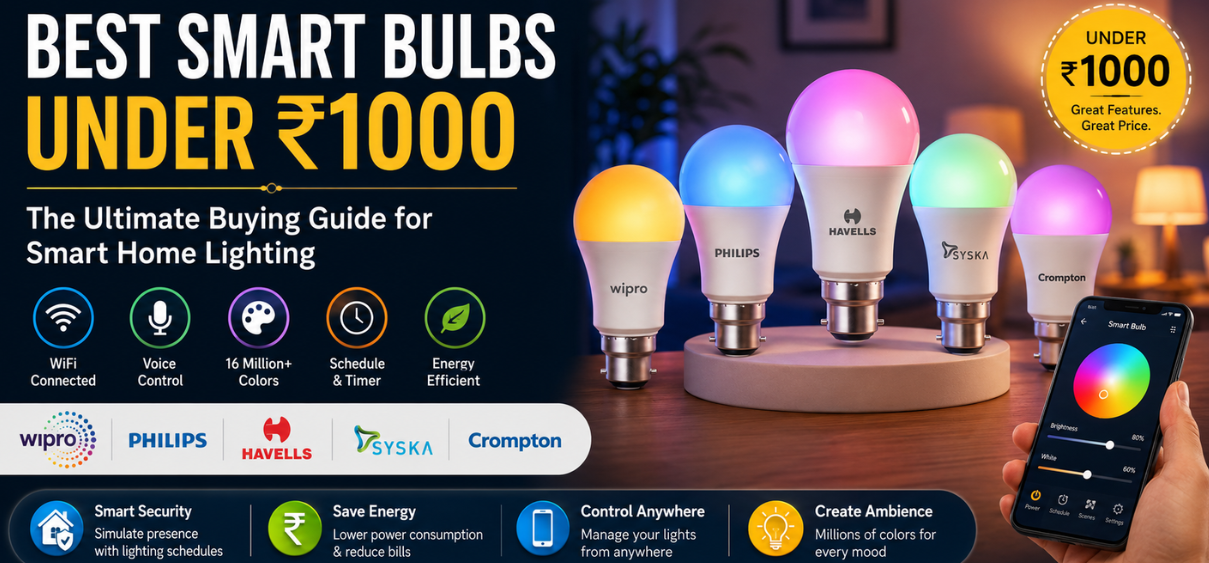
Best Smart Bulbs Under ₹1000: The Ultimate Buying Guide for Smart Home Lighting
Smart home technology has transformed the way we interact with our living spaces, and smart lighting remains one of the most affordable and impactful upgrades available today. The best smart bulbs under ₹1000 offer advanced features such as voice control, smartphone connectivity, customizable colors, scheduling, automation, and energy efficiency without requiring a significant investment.
Whether we want to create a relaxing atmosphere for movie nights, improve productivity while working, enhance home security, or simply enjoy the convenience of controlling lights remotely, modern smart bulbs provide exceptional value at budget-friendly prices.
This comprehensive guide explores everything about smart bulbs under ₹1000, including key features, benefits, top recommendations, buying considerations, installation tips, and expert advice.
Why Smart Bulbs Have Become So Popular
Traditional LED bulbs provide energy savings, but smart bulbs add an entirely new layer of convenience and personalization.
Modern smart bulbs can:
- Connect directly to WiFi
- Work with smartphones
- Support voice assistants
- Change colors instantly
- Adjust brightness remotely
- Create lighting schedules
- Enable automation routines
- Improve home security
As smart home ecosystems continue to expand, affordable smart bulbs under ₹1000 have become increasingly feature-rich.
Top Smart Bulbs Under ₹1000
1. Wipro Smart LED WiFi Bulb
Key Features
- WiFi enabled
- Voice control support
- Compatible with Google Assistant
- Compatible with Alexa
- RGB color-changing capability
- Millions of color options
- Energy-efficient LED technology
- Mobile app control
Advantages
The Wipro Smart LED bulb offers an excellent balance between affordability and functionality. It provides vibrant color reproduction, reliable connectivity, and easy installation.
Best For
- Living rooms
- Bedrooms
- Smart home beginners
- Mood lighting setups
2. Philips Smart WiFi LED Bulb
Key Features
- Trusted brand reliability
- App control
- Voice assistant compatibility
- Adjustable brightness
- Multiple color temperatures
- Long lifespan
Advantages
Philips continues to be one of the most respected names in lighting. Their budget smart bulb offerings deliver dependable performance and excellent brightness levels.
Best For
- Home offices
- Study rooms
- Everyday lighting
3. Havells Smart LED Bulb
Key Features
- Smart app integration
- WiFi connectivity
- Voice commands
- Scheduling functions
- Color-changing modes
- Energy-efficient operation
Advantages
Havells smart bulbs provide strong brightness and consistent network connectivity while maintaining competitive pricing.
Best For
- Family rooms
- Reading areas
- Smart lighting automation
4. Syska Smart WiFi LED Bulb
Key Features
- RGB lighting
- Smartphone control
- Voice assistant integration
- Adjustable brightness
- Timer settings
- Scene customization
Advantages
Syska offers feature-packed smart bulbs suitable for users seeking colorful lighting experiences without exceeding their budget.
Best For
- Gaming rooms
- Entertainment spaces
- Decorative lighting
5. Crompton Smart LED Bulb
Key Features
- WiFi enabled
- Remote operation
- Color customization
- Voice control support
- Energy-efficient design
- Smart scheduling
Advantages
Crompton combines efficient lighting technology with practical smart features, making it a strong contender in the budget category.
Best For
- Daily home use
- Apartment lighting
- Smart home upgrades
Smart Bulb Comparison Table
| Feature | Wipro | Philips | Havells | Syska | Crompton |
|---|---|---|---|---|---|
| WiFi Connectivity | Yes | Yes | Yes | Yes | Yes |
| Voice Control | Yes | Yes | Yes | Yes | Yes |
| RGB Colors | Yes | Selected Models | Yes | Yes | Yes |
| Mobile App | Yes | Yes | Yes | Yes | Yes |
| Scheduling | Yes | Yes | Yes | Yes | Yes |
| Energy Efficient | Yes | Yes | Yes | Yes | Yes |
| Price Under ₹1000 | Yes | Yes | Yes | Yes | Yes |
Essential Features to Look for in Smart Bulbs Under ₹1000
WiFi Connectivity
A good smart bulb should connect directly to your home's WiFi network. Direct WiFi connectivity eliminates the need for separate hubs or gateways.
Benefits
- Easy installation
- Remote access
- Reduced setup complexity
- Lower overall cost
Voice Assistant Compatibility
Modern smart bulbs should support:
- Google Assistant
- Amazon Alexa
Voice commands allow hands-free control for turning lights on and off, changing brightness levels, and adjusting colors.
RGB Color Support
RGB-enabled smart bulbs provide access to millions of colors.
Popular lighting scenes include:
- Romantic lighting
- Movie mode
- Party mode
- Reading mode
- Night mode
- Relaxation mode
Brightness Adjustment
Dimming capability enables users to customize lighting intensity according to different activities and preferences.
Applications include:
- Reading
- Sleeping
- Watching television
- Working from home
- Studying
Scheduling and Automation
Smart scheduling allows lights to:
- Turn on automatically
- Turn off automatically
- Follow sunrise routines
- Follow sunset routines
- Simulate occupancy
Automation significantly enhances convenience and security.
Energy Efficiency
Most smart LED bulbs consume significantly less electricity compared to traditional incandescent bulbs.
Benefits include:
- Lower electricity bills
- Reduced environmental impact
- Longer operational lifespan
- Lower maintenance costs
Benefits of Using Smart Bulbs
Enhanced Convenience
Smart bulbs eliminate the need to manually operate switches.
Users can:
- Control lights remotely
- Use voice commands
- Automate routines
- Manage multiple rooms simultaneously
Improved Ambience
Different colors and brightness levels help create personalized environments for various occasions.
Examples include:
- Warm white for relaxation
- Cool white for productivity
- Blue tones for focus
- Colorful scenes for entertainment
Increased Security
Scheduled lighting creates the appearance that someone is home, which can deter potential intruders.
Security benefits include:
- Vacation mode
- Remote access
- Automatic lighting schedules
Energy Savings
Smart bulbs use advanced LED technology while enabling better energy management through automation.
Energy-saving features include:
- Timers
- Auto shutoff
- Scheduling
- Occupancy simulation
How to Install a Smart Bulb
Installation is typically straightforward.
Step 1
Switch off power.
Step 2
Remove the old bulb.
Step 3
Install the smart bulb.
Step 4
Download the manufacturer's app.
Step 5
Connect the bulb to WiFi.
Step 6
Pair with Alexa or Google Assistant if desired.
Step 7
Customize settings and lighting scenes.
Most installations take less than ten minutes.
Common Smart Bulb Use Cases
Bedroom Lighting
Smart bulbs can gradually brighten in the morning and dim automatically at bedtime.
Benefits include:
- Better sleep routines
- Comfortable wake-up experience
Living Room Entertainment
Color-changing smart bulbs can synchronize with entertainment preferences and create immersive viewing experiences.
Home Office Productivity
Cool white lighting can help improve focus and visibility during work hours.
Children's Rooms
Smart bulbs can function as:
- Night lights
- Reading lights
- Gentle wake-up lights
Holiday Decorations
RGB smart bulbs simplify seasonal decorating by allowing instant color changes through an app.
Although smart bulbs cost more initially than standard LED bulbs, they often provide long-term savings through:
- Reduced energy consumption
- Extended lifespan
- Automated usage control
- Lower replacement frequency
Many quality smart bulbs can last more than 15,000 to 25,000 hours under normal usage conditions.
Mistakes to Avoid When Buying Smart Bulbs
Ignoring Socket Compatibility
Verify whether the bulb uses:
- B22 base
- E27 base
before purchasing.
Overlooking WiFi Requirements
Most smart bulbs require stable 2.4GHz WiFi networks.
Choosing Low Brightness Models
Brightness is measured in lumens. Higher lumen ratings generally provide stronger illumination.
Ignoring Ecosystem Compatibility
Ensure compatibility with:
- Alexa
- Google Assistant
- Smart home applications
Focusing Only on Price
The cheapest bulb may not provide reliable connectivity, durability, or color quality.
Future of Smart Lighting
Smart lighting technology continues to evolve rapidly.
Upcoming innovations include:
- AI-powered automation
- Occupancy sensing
- Advanced energy analytics
- Circadian rhythm lighting
- Enhanced voice interaction
- Deeper smart home integration
Budget smart bulbs are increasingly gaining features previously reserved for premium models.
Conclusion
The best smart bulbs under ₹1000 provide an affordable entry point into smart home technology. With WiFi connectivity, voice control, customizable lighting, scheduling, automation, and energy-efficient LED technology, these devices deliver exceptional value.
Whether choosing Wipro, Philips, Havells, Syska, or Crompton, consumers can enjoy advanced lighting control without exceeding a modest budget. By focusing on brightness, connectivity, compatibility, color options, and reliability, it is possible to find a smart bulb that perfectly suits both practical needs and aesthetic preferences.
25 Frequently Asked Questions
1. What is a smart bulb?
A smart bulb is an LED light that can be controlled through a smartphone app or voice assistant.
2. Are smart bulbs worth buying?
Yes, they offer convenience, automation, and energy savings.
3. Do smart bulbs need WiFi?
Most smart bulbs require WiFi connectivity.
4. Can smart bulbs work without the internet?
Many continue basic operation locally but require internet for remote access.
5. Do smart bulbs save electricity?
Yes, they use energy-efficient LED technology.
6. Can Alexa control smart bulbs?
Yes, most modern smart bulbs support Alexa.
7. Can Google Assistant control smart bulbs?
Yes, many models support Google Assistant.
8. What is RGB lighting?
RGB lighting allows bulbs to display millions of colors.
9. Are smart bulbs difficult to install?
No, installation is usually simple.
10. Do smart bulbs require a hub?
Many WiFi bulbs work without a hub.
11. How long do smart bulbs last?
Typically 15,000 to 25,000 hours.
12. Can smart bulbs be dimmed?
Yes, most models support dimming.
13. Are smart bulbs safe?
Yes, when purchased from reputable manufacturers.
14. What socket types are common?
B22 and E27 are the most common.
15. Can I schedule smart bulbs?
Yes, scheduling is a standard feature.
16. Can multiple bulbs be controlled together?
Yes, through groups and scenes.
17. Do smart bulbs work during power cuts?
No, they require electrical power.
18. Can smart bulbs change color?
RGB models can change colors.
19. What is color temperature?
It measures how warm or cool white light appears.
20. Can smart bulbs improve home security?
Yes, through automated schedules.
21. Which smart bulb brand is most reliable?
Philips, Wipro, Havells, Syska, and Crompton are popular options.
22. Are smart bulbs suitable for offices?
Yes, especially adjustable white-light models.
23. Can smart bulbs be controlled remotely?
Yes, through internet-connected apps.
24. Do smart bulbs increase electricity bills?
No, they generally reduce energy consumption.
25. Which smart bulb under ₹1000 offers the best value?
Wipro and Philips are frequently considered excellent value choices.