
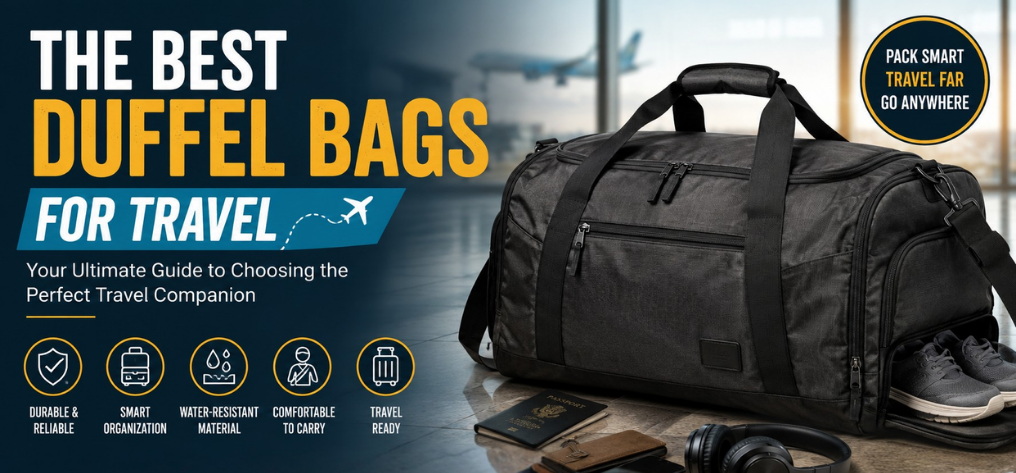
Finding the best duffel bags for travel can make a significant difference to how comfortably and efficiently we pack, carry, and organize our belongings. A good duffel bag gives us the flexibility of a suitcase while offering the lightweight construction and easy-access design of a traditional travel bag. Whether we are planning a weekend getaway, a business trip, a road journey, an outdoor adventure, or a longer vacation, choosing the right duffel bag helps us travel with greater convenience.
Unlike conventional suitcases, travel duffel bags are usually flexible, easy to store, and capable of accommodating a surprising amount of luggage. Many modern designs also include padded laptop compartments, shoe compartments, wet-dry sections, compression straps, trolley sleeves, backpack straps, and water-resistant materials.
The ideal duffel bag depends on several factors, including capacity, material, durability, portability, compartment design, weather resistance, carrying comfort, and travel requirements. A compact 30–40 litre duffel may be perfect for a short trip, while a 60–80 litre model can be more suitable for extended travel.
In this guide, we explore the best duffel bags for travel, the different types available, recommended capacities, essential features, packing strategies, and the factors we should consider before making a purchase.
Best Duffel Bags for Travel at a Glance
| Duffel Bag Type | Ideal Capacity | Best For | Key Advantage |
|---|---|---|---|
| Small Travel Duffel | 20–35L | Day trips, short journeys | Lightweight and compact |
| Weekend Duffel | 35–50 L | 2–4 day trips | Excellent balance of space and portability |
| Carry-On Duffel | 40–45L | Flights | Designed around compact travel |
| Large Travel Duffel | 50–70L | Extended vacations | High storage capacity |
| Extra-Large Duffel | 70–100L+ | Long trips, equipment | Maximum capacity |
| Duffel Backpack | 30–60L | Active travel | Hands-free carrying |
| Wheeled Duffel | 50–100L | Heavy luggage | Easier transportation |
| Waterproof Duffel | 30–100L | Outdoor travel | Better protection from moisture |
What Makes the Best Duffel Bag for Travel?
The best travel duffel bag should combine capacity, durability, comfort, organization, and portability without becoming unnecessarily bulky. We should look beyond appearance and evaluate how the bag performs during real travel.
A strong duffel bag typically uses durable fabric, reinforced stitching, reliable zippers, comfortable handles, and strategically placed compartments. If we travel frequently, additional features such as padded shoulder straps, backpack conversion, trolley sleeves, and water-resistant construction can become especially valuable.
The best option is not necessarily the largest bag available. Instead, we should select a size that matches the duration and type of our trips.
Important Features to Look For
- Durable construction
- Water-resistant or waterproof material
- Strong zippers
- Reinforced handles
- Adjustable shoulder straps
- Padded backpack straps
- Dedicated shoe compartment
- Separate wet compartment
- Laptop or tablet sleeve
- Interior organization pockets
- Compression straps
- Trolley sleeve
- Lightweight construction
- Wide top opening
- Reinforced base
- Lock-compatible zippers
Best Duffel Bag Sizes for Different Types of Travel
Choosing the correct capacity is one of the most important decisions we can make when buying a travel duffel bag.
20–30 L Duffel Bags
Small duffel bags between 20 and 30 liters work well for day trips, gym sessions, overnight stays, and short journeys.
They are easy to carry and generally fit comfortably under seats or in compact storage areas. However, their limited capacity makes them unsuitable for travellers who need to pack several outfits, shoes, toiletries, and electronics.
Best for:
- Overnight trips
- Gym travel
- Day trips
- Minimalist packing
- Personal items
30–40 L Duffel Bags
A 30–40-liter duffel provides a practical middle ground. We can usually pack clothing, toiletries, footwear, electronics, and other essentials without carrying a large bag.
This size is particularly useful for weekend travel and short business trips.
40–50 L Duffel Bags
For many travellers, 40–50 litres represents the ideal combination of capacity and portability.
A well-designed 40–45 litre duffel can often work effectively for short air travel, depending on the airline's current baggage rules and the bag's dimensions.
Best for:
- Weekend vacations
- Business trips
- Short international trips
- Carry-on-oriented travel
- Minimalist travellers
50–70 L Duffel Bags
When we need additional clothing, footwear, accessories, or outdoor equipment, a 50–70 litre duffel becomes more practical.
These bags are suitable for long weekends, extended vacations, road trips, and adventure travel.
70–100 L+ Duffel Bags
Extra-large duffel bags are designed for travellers who prioritize capacity over compactness.
They can accommodate substantial amounts of clothing and equipment, making them useful for:
- Long vacations
- Group travel
- Camping equipment
- Sports equipment
- Relocation
- Expedition-style travel
However, a larger capacity also means a heavier bag once packed, so we should consider whether we can comfortably carry it.
Best Duffel Bags for Weekend Travel
For a weekend trip, we usually do not need an enormous suitcase. A 35–50-liter travel duffel can provide enough space for several outfits, toiletries, footwear, electronics, and travel accessories.
A good weekend duffel should have a large main compartment with smaller organizational pockets. A dedicated shoe compartment is especially useful because it keeps footwear away from clean clothing.
A removable shoulder strap can make the bag more versatile, while a trolley sleeve allows us to attach it securely to a rolling suitcase.
For frequent weekend travelers, we should prioritize:
- Lightweight construction
- Wide opening
- Comfortable handles
- External quick-access pocket
- Shoe compartment
- Water-resistant fabric
- Trolley compatibility
Best Duffel Bags for Air Travel
Air travel requires a slightly different approach. We need to pay attention not only to capacity but also to overall dimensions and airline baggage policies.
A 40–45 litre duffel can be an attractive option for carry-on-oriented packing, but capacity alone does not determine whether a bag qualifies as cabin baggage. Airlines can specify maximum dimensions and weight limits, so we should always check the applicable airline rules before travelling.
A good airport duffel should include:
- Compact dimensions
- Comfortable shoulder straps
- Trolley sleeve
- Easy-access passport pocket
- Laptop compartment
- Secure zippers
- Lightweight construction
A convertible duffel backpack can be particularly useful because we can carry it on our back while walking through airports and convert it to a traditional duffel when necessary.
Best Duffel Bags for Business Travel
Business travellers need organization as much as capacity.
The best business travel duffel should have dedicated storage for a laptop, tablet, documents, chargers, headphones, power banks, and other accessories.
A separate laptop compartment prevents electronics from being buried beneath clothing. External pockets also make passports, boarding passes, keys, and smartphones easier to access.
For professional travel, we should look for:
- Padded laptop compartment
- Tablet sleeve
- Cable organization
- Document pocket
- Minimalist design
- Trolley sleeve
- Comfortable shoulder strap
- Water-resistant exterior
A structured duffel generally looks more professional than an extremely soft and unstructured gym-style bag.
Best Duffel Bags for Road Trips
Road trips give us more flexibility with luggage size, making larger duffel bags particularly useful.
Unlike rigid suitcases, duffel bags can be squeezed into car trunks and storage areas more easily. Their flexible construction makes them excellent for road travel where luggage may need to fit around other equipment.
For road trips, we should prioritize large openings, durable materials, multiple compartments, and easy-access pockets.
A 60–80-liter duffel can be suitable when we need clothing and additional travel equipment, although the right capacity depends on trip length and the number of travellers sharing luggage.
Best Duffel Bags for Adventure Travel
Adventure travel places greater demands on luggage.
When hiking, camping, trekking, boating, or travelling through unpredictable weather, we need a bag capable of handling rougher conditions.
A good adventure duffel should use durable fabric with reinforced stress points. Water-resistant or waterproof construction becomes especially valuable when travelling through rain, coastal environments, or humid conditions.
Useful features include:
- Waterproof zippers
- Roll-top closure
- Reinforced base
- Heavy-duty handles
- Compression straps
- Removable backpack straps
- Weather-resistant fabric
- High-visibility interior
- Separate wet compartment
For outdoor activities, a bag's construction quality is often more important than its appearance.
Duffel Bag vs Suitcase: Which Is Better for Travel?
Both duffel bags and suitcases have advantages.
| Feature | Duffel Bag | Suitcase |
| Weight | Usually lighter | Usually heavier |
| Flexibility | Excellent | Limited |
| Storage | Easy to compress | Requires fixed space |
| Organization | Moderate to excellent | Usually excellent |
| Wheels | Optional | Common |
| Rough terrain | Good with backpack straps | Less convenient |
| Packing access | Usually excellent | Excellent |
| Professional appearance | Depends on design | Usually structured |
| Heavy luggage | Can be difficult to carry | Easier with wheels |
| Adventure travel | Excellent | Less suitable |
Duffel bags are generally better when we value flexibility and portability, while suitcases are often better when we need structured organization and easy wheeled transportation.
Duffel Bag vs Backpack
A duffel bag typically provides more usable packing volume than a conventional backpack. However, backpacks distribute weight more naturally across both shoulders.
A duffel backpack combines elements of both designs.
| Feature | Duffel | Backpack |
| Packing capacity | High | Moderate |
| Accessibility | Excellent | Good |
| Carrying comfort | Moderate | Excellent |
| Clothing storage | Excellent | Good |
| Outdoor travel | Good | Excellent |
| Professional travel | Good | Excellent |
| Heavy loads | Moderate | Better |
| Flexibility | Excellent | Good |
For travellers who regularly move through airports, train stations, and urban environments, a convertible duffel backpack can provide excellent versatility.
Best Materials for Travel Duffel Bags
The material used in a duffel bag affects durability, weight, weather resistance, and appearance.
Nylon
Nylon is widely used because it is lightweight, durable, and flexible. High-quality nylon can withstand frequent travel while keeping overall bag weight relatively low.
Polyester
Polyester is another common material. It offers good durability and can provide excellent resistance to everyday wear.
Canvas
Canvas provides a classic appearance and can be extremely durable. However, canvas duffel bags can be heavier than synthetic alternatives.
TPU and Waterproof Materials
Some adventure-oriented duffel bags use coated materials such as TPU to provide stronger resistance to water and abrasion.
For regular air travel, lightweight nylon or polyester can be sufficient. For demanding outdoor conditions, we should consider more robust weather-resistant construction.
Waterproof vs Water-Resistant Duffel Bags
These terms should not be treated as interchangeable.
A water-resistant duffel bag can resist light rain and splashes, while a genuinely waterproof design provides a higher level of protection when exposed to significant moisture.
Waterproof construction may include:
- Waterproof fabric
- Welded seams
- Roll-top closures
- Waterproof zippers
- Protective coatings
For normal city travel, water resistance may be enough. For boating, trekking, camping, or heavy rain exposure, stronger waterproof protection can be worthwhile.
Best Duffel Bags with Shoe Compartments
A shoe compartment is one of the most practical features available on modern travel duffels.
Shoes can contain dirt, moisture, and odors, so separating them from clothing helps maintain better organization.
The compartment should ideally be positioned at the bottom or side of the bag and should be large enough for the footwear we normally travel with.
A ventilation opening can also help reduce odor buildup.
Best Duffel Bags with Laptop Compartments
For business travellers and digital nomads, laptop protection is essential.
A dedicated laptop compartment should ideally be:
- Padded
- Suspended slightly above the base
- Securely closed
- Easy to access
- Large enough for the intended laptop size
If we regularly travel with expensive electronics, additional protection through a separate laptop sleeve can provide another layer of security.
How to Choose the Best Duffel Bag for Travel
Before buying a duffel bag, we should evaluate the following factors.
1. Determine the Trip Length
Start by considering how long we typically travel.
For one or two nights, a 25–40 litre bag may be sufficient. For longer trips, a 50–70 litre model may provide better flexibility.
2. Check the Dimensions
Capacity is not the only consideration. Two bags with similar litre ratings can have very different dimensions.
For flights, always compare the bag's external dimensions against the airline's current baggage requirements.
3. Evaluate the Weight
A heavy empty bag reduces how much useful luggage we can carry.
For frequent travel, lightweight construction can make a substantial difference.
4. Check the Carrying System
A duffel should be comfortable in the way we intend to carry it.
Look for:
- Padded shoulder straps
- Adjustable straps
- Padded handles
- Backpack straps
- Sternum straps where applicable
5. Consider Organization
Think about the items we normally carry.
If we travel with shoes, electronics, toiletries, documents, and clothing, multiple compartments can make packing considerably easier.
6. Check the Zippers
Zippers experience frequent stress during travel. Smooth, strong, well-protected zippers can improve durability and security.
7. Examine the Base
A reinforced bottom protects the bag when it is placed on airport floors, roads, hotel rooms, and outdoor surfaces.
8. Consider Weather Protection
Frequent outdoor travellers should prioritize water-resistant or waterproof construction.
How to Pack a Duffel Bag Efficiently
A good packing system can make even a relatively compact duffel feel spacious.
Plan the Outfits
Instead of packing random clothing, plan complete outfits based on the number of travel days.
Use Packing Cubes
Packing cubes divide clothing into manageable sections and make it easier to locate individual items.
Roll Suitable Clothing
Rolling lightweight garments can reduce wasted space and improve organization.
Place Shoes Separately
Use the shoe compartment whenever available. If there is no dedicated section, place shoes inside a protective bag.
Keep Heavy Items Near the Base
Position heavier objects close to the bottom and center of the bag to improve balance.
Keep Electronics Accessible
Place laptops, tablets, chargers, and headphones where they can be reached quickly.
Leave Some Extra Space
Avoid filling the bag completely. Extra space makes it easier to repack after shopping or moving between hotels.
Duffel Bag Features Worth Paying More For
Not every premium feature provides meaningful value. We should prioritize features that match our travel habits.
Worth considering:
- High-quality waterproof construction
- Durable zippers
- Reinforced stitching
- Comfortable backpack straps
- Padded laptop compartment
- Trolley sleeve
- Separate shoe compartment
- Strong compression straps
- Lightweight materials
Features that may be less important:
- Excessive decorative hardware
- Unnecessary external pockets
- Heavy metal components
- Complicated compartment systems
- Oversized logos
The best travel bag is usually the one that provides practical functionality without unnecessary bulk.
Choosing Capacity Without Checking Dimensions
A large liter capacity does not automatically make a bag suitable for flights.
Ignoring Empty Weight
A heavy bag can become uncomfortable after packing.
Buying Too Many Compartments
Organization is useful, but excessive compartments can reduce usable main-compartment space.
Ignoring Shoulder Strap Quality
A large duffel becomes uncomfortable quickly when the shoulder strap has poor padding.
Choosing Appearance Over Construction
A stylish bag is useful, but durability should come first for frequent travellers.
Ignoring Weather Resistance
Unexpected rain can damage clothing and electronics if the bag offers little protection.
Best Duffel Bag Size by Travel Duration
| Trip Duration | Recommended Capacity | Suggested Type |
| 1 Day | 15–25L | Compact duffel |
| 1–2 Nights | 25–35L | Small travel duffel |
| 2–4 Days | 35–50L | Weekend duffel |
| 4–7 Days | 50–65L | Large travel duffel |
| 1–2 Weeks | 60–80L | Large/extra-large duffel |
| Extended Travel | 80L+ | Expedition-style duffel |
These are general guidelines. Packing style, clothing requirements, weather, footwear, and personal preferences can significantly change the amount of space we need.
Best Duffel Bags for Different Travellers
For Minimalist Travellers
Choose a lightweight 25–40-liter duffel with a simple compartment layout.
For Business Travellers
Choose a structured duffel with laptop protection, document storage, and a trolley sleeve.
For Families
A 60–90 litre duffel can provide useful shared storage, particularly for road trips.
For Fitness Enthusiasts
Choose a duffel with shoe storage, ventilated compartments, and easy-clean materials.
For Adventure Travellers
Prioritize waterproof construction, reinforced fabric, compression straps, and backpack carrying options.
For Frequent Flyers
Choose a compact duffel that matches applicable cabin baggage dimensions and offers quick airport access.
How to Maintain a Travel Duffel Bag
Proper maintenance can extend the life of a quality duffel bag.
We should empty the bag after every trip and remove dirt, sand, and debris. Small spills should be cleaned promptly rather than left to stain the fabric.
For washable bags, we should follow the manufacturer's cleaning instructions instead of automatically putting the bag in a washing machine.
Zippers should be kept free from dust and debris. Wet bags should also be allowed to dry completely before storage to prevent unpleasant odors and mildew.
When storing the bag for long periods, keep it in a cool, dry environment away from direct sunlight.
Are Expensive Duffel Bags Worth It?
A higher price does not automatically guarantee a better travel bag.
However, premium models may provide better materials, stitching, zippers, hardware, carrying systems, weather protection, and warranty support.
If we travel once or twice a year, a well-built affordable duffel may be sufficient. Frequent travellers may benefit from investing in a durable model that can withstand repeated airport handling and long-term use.
The best value comes from matching construction quality and features to actual travel frequency.
Final Buying Checklist for the Best Duffel Bag
Before purchasing, we can use this checklist:
-
Is the capacity appropriate for our trips?
-
Are the dimensions suitable for our intended travel?
-
Is the bag lightweight?
-
Are the handles reinforced?
-
Is the shoulder strap comfortable?
-
Does it have sufficient organization?
-
Is there a shoe compartment?
-
Is there laptop protection if required?
-
Is the fabric durable?
-
Is it water-resistant or waterproof?
-
Are the zippers strong?
-
Does it have a reinforced base?
-
Does it include a trolley sleeve?
-
Can it be carried as a backpack?
-
Does the design suit our travel style?
The best duffel bag for travel is ultimately the one that fits our trip length, packing habits, transportation method, and comfort requirements. A compact 30–40 litre model can be ideal for minimalist weekend travel, while a 50–80-liter duffel offers greater flexibility for extended journeys. Travellers carrying electronics may prioritize laptop protection, while adventure travellers may prefer waterproof materials and backpack straps.
By evaluating capacity, materials, durability, organization, comfort, weather protection, and portability, we can choose a duffel bag that remains practical across multiple journeys rather than purchasing a bag based only on appearance.
FAQs
1. What is the best size duffel bag for travel?
A 35–50-liter duffel bag is a versatile choice for many short trips and weekend journeys. Longer trips may require 50–80 litres or more.
2. Is a duffel bag good for air travel?
Yes. Duffel bags can be excellent for air travel, particularly when their dimensions and weight comply with the applicable airline baggage requirements.
3. Can a duffel bag be used as carry-on luggage?
Some duffel bags can be used as carry-on luggage. However, we should check the airline's current size and weight restrictions before travelling.
4. What size duffel bag is best for a weekend trip?
A 35–50 litre duffel is generally suitable for a two- to four-day trip, depending on how efficiently we pack.
5. Are duffel bags better than suitcases?
Duffel bags offer greater flexibility and are often lighter, while suitcases generally provide better structure and wheeled transportation.
6. Are duffel bags comfortable to carry?
Comfort depends on the carrying system. Padded shoulder straps and backpack straps can make larger duffels significantly easier to carry.
7. What material is best for a travel duffel bag?
Nylon and polyester are popular choices because they offer a good combination of durability and low weight. Waterproof coated materials can be better for outdoor travel.
8. Are waterproof duffel bags worth buying?
They can be especially useful for outdoor travel, boating, camping, trekking, and destinations with frequent rain.
9. What is a duffel backpack?
A duffel backpack combines the storage design of a duffel with backpack-style shoulder straps, allowing us to carry the bag hands-free.
10. What is the best duffel bag size for international travel?
For cabin-oriented international travel, a compact 35–45 litre design can be useful, but we should always verify the specific airline's baggage dimensions and weight limits.
11. Should a travel duffel have a shoe compartment?
A shoe compartment is highly useful because it separates footwear from clean clothing and helps maintain better organization.
12. Can we use a duffel bag for business travel?
Yes. Business-oriented duffels with laptop compartments, document pockets, and trolley sleeves are particularly practical.
13. How many clothes fit in a 40 litre duffel?
A 40 litre bag can hold several outfits when we pack efficiently. The exact amount depends on clothing thickness, footwear, toiletries, and personal packing habits.
14. Is a 60 litre duffel too big for travel?
Not necessarily. A 60 litre duffel can be useful for longer trips, road travel, and travellers who need additional clothing or equipment.
15. What is the difference between waterproof and water-resistant duffel bags?
Water-resistant bags protect against limited moisture exposure, while waterproof bags are designed to provide substantially stronger protection against water.
16. Are canvas duffel bags good for travel?
Canvas can be durable and attractive, but it may be heavier than synthetic materials. It is a good option when durability and classic styling are priorities.
17. Should a duffel bag have wheels?
Wheeled duffels are useful when carrying heavy loads over smooth surfaces. Traditional duffels can be more flexible for uneven terrain.
18. Is a duffel bag good for road trips?
Yes. Flexible construction makes duffel bags particularly useful for road trips because they can fit into irregular storage spaces.
19. What features should we look for in an adventure duffel?
Adventure travellers should consider waterproof construction, reinforced fabric, durable zippers, compression straps, and backpack carrying options.
20. How do we organize a large duffel bag?
Packing cubes, separate shoe storage, toiletry pouches, and smaller accessory compartments can make a large duffel much easier to organize.
21. Are lightweight duffel bags durable?
Yes. Modern synthetic fabrics can provide excellent durability without adding unnecessary weight. Construction quality remains important.
22. Can a duffel bag replace a suitcase?
For many travellers, yes. A duffel can replace a suitcase for weekend trips, road journeys, adventure travel, and minimalist vacations.
23. What is the best duffel bag for frequent travellers?
Frequent travellers should prioritize durability, comfortable carrying systems, strong zippers, weather resistance, organization, and lightweight construction.
24. Should we buy a duffel bag with a laptop compartment?
If we regularly travel with a laptop, a padded dedicated compartment can make transportation more convenient and provide additional protection.
25. How long should a good travel duffel bag last?
A well-constructed duffel can last for many years when properly maintained. Longevity depends on material quality, construction, frequency of use, load weight, and travel conditions.