
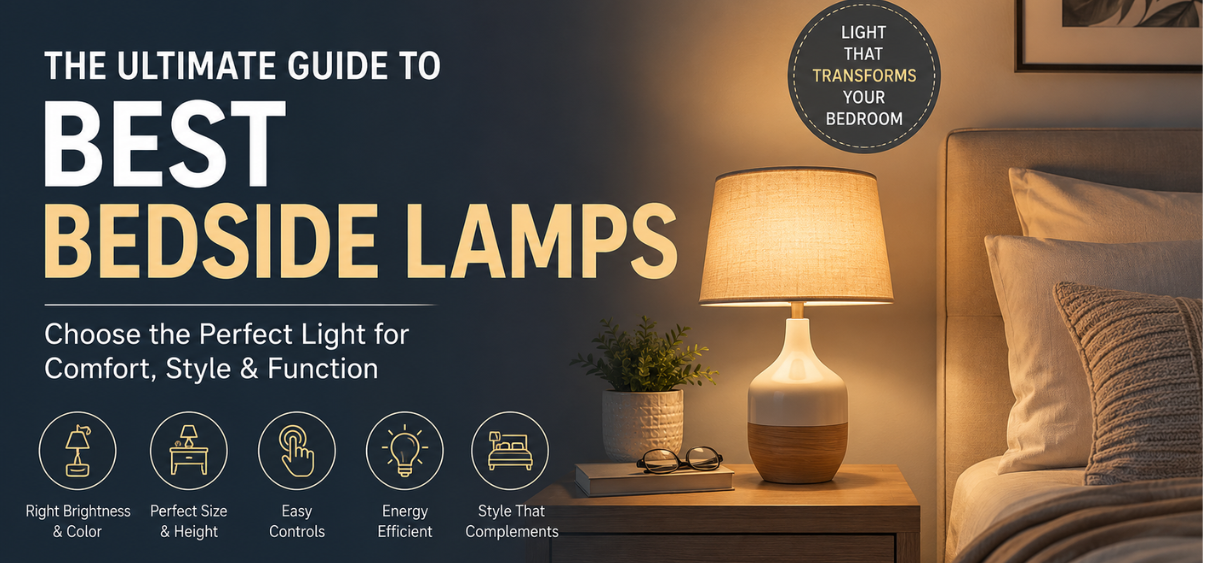
Choosing the best bedside lamp can transform the way we use and experience our bedroom. A well-chosen lamp does much more than illuminate a nightstand. It creates a comfortable atmosphere, provides focused light for reading, supports relaxing evening routines, and adds a finishing touch to the overall bedroom décor.
With so many options available, choosing the right bedside table lamp can sometimes feel overwhelming. We need to consider the lamp's size, brightness, color temperature, shade, material, style, controls, energy efficiency, and compatibility with the available space. A lamp that looks beautiful in a showroom may not necessarily be the most practical choice for our bedside table.
The ideal bedside lamp should balance functionality, comfort, style, and convenience. Whether we are furnishing a modern apartment, refreshing a traditional bedroom, designing a minimalist space, or creating a cozy reading corner, the right lighting can make a noticeable difference.
In this comprehensive guide, we explore how to choose the best bedside lamps, compare popular styles, understand different lighting options, and select a design that works beautifully with our bedroom and daily routine.
What Is a Bedside Lamp?
A bedside lamp is a compact lighting fixture designed to sit on or near a bedside table, nightstand, or other bedroom furniture. It typically provides localized illumination for activities such as reading, checking the time, getting ready for bed, or navigating the room at night.
Unlike a main ceiling light, which is designed to illuminate a larger area, a bedside lamp provides personalized and concentrated lighting. This makes it especially useful when we want to create a relaxing environment without turning on bright overhead lighting.
Bedside lamps are available in a wide range of designs, including:
- Traditional table lamps
- Modern bedside lamps
- Minimalist lamps
- Touch-control lamps
- Rechargeable cordless lamps
- LED bedside lamps
- Smart lamps
- Reading lamps
- Adjustable lamps
- Industrial-style lamps
- Ceramic lamps
- Wooden lamps
- Glass lamps
- Fabric-shade lamps
- Wall-mounted bedside lights
The best choice depends on how we intend to use the lamp and the atmosphere we want to create.
Why Choosing the Best Bedside Lamp Matters
Bedroom lighting influences both function and atmosphere. A poorly chosen lamp can be too bright, too dim, too large, or difficult to operate. A carefully selected bedside lamp, on the other hand, can make the entire room feel more comfortable and coordinated.
A good bedside lamp can help us:
- Create a warm and relaxing bedroom atmosphere
- Read comfortably before sleeping
- Reduce our dependence on harsh overhead lighting
- Add visual balance to bedside furniture
- Improve nighttime visibility
- Complement bedroom furniture and décor
- Provide convenient lighting for late-night activities
- Create a decorative focal point
- Support a layered lighting design
- Add personality to the bedroom
The best bedside lamp is therefore not simply the one with the most attractive appearance. It is the one that meets our practical needs while fitting naturally into the room.
Best Bedside Lamps at a Glance
| Bedside Lamp Type | Best For | Main Advantage | Potential Limitation |
|---|---|---|---|
| LED Table Lamp | Everyday bedroom use | Energy efficient and long lasting | Design varies by model |
| Touch Lamp | Easy operation | Convenient controls | May require compatible touch surfaces |
| Rechargeable Lamp | Flexible placement | No constant power connection | Requires charging |
| Reading Lamp | Nighttime reading | Focused illumination | Less decorative in some designs |
| Smart Lamp | Connected homes | App and voice control | More expensive |
| Minimalist Lamp | Modern bedrooms | Clean appearance | Limited decorative detail |
| Ceramic Lamp | Traditional interiors | Decorative and elegant | Can be heavier |
| Wooden Lamp | Natural décor | Warm visual character | Requires suitable styling |
| Wall-Mounted Lamp | Small bedrooms | Saves bedside space | Installation is required |
| Adjustable Lamp | Flexible lighting | Directional control | May have a more functional appearance |
How to Choose the Best Bedside Lamp
When selecting a bedside lamp, we should consider the complete relationship between the lamp, nightstand, bed, room, and lighting requirements. Looking at the lamp in isolation can lead to an unsuitable choice.
1. Consider the Size of the Bedside Table
The first consideration should be the available surface area.
A bedside lamp should not dominate the nightstand or leave too little space for essential items. If our nightstand is compact, a smaller lamp with a narrow base may be more practical. For a larger bedside table, we can choose a lamp with a broader base or a more substantial shade.
We should also consider the height of the lamp. A very tall lamp may visually overpower a low bed, while an extremely short lamp may not provide sufficient illumination.
As a general approach, we can choose a lamp that maintains visual proportion with the bedside furniture rather than focusing solely on exact measurements.
2. Choose the Right Lamp Height
The height of a bedside lamp affects both appearance and comfort.
Ideally, when we are sitting or lying in bed, the light source should provide comfortable illumination without shining directly into our eyes. If the lamp is too tall, the bulb may be visible from the pillow. If it is too short, the light may not spread effectively across the reading area.
We should consider:
- Mattress height
- Bedside table height
- Lamp base height
- Shade dimensions
- Position of the bulb
- Our usual reading position
For a balanced look, the lamp should feel visually connected to the bed rather than appearing disconnected from the furniture.
3. Select the Right Brightness
Brightness is one of the most important characteristics of a bedside lamp.
We should choose brightness according to how we use the lamp. A lamp used primarily for relaxation does not need the same intensity as one intended for reading.
For general bedroom ambiance, a softer light can create a comfortable environment. For reading, we generally need brighter and more focused illumination.
A dimmable bedside lamp is particularly versatile because it allows us to adjust the brightness depending on the situation.
We can use:
- Lower brightness for relaxing
- Medium brightness for general activities
- Higher brightness for reading or detailed tasks
This flexibility makes dimmable lamps an excellent option for multipurpose bedrooms.
4. Understand Color Temperature
Color temperature influences the appearance and mood of bedroom lighting.
Warm light generally creates a cozy and inviting atmosphere, while cooler light can appear more energetic and functional.
For bedrooms, many people prefer warm or soft-white lighting because it creates a calm environment. A cooler light may be useful when we need stronger visibility, but it can feel less relaxing when used late at night.
When choosing a bedside lamp, we should consider whether the bulb is:
- Warm white
- Soft white
- Neutral white
- Cool white
- Adjustable white
An adjustable-color lamp gives us greater flexibility, especially when the bedroom serves multiple purposes.
5. Choose LED for Efficiency
LED bedside lamps are popular because LED lighting generally offers excellent energy efficiency and long service life.
Compared with traditional incandescent bulbs, LED technology can provide efficient illumination while generating less heat during operation. Many LED lamps also offer features such as:
- Dimming
- Adjustable color temperature
- Touch controls
- USB charging
- Remote controls
- Smart-home integration
If we use our bedside lamp every evening, an LED model can be a practical long-term choice.
6. Look for Convenient Controls
A bedside lamp should be easy to operate from the bed.
Traditional switches work well, but modern designs may include:
- Touch controls
- Push buttons
- Rotary dimmers
- Pull chains
- Remote controls
- Smartphone controls
- Voice controls
A touch bedside lamp can be especially convenient because we can switch the light on or off with a simple touch.
For smart bedrooms, a connected lamp may allow us to adjust brightness or turn the light off without reaching across the nightstand.
7. Consider Cordless and Rechargeable Options
A rechargeable bedside lamp can be useful when we want flexibility in placement.
Without a permanently connected power cable, we can move the lamp more easily. This can be particularly helpful for small bedrooms, temporary living arrangements, or rooms where power outlets are inconveniently positioned.
However, we should remember that rechargeable lamps need to be charged regularly. Battery capacity and charging time are therefore important considerations.
Popular Types of Bedside Lamps
LED Bedside Lamps
LED lamps are among the most practical choices for modern bedrooms. They combine energy efficiency with flexible lighting options.
Many LED models feature integrated light sources, while others use replaceable LED-compatible bulbs.
They are ideal for:
- Modern bedrooms
- Everyday use
- Energy-conscious households
- Dimmable lighting
- Long-term use
Touch Bedside Lamps
Touch lamps provide a simple and convenient user experience. Instead of searching for a small switch in the dark, we can activate the lamp with a touch.
Some models offer multiple brightness levels, allowing us to cycle between low, medium, and high settings.
These lamps are particularly useful for:
- Children
- Older adults
- Nighttime reading
- Guest bedrooms
- Minimalist interiors
Bedside Lamps for Reading
A dedicated reading bedside lamp should provide sufficient light for books or other close-up activities without creating excessive glare.
Adjustable designs are especially useful because we can direct the light toward the reading material.
When selecting a reading lamp, we should look for:
- Adjustable positioning
- Comfortable brightness
- Low glare
- Stable construction
- Easy controls
- Suitable color temperature
A directional reading lamp can be combined with a softer decorative lamp to create layered lighting.
Smart Bedside Lamps
Smart bedside lamps are designed for connected homes. Depending on the model, they may offer smartphone control, scheduling, dimming, and voice-assistant compatibility.
A smart lamp can allow us to:
- Schedule lighting
- Adjust brightness remotely
- Change color temperature
- Create lighting routines
- Integrate lighting with other smart devices
These features can be useful for people who enjoy technology and automation.
Wall-Mounted Bedside Lamps
Wall-mounted lamps are an excellent solution when bedside table space is limited.
Instead of occupying the nightstand, the lamp is installed directly on the wall. This creates a cleaner surface and can be especially useful in small bedrooms.
However, installation requires more planning. We should carefully consider the mounting position, wiring, and accessibility of the controls.
Rechargeable Cordless Bedside Lamps
Cordless lamps provide maximum placement flexibility.
They can be moved from one side of the room to another without worrying about nearby outlets. Some compact designs can also be used temporarily in other areas of the home.
The main factors to consider are:
- Battery life
- Charging method
- Charging time
- Brightness
- Portability
- Stability
Best Bedside Lamp Styles for Different Bedrooms
Modern Bedroom
For a modern bedroom, we can choose lamps with:
- Clean lines
- Simple geometric shapes
- Metal finishes
- Glass elements
- Neutral colors
- Integrated LED technology
Minimalist lamps work particularly well when the rest of the room has a streamlined design.
Traditional Bedroom
Traditional bedrooms often benefit from classic lamps with decorative bases and fabric shades.
Ceramic, brass, wood, and glass can add character without making the lighting feel overly contemporary.
A traditional bedside lamp can complement:
- Wooden furniture
- Upholstered beds
- Classic décor
- Patterned textiles
- Warm neutral colors
Minimalist Bedroom
Minimalist bedrooms benefit from lamps that combine simplicity with functionality.
A compact lamp with a clean silhouette can provide illumination without introducing visual clutter.
We should focus on:
- Simple shapes
- Limited decorative details
- Neutral finishes
- Integrated functionality
- Compact proportions
Small Bedroom
In a small bedroom, every centimeter of surface area matters.
We can consider:
- Slim table lamps
- Wall-mounted lamps
- Clip-on reading lights
- Compact rechargeable lamps
- Lamps with built-in charging ports
The goal is to provide useful illumination while preserving valuable bedside space.
Bedside Lamp Materials and Their Benefits
Ceramic Lamps
Ceramic lamps offer a decorative and timeless appearance. They are available in numerous colors, shapes, and finishes.
They work particularly well in bedrooms where the lamp is intended to function as both a lighting fixture and a decorative accessory.
Wooden Lamps
Wood adds warmth and natural texture. Wooden lamps are suitable for Scandinavian, rustic, farmhouse, and contemporary interiors.
Metal Lamps
Metal lamps often have a sleek and durable appearance. Depending on the finish, they can suit industrial, modern, minimalist, or traditional rooms.
Glass Lamps
Glass creates a lighter visual appearance and can help a bedside table feel less crowded.
Fabric Shades
Fabric shades soften the light and create a comfortable atmosphere. They are particularly popular in traditional and cozy bedroom designs.
How to Match a Bedside Lamp With Bedroom Décor
A bedside lamp does not necessarily need to match every other item in the room. Instead, it should contribute to a cohesive design language.
We can coordinate the lamp with:
- Bed frame material
- Nightstand finish
- Curtain colors
- Wall décor
- Bedding
- Floor finishes
- Other lighting fixtures
For example, a wooden nightstand can be paired with a ceramic lamp for contrast, while a metal bedside table may work well with a glass or minimalist lamp.
The key is to create visual harmony rather than perfect duplication.
Single Lamp or Pair of Bedside Lamps?
Using two matching bedside lamps is a classic approach, particularly for double beds.
A pair creates symmetry and balance. It also ensures that both sides of the bed have comparable lighting.
However, matching lamps are not mandatory.
We can also use:
- Two identical lamps
- Two lamps with the same color but different shapes
- Two lamps with complementary designs
- One table lamp and one wall-mounted lamp
For a symmetrical bedroom, identical lamps are usually the easiest solution. For a more eclectic interior, complementary designs can create greater personality.
Bedside Lamp Buying Checklist
Before purchasing a bedside lamp, we should check the following:
- Available table space
- Lamp height
- Shade width
- Brightness
- Color temperature
- Bulb compatibility
- Dimming capability
- Switch location
- Cord length
- Power outlet position
- Energy efficiency
- Material quality
- Overall stability
- Cleaning requirements
- Bedroom décor
- Warranty
- Smart features, if required
A simple checklist can prevent many common buying mistakes.
Common Mistakes When Choosing a Bedside Lamp
Choosing a Lamp That Is Too Large
A large lamp can overwhelm a small nightstand and make the entire arrangement feel crowded.
Ignoring the Lamp's Height
The wrong height can affect both appearance and comfort.
Choosing Only Based on Appearance
A beautiful lamp may still be inconvenient if the switch is difficult to reach or the light is unsuitable for reading.
Using Excessively Bright Light
Very bright lighting can feel harsh in a relaxing bedroom environment.
Forgetting About the Bulb
The lamp's performance depends heavily on the bulb or integrated LED system.
Ignoring Cord Management
Visible or tangled cables can reduce the visual appeal of an otherwise attractive bedside setup.
Not Considering Nighttime Use
We should think about how easy the lamp is to operate when the room is dark.
How to Create a Cozy Bedroom With Bedside Lighting
A cozy bedroom often benefits from layered lighting rather than relying on one central ceiling fixture.
We can combine:
- Ambient lighting for general illumination
- Bedside lighting for personal activities
- Accent lighting for decorative elements
A bedside lamp with a warm light source can become the central element of the evening lighting scheme.
We can also combine bedside lamps with:
- Floor lamps
- Wall sconces
- LED strips
- Pendant lights
- Dimmable ceiling fixtures
The result is a bedroom that feels more adaptable throughout the day.
Best Bedside Lamps for Reading at Night
For nighttime reading, the ideal lamp should offer sufficient illumination without creating uncomfortable glare.
We should prioritize:
- Adjustable direction
- Appropriate brightness
- Easy access to controls
- Stable base
- Comfortable color temperature
- Dimming capability
A lamp positioned slightly behind or beside the reader can often provide more comfortable illumination than a lamp shining directly toward the face.
If two people share a bed and have different sleeping schedules, individual reading lamps can be particularly useful.
Best Bedside Lamps for a Guest Bedroom
A guest bedroom lamp should be simple and intuitive.
Guests may not be familiar with complicated controls, so a conventional switch or straightforward touch control can be preferable.
A good guest-room lamp should ideally offer:
- Easy operation
- Comfortable brightness
- Attractive appearance
- Reliable construction
- Suitable proportions
- Accessible controls
A small USB charging port can also be a useful modern feature.
Best Bedside Lamps for Children and Teen Bedrooms
For younger users, practical features can be more important than sophisticated design.
We can look for:
- Stable construction
- Easy controls
- Durable materials
- Adjustable brightness
- Soft lighting
- Rechargeable functionality
The lamp should be positioned safely and used according to the manufacturer's instructions.
How to Maintain a Bedside Lamp
Regular maintenance can keep a bedside lamp looking attractive and functioning properly.
We should:
- Dust the lampshade regularly
- Clean the base according to the material
- Keep electrical connections dry
- Check cables for visible damage
- Replace damaged bulbs
- Follow manufacturer instructions
- Avoid covering ventilation areas on LED or electronic lamps
Fabric shades can collect dust over time, while glass and metal surfaces may benefit from occasional gentle cleaning.
FAQS
1. What is the best type of bedside lamp?
The best type depends on our needs. For general use, an LED table lamp is a practical choice. For reading, an adjustable reading lamp may be better. For convenience, a touch or smart lamp can be ideal.
2. How tall should a bedside lamp be?
The ideal height depends on the bed and nightstand. We should choose a height that provides comfortable illumination without placing the light source directly at eye level.
3. Are LED bedside lamps good?
Yes. LED lamps are popular because they are generally energy efficient, long lasting, and available with features such as dimming and adjustable color temperature.
4. Is warm light better for a bedroom?
Warm light is often preferred for bedrooms because it creates a softer and more relaxing atmosphere.
5. Should bedside lamps match?
Matching lamps create symmetry, but they do not have to be identical. Complementary designs can also create an attractive appearance.
6. Are touch lamps good for bedrooms?
Touch lamps can be very convenient because they are easy to operate, especially at night.
7. What is the best bedside lamp for reading?
An adjustable lamp with comfortable brightness and directional control is generally a good choice for reading.
8. Are rechargeable bedside lamps worth buying?
Rechargeable lamps can be worthwhile when we need flexible placement or want to avoid a permanent power cable.
9. What color temperature is best for a bedside lamp?
Warm or soft-white light is commonly preferred for relaxing bedroom environments.
10. Can we use a smart lamp as a bedside lamp?
Yes. Smart lamps can provide convenient features such as remote control, dimming, scheduling, and automation.
11. What should we look for in a reading lamp?
We should consider brightness, adjustability, glare control, stability, and convenient positioning.
12. Are wall-mounted bedside lamps better than table lamps?
Wall-mounted lamps save nightstand space, while table lamps are easier to reposition. The better option depends on the room and installation requirements.
13. How do we choose a lamp for a small nightstand?
We should look for a compact lamp with a narrow base or consider a wall-mounted design.
14. Can one bedside lamp be enough?
Yes. One lamp may be sufficient for a single bed or when the bedroom layout does not require symmetrical lighting.
15. Should bedside lamps be the same height?
For a symmetrical arrangement, similar heights usually create a balanced appearance.
16. What is the best bedside lamp for a modern bedroom?
Minimalist LED lamps, glass lamps, and simple metal designs can work well in modern bedrooms.
17. What is the best bedside lamp for a traditional bedroom?
Ceramic lamps, fabric-shade lamps, wooden lamps, and decorative metal designs often complement traditional interiors.
18. Are dimmable bedside lamps useful?
Yes. Dimming allows us to adjust the lighting according to different activities and times of day.
19. Can bedside lamps charge phones?
Some modern lamps include USB or wireless charging features. We should check the product specifications before purchasing.
20. What is the most energy-efficient bedside lamp?
LED lighting is generally among the most energy-efficient common lighting options.
21. How can we make a bedside lamp more decorative?
We can choose a lamp with an attractive base, distinctive shade, interesting texture, or finish that complements the bedroom décor.
22. What is better, a lamp with a replaceable bulb or integrated LED?
Both have advantages. Replaceable bulbs offer flexibility, while integrated LED designs can be compact and highly streamlined.
23. How do we prevent a bedside lamp from looking too bulky?
We should select a lamp proportionate to the nightstand and bed. A narrow base and appropriately sized shade can help maintain visual balance.
24. Can we use a bedside lamp as the main bedroom light?
A bedside lamp can provide useful localized lighting but may not adequately illuminate an entire bedroom. A combination of ambient and task lighting is usually more practical.
25. What is the most important feature of a bedside lamp?
The most important feature is suitability for our needs. A good bedside lamp should provide comfortable illumination, be easy to operate, fit the available space, and complement the bedroom.