
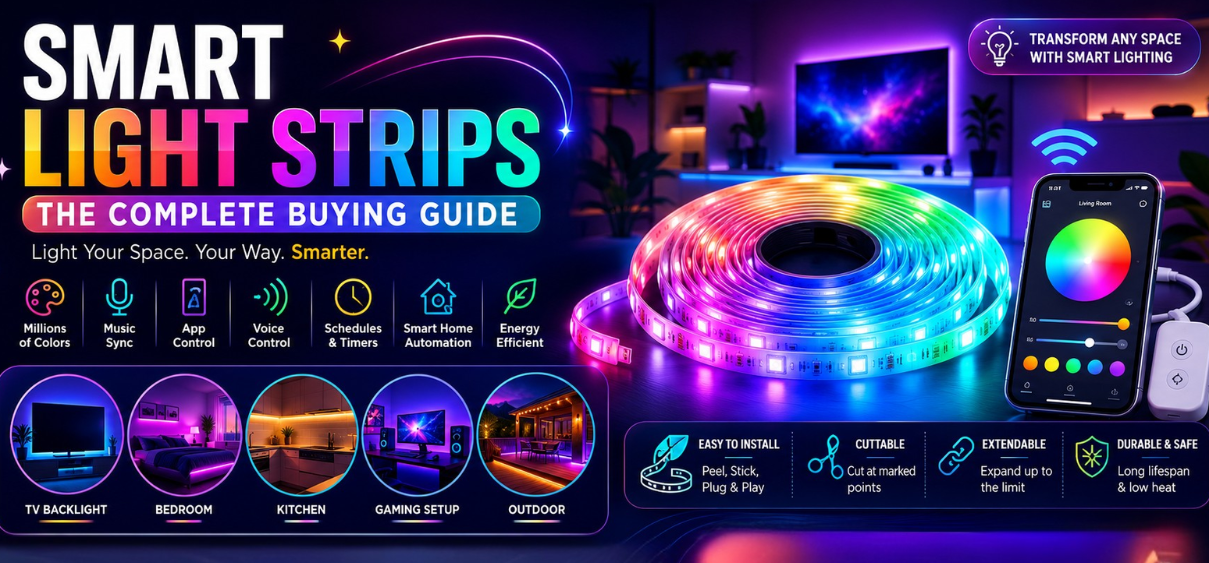
Best Smart Light Strips: Complete Buying Guide
Smart lighting has transformed modern homes by combining convenience, personalization, energy efficiency, and smart automation. Among all smart lighting products available today, smart LED light strips have become one of the most versatile lighting solutions. Whether we want to enhance our living room, gaming setup, bedroom, kitchen, TV area, staircase, office, or outdoor entertainment space, smart light strips provide endless customization options.
Today's smart light strips support millions of colors, adjustable white temperatures, music synchronization, voice assistants, automation schedules, mobile app control, and integration with complete smart home ecosystems. Choosing the right model requires careful consideration of brightness, connectivity, compatibility, installation quality, durability, and long-term reliability.
This comprehensive buying guide explores everything we need to know before purchasing the best smart light strips.
Why Smart Light Strips Are Worth Buying
Smart LED strips offer much more than decorative lighting.
Some of the biggest advantages include:
- Voice control
- Millions of RGB colors
- Warm and cool white lighting
- Energy efficiency
- Long lifespan
- Custom lighting scenes
- Music synchronization
- Smart scheduling
- App-based controls
- Gaming ambience
- Movie room enhancement
- Holiday decorations
- Smart home automation
Unlike traditional LED strips, smart versions allow complete control from anywhere using a smartphone or voice assistant.
How Smart Light Strips Work
Smart light strips contain flexible LED circuits connected to a controller that communicates through:
- Wi-Fi
- Bluetooth
- Zigbee
- Matter
- Thread
Once connected to a compatible mobile application, users can:
- Turn lights on or off
- Change brightness
- Adjust colors
- Create schedules
- Build automation routines
- Sync with music
- Integrate with smart home devices
Types of Smart Light Strips
RGB Light Strips
RGB strips display millions of colors but usually cannot produce pure white light.
Best for:
- Gaming rooms
- TV backlighting
- Entertainment areas
RGBW Light Strips
RGBW models include a dedicated white LED.
Benefits:
- Better reading light
- Natural white illumination
- Improved brightness
RGBIC Light Strips
RGBIC technology allows multiple colors to appear simultaneously on one strip.
Advantages:
- Dynamic rainbow effects
- Animated lighting
- Premium visual experience
Addressable LED Strips
Every LED can be individually controlled.
Perfect for:
- Gaming setups
- Streaming rooms
- Creative lighting effects
Key Features to Consider Before Buying
Brightness
Brightness is measured in lumens.
Recommended levels:
| Installation Area | Recommended Brightness |
|---|---|
| Bedroom | 300–600 lumens |
| Living Room | 600–1200 lumens |
| Kitchen | 800–1500 lumens |
| TV Backlight | 200–500 lumens |
| Gaming Desk | 400–900 lumens |
Color Accuracy
Choose strips capable of producing:
- Deep reds
- Rich blues
- Bright greens
- Warm whites
- Cool whites
- Natural daylight
High-quality LEDs provide smoother color transitions.
Connectivity Options
Wi-Fi
Pros:
- Remote access
- Automation
- Cloud control
Cons:
- Requires stable internet
Bluetooth
Pros:
- Quick setup
- No internet required
Cons:
- Limited control range
Matter Compatibility
Matter is becoming the universal smart home standard.
Benefits include:
- Easier setup
- Cross-platform compatibility
- Improved reliability
Smart Home Compatibility
Choose strips compatible with:
- Amazon Alexa
- Google Home
- Apple HomeKit
- Samsung SmartThings
- Matter ecosystem
This allows voice control and automation routines.
Installation Guide
Installing smart LED strips is straightforward.
Step 1
Measure the installation area.
Step 2
Clean the mounting surface thoroughly.
Step 3
Peel the adhesive backing.
Step 4
Apply the strip carefully.
Step 5
Connect the controller.
Step 6
Install the companion app.
Step 7
Pair the strip.
Step 8
Customize lighting scenes.
Best Places to Install Smart Light Strips
Living Room
Ideal behind:
- TV units
- Shelves
- Entertainment centers
Bedroom
Popular locations include:
- Behind the headboard
- Under the bed
- Wardrobes
- Ceiling coves
Kitchen
Suitable for:
- Under cabinets
- Countertops
- Pantry shelves
- Island counters
Gaming Room
Perfect around:
- Gaming desks
- Monitors
- PC cases
- Shelves
Home Office
Improve productivity with adjustable white lighting.
Outdoor Spaces
Weather-resistant models are suitable for:
- Balconies
- Gardens
- Patios
- Decks
Benefits of Smart Light Automation
Automation can:
- Turn lights on at sunset
- Switch lights off automatically
- Wake users gradually
- Simulate occupancy
- Improve energy savings
Energy Efficiency
Smart LEDs typically consume much less electricity than incandescent lighting and have operational lifespans of 25,000 to 50,000 hours, making them an economical long-term choice.
Music Sync Features
Many premium models include built-in microphones or app-based synchronization.
Ideal for:
- Parties
- Movie nights
- Gaming
- Celebrations
Common Mistakes to Avoid
- Buying indoor strips for outdoor use
- Ignoring brightness ratings
- Overlooking compatibility with smart home systems
- Measuring incorrectly
- Installing on dusty surfaces
- Cutting strips at the wrong points
- Choosing the cheapest option without considering build quality
Maintenance Tips
To maximize lifespan:
- Clean gently with a dry cloth
- Avoid excessive bending
- Keep controllers ventilated
- Use compatible power adapters
- Protect outdoor strips from unnecessary water exposure
Pros and Cons
| Pros | Cons |
| Easy installation | Premium models can be expensive |
| Energy efficient | Some features require apps |
| Voice control | Wi-Fi models depend on network stability |
| Millions of colors | Cheaper strips may have inconsistent colors |
| Smart automation | Setup varies by ecosystem |
| Long lifespan | Extension limits vary by brand |
Who Should Buy Smart Light Strips?
Smart light strips are ideal for:
- Homeowners
- Renters
- Students
- Gamers
- Content creators
- Home theater enthusiasts
- Families
- Interior design enthusiasts
Buying Checklist
Before purchasing, verify:
- Brightness
- RGB or RGBIC support
- White light capability
- App quality
- Voice assistant compatibility
- Matter support
- Length
- Extendability
- Adhesive quality
- Warranty
- Indoor or outdoor rating
Frequently Asked Questions
1. What is a smart light strip?
A flexible LED strip that can be controlled using a smartphone app, voice assistant, or automation platform.
2. Can I control smart light strips with my phone?
Yes, most models include a dedicated mobile app.
3. Do smart light strips work without Wi-Fi?
Bluetooth-enabled models generally do, while Wi-Fi features may require an internet connection.
4. Are smart light strips energy efficient?
Yes, LED technology uses significantly less electricity than traditional lighting.
5. Can I cut smart light strips?
Many models can be cut only at marked cut points.
6. Can I extend the strip length?
Many brands support extension kits, up to the manufacturer's specified limit.
7. Are smart light strips waterproof?
Some are. Check the IP rating before outdoor installation.
8. Can I install them behind a TV?
Yes, they are commonly used for TV backlighting.
9. Do they support voice assistants?
Many support Alexa, Google Assistant, and Siri via compatible ecosystems.
10. What is RGBIC?
A technology that allows multiple colors to display simultaneously along one strip.
11. What is the difference between RGB and RGBW?
RGBW includes a dedicated white LED for improved white lighting.
12. Can they sync with music?
Many models offer music synchronization features.
13. Are they safe to leave on?
Quality products are generally designed for extended operation when installed correctly.
14. Can I schedule lighting?
Yes, scheduling is a standard feature in most smart lighting apps.
15. Do they dim?
Most smart light strips support adjustable brightness.
16. How long do they last?
Typically between 25,000 and 50,000 hours.
17. Are they suitable for bedrooms?
Yes, especially with adjustable warm white settings.
18. Can I use them in kitchens?
Yes, under-cabinet lighting is a popular application.
19. What length should I buy?
Measure the installation area first and choose a suitable length or expandable kit.
20. Do they generate much heat?
LED strips generally operate much cooler than traditional bulbs.
21. Can multiple strips be controlled together?
Many apps allow grouping multiple light strips.
22. Do they work with smart home routines?
Yes, many integrate with broader home automation systems.
23. Are they easy to install?
Most feature peel-and-stick adhesive for simple installation.
24. What should I check before buying?
Compatibility, brightness, color options, length, IP rating, and warranty.
25. Are smart light strips worth it?
For users seeking customizable, energy-efficient, and connected lighting, they offer excellent versatility and value.