
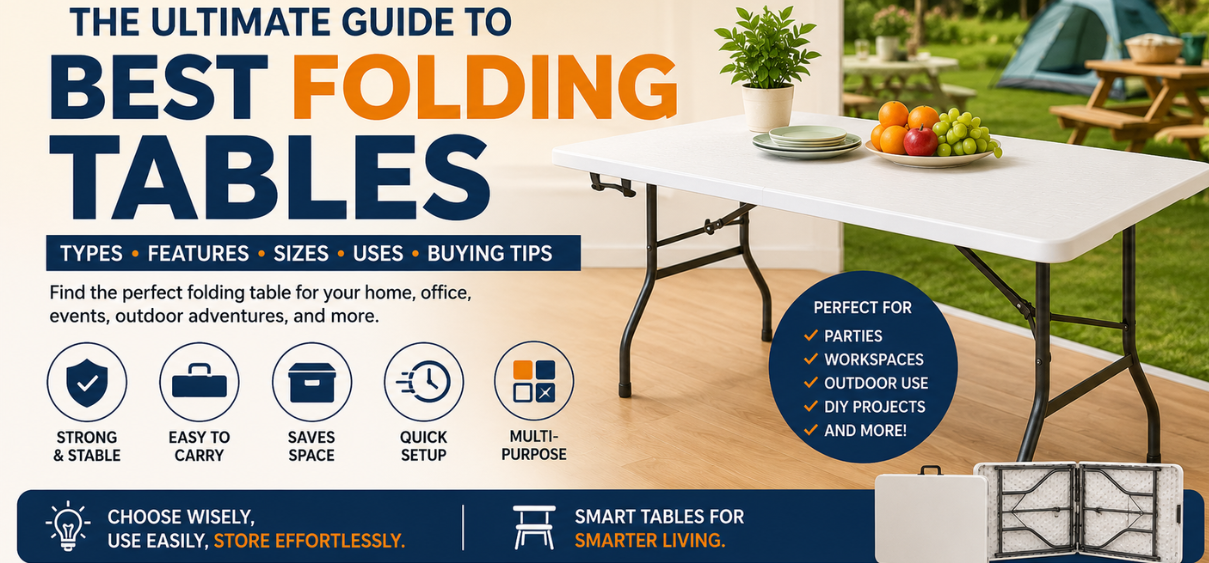
Finding the best folding table can make everyday activities, events, workspaces, and outdoor gatherings much easier. A good folding table should be strong, stable, easy to transport, simple to store, and suitable for its intended purpose. Whether we need a table for a home office, family gathering, picnic, exhibition, classroom, garage, craft project, or commercial event, choosing the right design and material can make a significant difference.
Unlike traditional fixed tables, folding tables offer exceptional flexibility. We can set them up when needed and fold them away when the space is required for another purpose. This makes them particularly valuable for homes and workplaces where every square foot matters.
In this comprehensive guide, we explore the best folding tables, the different types available, the materials and features to consider, and how to select the right size, shape, weight capacity, and design.
Quick Comparison of the Best Folding Table Types
| Folding Table Type | Best For | Main Advantage | Common Limitation |
|---|---|---|---|
| Plastic Folding Table | Parties, events, homes | Lightweight and easy to clean | Can be less rigid than premium tables |
| Wood Folding Table | Dining and indoor events | Attractive and sturdy | Heavier to transport |
| Folding Banquet Table | Weddings and functions | Large usable surface | Requires more storage space |
| Folding Card Table | Games and small gatherings | Compact and portable | Limited weight capacity |
| Folding Camping Table | Outdoor activities | Lightweight and portable | Smaller working area |
| Folding Picnic Table | Outdoor dining | Convenient for families | Less versatile indoors |
| Folding Work Table | DIY and workshops | Strong work surface | Usually heavier |
| Folding Laptop Table | Studying and remote work | Compact and convenient | Designed for lighter loads |
| Adjustable Folding Table | Multi-purpose use | Flexible height | Often more expensive |
| Folding Conference Table | Offices and meetings | Professional appearance | Larger models can be difficult to move |
What Is a Folding Table?
A folding table is a portable or semi-portable table designed with hinges or folding mechanisms that allow its legs, tabletop, or both to collapse for convenient storage and transportation.
The main advantage of a folding table is its ability to provide a useful work or dining surface without permanently occupying floor space. Once the activity is finished, we can fold the table and store it against a wall, under furniture, in a closet, or in a storage room.
Modern folding tables are available in numerous configurations. Some feature bi-fold tabletops, while others have legs that fold underneath a fixed tabletop. Certain models include adjustable heights, carrying handles, wheels, locking mechanisms, and built-in storage features.
The best choice depends on how frequently we plan to use the table and where we intend to use it.
Why Choose a Folding Table?
Folding tables have become popular because they combine functionality, portability, and space efficiency.
1. Space-Saving Design
One of the biggest advantages is easy storage. A folding table can be collapsed when it is not required, freeing valuable floor space.
This is particularly useful in:
- Small apartments
- Compact homes
- Classrooms
- Offices
- Community halls
- Event venues
- Garages
- Workshops
- Restaurants
- Training rooms
2. Easy Transportation
Many folding tables are designed to be carried from one location to another. Lightweight plastic and aluminum models are particularly convenient for outdoor events and temporary setups.
3. Versatile Usage
A single folding table can serve multiple purposes. We can use the same table for:
- Dining
- Studying
- Working
- Crafting
- Gaming
- Parties
- Exhibitions
- Conferences
- Outdoor activities
- Garage projects
4. Quick Setup
Most folding tables require minimal assembly. We can unfold the legs, lock them into position, and start using the table.
5. Convenient Storage
When folded, the table takes up significantly less space than a conventional table.
Best Folding Table Materials
The material used to manufacture a folding table affects its weight, durability, appearance, maintenance requirements, and price.
Plastic Folding Tables
Plastic folding tables are among the most popular options for general-purpose use.
High-quality models often use high-density polyethylene (HDPE) for the tabletop. This material is durable, moisture-resistant, and relatively easy to clean.
Advantages
- Lightweight
- Easy to clean
- Resistant to moisture
- Suitable for indoor and outdoor use
- Easy to transport
- Available in different sizes
Best Uses
Plastic folding tables are ideal for:
- Birthday parties
- Family gatherings
- Community events
- Outdoor functions
- Temporary dining
- Craft activities
- School events
When selecting a plastic folding table, we should check the quality of the frame and the strength of the locking mechanism rather than focusing only on the tabletop material.
Wood Folding Tables
Wood folding tables provide a more traditional and attractive appearance. They are particularly suitable when aesthetics matter.
A well-constructed wooden folding table can offer excellent stability and a comfortable surface for dining, meetings, and indoor events.
Advantages
- Attractive appearance
- Solid construction
- Comfortable for indoor use
- Suitable for dining and meetings
- Often more visually appealing
Potential Drawbacks
- Heavier than plastic
- Requires more care
- Can be affected by prolonged moisture exposure
- May be more expensive
For indoor events and formal settings, a wooden folding table can be an excellent choice.
Metal Folding Tables
Metal is commonly used for folding table frames and legs. Some tables also use metal tabletops, particularly models designed for workshops and industrial applications.
Steel provides excellent strength, while aluminum is valued for its lighter weight.
Steel Folding Tables
Steel frames offer excellent rigidity and durability. They are suitable for applications where stability is important.
Aluminum Folding Tables
Aluminum models are easier to carry and are often preferred for camping, travel, exhibitions, and outdoor activities.
Best Folding Table Shapes
The shape of a folding table influences how we use available space and how many people can comfortably sit around it.
Rectangular Folding Tables
Rectangular tables are among the most versatile options.
They are suitable for:
- Dining
- Meetings
- Parties
- Buffets
- Training sessions
- Crafting
- Workspaces
Their long, straight shape makes them easy to arrange against walls or combine with other tables.
Round Folding Tables
Round folding tables encourage face-to-face interaction and are popular for dining and social gatherings.
They are particularly useful for:
- Weddings
- Banquets
- Family meals
- Group discussions
- Social events
One limitation is that round tables may require more floor space than rectangular tables with similar seating capacity.
Square Folding Tables
Square tables provide a balanced arrangement and work well in compact spaces.
They are suitable for:
- Card games
- Small dining areas
- Study sessions
- Individual work
- Small meetings
Half-Round Folding Tables
Half-round tables can be placed against walls or combined with rectangular tables to create different layouts.
They are useful for:
- Events
- Conferences
- Registration areas
- Buffet arrangements
- Exhibition booths
How to Choose the Best Folding Table
Choosing the right folding table requires more than simply selecting the cheapest or largest model. We should consider the table's intended use, available space, weight, durability, and storage requirements.
1. Consider the Intended Use
The first question we should ask is: What will we use the table for?
A table designed for occasional parties may not be suitable for heavy workshop projects.
For example:
- Home dining: Choose a sturdy, attractive table.
- Outdoor events: Prioritize weather resistance and portability.
- Camping: Choose lightweight construction.
- DIY work: Look for a strong frame and high weight capacity.
- Office meetings: Consider appearance and easy reconfiguration.
- Crafting: Choose a wide and stable tabletop.
- Exhibitions: Look for portable models that can be transported easily.
2. Choose the Right Table Size
The ideal size depends on the available room and the number of people who will use the table.
Common folding table lengths include:
- 4 feet
- 5 feet
- 6 feet
- 8 feet
Smaller tables are easier to transport and store, while larger tables provide more working space.
We should also remember to measure the folded dimensions, not just the open dimensions. A table may fit perfectly in a room but still be difficult to store if it folds into a bulky package.
3. Check Weight Capacity
Weight capacity is particularly important for worktables, equipment tables, and commercial use.
A table's weight rating should be suitable for the combined weight of:
- Equipment
- Tools
- Food
- Decorations
- Computers
- Craft supplies
- Other objects
For heavy-duty applications, we should select a table with a reinforced frame and strong locking system.
4. Examine the Folding Mechanism
The folding mechanism should be easy to operate while remaining secure during use.
Look for:
- Strong hinges
- Reliable leg locks
- Safety latches
- Reinforced joints
- Smooth folding action
- Secure locking positions
A poorly designed folding mechanism can reduce stability and shorten the table's useful life.
5. Look for a Stable Frame
A strong tabletop is not enough. The frame is equally important.
A quality frame should resist:
- Wobbling
- Bending
- Twisting
- Accidental folding
For frequent use, a reinforced steel frame is often preferable.
Best Folding Tables for Different Situations
Best Folding Table for Home Use
For general household use, we should prioritize a balance between size, weight, durability, and storage convenience.
A medium-sized rectangular folding table is often the most versatile option. It can function as an extra dining table, temporary workstation, party table, or craft surface.
Best Folding Table for Parties
For parties and family gatherings, a 6-foot or 8-foot rectangular folding table can provide plenty of serving and dining space.
A plastic tabletop is particularly practical because spills can generally be cleaned quickly.
We should look for:
- Easy-to-clean surfaces
- Sturdy legs
- Rounded edges
- Comfortable height
- Easy storage
Best Folding Table for Camping
For camping, portability becomes the priority.
A good camping folding table should be:
- Lightweight
- Compact
- Easy to carry
- Quick to assemble
- Resistant to outdoor conditions
Aluminum is commonly preferred because it offers a useful balance between strength and weight.
Best Folding Table for Outdoor Events
Outdoor events require a table that can tolerate occasional exposure to moisture and changing conditions.
We should consider:
- Weather-resistant materials
- Stable legs
- Durable frame
- Easy cleaning
- Secure locking mechanism
Even weather-resistant tables should not automatically be treated as permanently outdoor furniture. Long-term exposure to sunlight and moisture can eventually affect materials and finishes.
Best Folding Table for Work and DIY Projects
For workshops and DIY projects, stability is more important than lightweight portability.
A worktable should ideally have:
- Strong legs
- High weight capacity
- Rigid frame
- Durable surface
- Reliable locking mechanism
Some worktables also feature adjustable heights, which can make certain tasks more comfortable.
Folding Table vs. Traditional Table
| Feature | Folding Table | Traditional Table |
|---|---|---|
| Storage | Excellent | Limited |
| Portability | High | Low |
| Setup | Quick | Usually permanent |
| Space Efficiency | Excellent | Moderate |
| Versatility | High | Moderate |
| Stability | Depends on design | Generally high |
| Long-Term Furniture Use | Varies by model | Excellent |
| Event Use | Excellent | Less convenient |
The biggest advantage of folding tables is flexibility. Traditional tables may offer greater permanence, but folding tables are better when we need furniture that can adapt to changing requirements.
How to Maintain a Folding Table
Proper maintenance can extend the life of a folding table.
Clean the Surface Regularly
Use appropriate cleaning products based on the tabletop material. Avoid harsh chemicals unless the manufacturer specifically recommends them.
Inspect the Hinges
Check folding joints periodically for:
- Loose screws
- Damage
- Rust
- Excessive movement
Check the Leg Locks
Before every major use, we should ensure that the legs are fully locked into place.
Store It Properly
When storing the table, keep it in a dry location whenever possible.
Avoid placing heavy objects on a folded table for extended periods if doing so could cause bending or deformation.
Protect Outdoor Tables
Outdoor tables should be cleaned and dried before storage. A protective cover can help reduce exposure to dust and moisture.
Safety Tips for Using Folding Tables
A folding table should always be used according to the manufacturer's instructions.
Important precautions include:
- Ensure all legs are fully extended.
- Confirm that locking mechanisms are engaged.
- Place the table on a stable, level surface.
- Do not exceed the recommended weight capacity.
- Keep fingers away from folding joints during setup.
- Do not use damaged legs or hinges.
- Inspect the table before important events.
- Keep children away from folding mechanisms during setup.
A table that appears stable may still become unsafe if its locking mechanism is damaged or improperly engaged.
Advantages and Disadvantages of Folding Tables
Advantages
- Space-saving
- Portable
- Easy to store
- Quick to set up
- Highly versatile
- Available in many sizes
- Suitable for indoor and outdoor use
- Often more affordable than permanent furniture
Disadvantages
- Some models may wobble
- Lightweight tables may have lower weight capacities
- Folding mechanisms can wear over time
- Large models may still be difficult to transport
- Some designs may not match formal interior décor
- Low-quality hinges and locks can affect durability
The key is to choose a folding table that matches the demands of the intended application.
Folding Table Buying Checklist
Before purchasing a folding table, we can use the following checklist:
- Choose the correct table size.
- Measure available storage space.
- Check folded dimensions.
- Confirm the weight capacity.
- Select a suitable tabletop material.
- Examine the frame construction.
- Test the folding mechanism.
- Check leg locks.
- Consider portability.
- Look for rounded or finished edges.
- Consider indoor or outdoor use.
- Check cleaning requirements.
- Review the manufacturer's warranty.
- Consider how frequently the table will be used.
How Many People Can Sit at a Folding Table?
Seating capacity depends on the table's dimensions and shape.
A general guide is:
| Table Length | Approximate Seating |
|---|---|
| 4-foot rectangular | 4 people |
| 5-foot rectangular | 4–6 people |
| 6-foot rectangular | 6–8 people |
| 8-foot rectangular | 8–10 people |
These figures are approximate. Seating comfort depends on chair width, table design, and whether people are seated at the ends.
For formal dining, we should allow enough personal space so guests can eat comfortably without feeling crowded.
Folding Table Storage Ideas
Even though folding tables are designed for easy storage, larger models can still take up considerable space.
We can store them:
- Behind a door
- Against a garage wall
- Inside a storage room
- Under a bed, depending on folded dimensions
- Behind large furniture
- In a dedicated utility closet
Wall-mounted storage racks can also help organize multiple folding tables in commercial or institutional settings.
When storing several tables, we should ensure that they are secured properly to prevent accidental tipping.
What Makes a Folding Table Durable?
Durability depends on several factors rather than a single material.
The most important factors include:
- Quality of construction
- Strength of the frame
- Thickness and quality of the tabletop
- Hinge design
- Leg-locking system
- Weight capacity
- Frequency of use
- Storage conditions
- Maintenance
A moderately priced table with a well-designed frame may outperform a cheaper table with a weak folding mechanism.
Folding Tables for Events and Businesses
Businesses and event organizers often rely on folding tables because their layouts change frequently.
Hotels, schools, offices, community centers, restaurants, and event companies can use folding tables for:
- Conferences
- Seminars
- Training sessions
- Weddings
- Exhibitions
- Registration desks
- Buffet service
- Temporary workstations
For professional use, it is worth considering tables with commercial-grade construction and durable surfaces designed for repeated setup and breakdown.
FAQS
1. What is the best folding table for general use?
A sturdy rectangular folding table is usually the most versatile option. It can be used for dining, parties, studying, crafts, and temporary workspaces.
2. Are folding tables strong?
Yes. High-quality folding tables can be very strong and stable. Their strength depends on the frame, tabletop material, construction quality, and stated weight capacity.
3. Are plastic folding tables durable?
Quality plastic folding tables can be highly durable and are especially practical for events and general household use. HDPE tabletops are commonly chosen for their strength and easy maintenance.
4. What is the most common folding table size?
Six-foot rectangular folding tables are widely used because they provide a useful balance between seating capacity, workspace, and portability.
5. Are folding tables suitable for outdoor use?
Many folding tables are suitable for occasional outdoor use. We should select a model with appropriate materials and store it indoors when it is not being used.
6. Can we use a folding table as a dining table?
Yes. Many folding tables are suitable for dining. We should choose a comfortable height and ensure that the surface is easy to clean.
7. How do we stop a folding table from wobbling?
We should place it on a level surface, ensure all legs are fully opened, and verify that the locking mechanisms are properly engaged. Damaged legs or uneven flooring can also cause instability.
8. Are folding tables easy to carry?
Smaller aluminum and plastic tables are generally easy to transport. Larger tables may be heavier and may require two people to move safely.
9. Which is better, a plastic or wooden folding table?
Plastic is usually more practical for portability and easy cleaning, while wood offers a more traditional appearance. The better choice depends on where and how we plan to use the table.
10. What should we look for in a folding table?
We should consider size, weight capacity, frame strength, tabletop material, folding mechanism, portability, storage dimensions, and intended use.
11. Are folding tables good for parties?
Yes. Folding tables are excellent for parties because they can be set up quickly and stored after the event.
12. Can folding tables be used for weddings?
Yes. Many event venues use folding tables for weddings and receptions. Round tables are popular for guest seating, while rectangular tables work well for buffets and serving areas.
13. How long do folding tables last?
The lifespan varies according to construction quality, frequency of use, maintenance, and storage conditions. A well-maintained high-quality table can last for many years.
14. Are folding tables waterproof?
Some are water-resistant, but not every folding table is waterproof. We should check the manufacturer's specifications before using a table outdoors or in wet conditions.
15. What is the best folding table for camping?
A lightweight aluminum folding table is often a practical choice for camping because it is easy to carry and store.
16. Can we use a folding table as a desk?
Yes. A folding table can serve as a temporary desk for studying or working from home. We should choose a comfortable height and sufficient surface area.
17. Are folding tables safe?
Quality folding tables are generally safe when used correctly. We should always lock the legs securely and avoid exceeding the recommended weight limit.
18. How do we clean a folding table?
Cleaning depends on the material. Many plastic tables can be wiped with mild soap and water, while wooden surfaces may require material-specific cleaning methods.
19. Can folding tables be used for heavy equipment?
Some heavy-duty folding tables can support significant loads, but we should always follow the manufacturer's stated weight capacity.
20. Are adjustable-height folding tables worth buying?
Adjustable-height models can be worthwhile when we need flexibility for different activities or users. They may cost more but provide greater versatility.
21. What is the best shape for a folding table?
Rectangular tables are generally the most versatile. Round tables are excellent for social gatherings, while square tables work well in smaller spaces.
22. How should we store folding tables?
We should store them in a clean, dry area and secure them properly. Large tables should be positioned safely to prevent accidental tipping.
23. Can we leave a folding table outside permanently?
It depends on the table's materials and manufacturer's recommendations. Even outdoor-rated tables may deteriorate faster when continuously exposed to sunlight, rain, and humidity.
24. How do we choose the correct folding table size?
We should consider the number of users, available floor space, intended activity, and storage area. We should also measure the table when folded to ensure convenient storage.
25. What is the most important feature of a folding table?
For most applications, a combination of stability, durability, portability, and a secure folding mechanism is most important. The ideal balance depends on the intended use.