
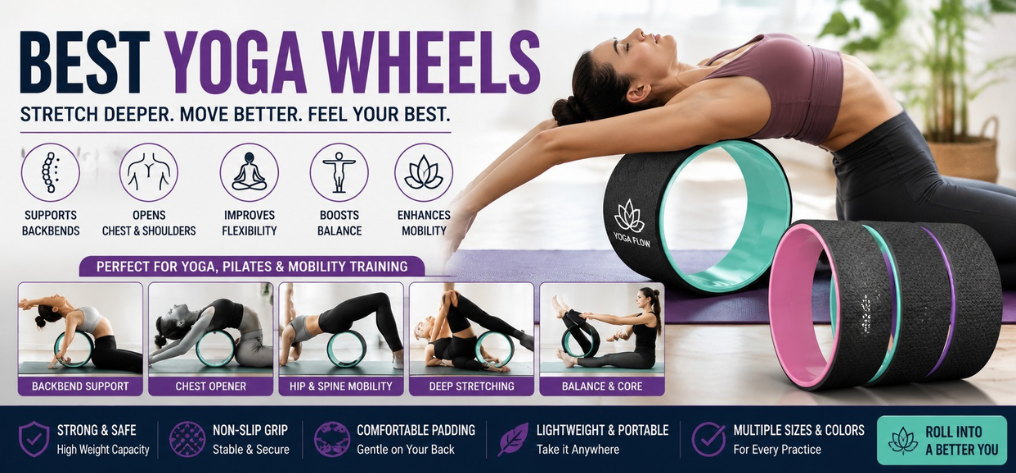
A yoga wheel can become a useful addition to our yoga practice when we want to explore backbends, chest opening, balance, flexibility, mobility, stretching, and supported yoga poses. Unlike a traditional yoga mat or yoga block, a yoga wheel provides a curved surface that can support the body while introducing controlled movement and extension.
The best yoga wheels are designed to provide a combination of stability, comfort, durability, grip, and appropriate dimensions. The right wheel should feel secure when placed on the floor and comfortable when used against the back, shoulders, hips, or legs. It should also be strong enough to support the intended user and exercise without excessive flexing or instability.
Yoga wheels are available in different diameters, widths, materials, padding levels, and surface textures. Some are designed primarily for gentle stretching, while others are built for advanced yoga practice and deeper backbends. There are also compact wheels designed for portability and wider wheels that provide greater stability for beginners.
Choosing the right yoga wheel requires more than selecting the most heavily padded model. We should consider wheel diameter, weight capacity, surface grip, padding, construction, stability, portability, and our experience level.
This guide explains the different types of yoga wheels, their benefits, important features, exercise applications, safety considerations, cleaning methods, buying tips, and frequently asked questions.
What Is a Yoga Wheel?
A yoga wheel is a circular fitness and yoga accessory designed to support stretching, mobility exercises, balance practice, and selected yoga poses.
Most yoga wheels consist of a strong internal frame surrounded by a padded or textured exterior surface. The wheel rolls along the floor and provides a curved support point for the body.
Depending on the exercise, we can position the wheel beneath or behind:
- The upper back
- Spine
- Shoulders
- Hips
- Legs
- Feet
- Hands
- Chest
The curved shape allows us to gradually open areas of the body that may feel restricted during conventional stretching.
Yoga wheels can be incorporated into beginner, intermediate, and advanced practices, although the exercises should be selected according to our mobility, experience, and comfort level.
Why Use a Yoga Wheel?
A yoga wheel can add variety to a conventional yoga routine.
1. Supports Back Stretching
One of the most common uses of a yoga wheel is supporting controlled spinal extension.
The curved surface can provide a stable point against the upper or middle back while we gradually open the chest.
2. Helps With Chest Opening
Many people spend considerable time sitting, working at computers, or using mobile devices. Yoga-wheel exercises can provide an opportunity to move the shoulders and chest through different positions.
3. Supports Flexibility Work
A yoga wheel can provide assistance during selected stretches by changing the position and support available to the body.
4. Adds Balance Challenges
Because the wheel can roll, certain exercises require additional control.
This can introduce a balance component to our practice.
5. Provides an Alternative to Blocks
Yoga blocks primarily provide a stable rectangular surface. A yoga wheel provides a curved support point, making it useful for exercises where a rounded surface is advantageous.
6. Useful for Mobility Practice
The wheel can be incorporated into controlled mobility exercises involving the shoulders, spine, hips, and legs.
Best Types of Yoga Wheels
Different yoga wheels serve different purposes.
1. Standard Yoga Wheels
Standard yoga wheels are designed for general stretching, yoga practice, and mobility exercises.
They are usually medium-sized and provide a practical balance between stability and range of motion.
Best for: beginners, general yoga practice, stretching, chest opening, and mobility work.
2. Yoga Wheels for Backbends
Backbend-focused wheels are designed to provide support during spinal extension.
A comfortable padded surface can make extended sessions easier, while a strong internal structure helps maintain stability.
Best for: intermediate and advanced yoga practitioners.
3. Wide Yoga Wheels
Wide wheels provide a larger contact area with the floor and body.
This can make them feel more stable, particularly for beginners.
Best for: beginners, larger users, balance practice, and users who prefer greater stability.
4. Compact Yoga Wheels
Smaller or lightweight wheels are convenient for people who travel frequently or have limited storage space.
They can also be useful for targeted mobility exercises.
Best for: travel, home workouts, and portability.
5. Padded Yoga Wheels
Padded wheels feature a softer outer layer that improves comfort when the wheel contacts the back, shoulders, or hips.
Padding thickness varies considerably.
A balance is important because excessive softness can reduce the stable feeling of the support surface.
6. Textured Yoga Wheels
Textured wheels provide additional grip.
The surface may include grooves, patterns, rubberized sections, or other materials designed to reduce slipping.
This can be particularly useful when the wheel is used on smooth flooring.
Yoga Wheel Sizes
Diameter is one of the most important characteristics to consider.
Many yoga wheels are approximately 12 to 15 inches in diameter, although dimensions vary by design.
| Wheel Size | General Use |
|---|---|
| Smaller wheel | Targeted mobility and portability |
| Medium wheel | General yoga and stretching |
| Larger wheel | Backbends and greater body clearance |
A larger wheel can provide greater extension during some backbend movements, while a smaller wheel may feel more compact and manageable.
The appropriate size depends on our body dimensions, flexibility, exercise goals, and comfort.
How to Choose the Best Yoga Wheel
Choosing the right wheel involves several important considerations.
1. Check the Weight Capacity
Weight capacity is one of the most important specifications.
The wheel should be rated to safely support the intended user's body weight and the type of exercise being performed.
We should never exceed the manufacturer's stated capacity.
2. Evaluate Construction
A strong internal structure is essential.
Many wheels use materials such as reinforced plastic or other rigid structural materials designed to support body weight.
The wheel should not feel excessively flexible or unstable under normal use.
3. Check the Surface Grip
A yoga wheel should remain reasonably stable on the floor.
The outer surface should also provide sufficient traction between the wheel and body.
Grip becomes particularly important during exercises where we place hands or feet on the wheel.
4. Consider Padding
Padding affects comfort.
A wheel that is too hard may feel uncomfortable against the spine, while an excessively soft wheel may reduce stability.
Moderate, resilient padding is often a practical balance.
5. Check the Width
Wider wheels generally provide a larger support surface.
A narrow wheel may be more compact but can require greater balance control.
6. Look at the Weight
If we plan to carry the wheel to classes or travel with it, the wheel's own weight becomes important.
For home use, weight may be less important than durability.
7. Check Portability
A portable wheel should be easy to carry and store.
Some models include handles or lightweight construction.
Best Yoga Wheels for Beginners
Beginners should generally prioritize stability and comfort rather than choosing the most advanced wheel.
Useful characteristics include:
- Stable construction
- Moderate diameter
- Comfortable padding
- Non-slip surface
- Appropriate width
- Clear weight rating
- Manageable weight
A beginner does not need an extremely specialized wheel to learn basic supported stretches.
The goal should be to develop familiarity with the wheel gradually.
Best Yoga Wheels for Backbends
Backbend practice requires careful control.
A yoga wheel can provide support while we gradually explore spinal extension.
For this purpose, we should prioritize:
- Durable internal structure
- Comfortable padding
- Secure floor grip
- Appropriate diameter
- Sufficient weight capacity
We should avoid forcing our body into a deeper position simply because the wheel makes the movement possible.
Best Yoga Wheels for Flexibility
A yoga wheel can support certain flexibility exercises involving the back, shoulders, hips, and legs.
For flexibility-focused use, comfort and stability are particularly important.
We should select a wheel that allows us to maintain controlled positions without excessive slipping.
Best Yoga Wheels for Mobility
Mobility training often involves controlled movement rather than simply holding a static stretch.
A yoga wheel can be incorporated into selected movements that encourage:
- Shoulder mobility
- Thoracic extension
- Hip mobility
- Spinal movement
- Leg stretching
The wheel should remain stable enough that we can focus on controlled movement.
Best Yoga Wheels for Home Workouts
For home use, we should consider the available floor space.
A yoga wheel needs sufficient room to roll and should be used on a surface where it can maintain reasonable traction.
We should also check that furniture, walls, and other equipment do not create hazards during movement.
Best Yoga Wheels for Travel
Traveling with a yoga wheel requires consideration of both size and weight.
A compact wheel can fit more easily into luggage or a vehicle.
Before traveling by air, we should check the airline's baggage requirements because the dimensions and weight of sports equipment can vary by carrier.
Yoga Wheel Exercises for Beginners
A yoga wheel should be introduced gradually.
1. Supported Chest Opener
Place the wheel on the floor and carefully position the upper back over the wheel.
Keep the feet stable and use the hands for additional support as needed.
Allow the chest to open gradually rather than forcing the spine into a deep extension.
2. Supported Back Stretch
Position the wheel beneath the upper back and gently extend over it.
Maintain controlled breathing and avoid sudden movements.
3. Hamstring Stretch
The wheel can be used as a support point while performing selected hamstring stretches.
The range of motion should remain comfortable.
4. Calf Stretch
We can use the wheel as part of a controlled calf mobility exercise.
5. Shoulder Mobility Exercise
The wheel can provide support while we move the arms through a controlled range.
Yoga Wheel Exercises for Intermediate Users
Once we become comfortable with basic movements, we can incorporate more dynamic exercises.
Examples include:
- Supported backbends
- Shoulder-opening movements
- Wheel-assisted lunges
- Controlled balance exercises
- Hip-opening sequences
- Advanced stretching variations
We should increase difficulty gradually rather than immediately attempting advanced poses.
Yoga Wheel Safety Tips
A yoga wheel can be useful, but it introduces rolling movement and instability.
We should follow several basic safety principles.
Use a Suitable Surface
A stable, non-slippery floor is generally preferable.
Avoid using the wheel on surfaces where it rolls unpredictably.
Inspect the Wheel
Before each session, check:
- Cracks
- Damaged padding
- Loose components
- Surface deterioration
- Structural damage
Do not use a damaged wheel.
Start Slowly
Beginners should start with simple supported exercises.
Avoid Sudden Movements
Sudden movements can cause the wheel to roll unexpectedly.
Do Not Force a Stretch
A deeper position is not necessarily a better position.
Use Additional Support When Needed
A wall, mat, block, or another stable support can help during learning.
Follow the Manufacturer's Weight Rating
Never exceed the specified capacity.
If an exercise causes pain rather than normal stretching discomfort, we should stop the movement and seek appropriate professional advice when necessary.
Yoga Wheel vs Yoga Block
Yoga wheels and blocks serve different functions.
| Feature | Yoga Wheel | Yoga Block |
| Shape | Circular | Rectangular |
| Main use | Extension & mobility | Support & alignment |
| Rolling movement | Yes | No |
| Backbend support | Excellent | Moderate |
| Balance challenge | Higher | Lower |
| Portability | Moderate | Excellent |
| Stability | Depends on use | Very high |
A yoga wheel does not necessarily replace a yoga block. Many practitioners can use both accessories in the same practice.
Yoga Wheel vs Foam Roller
Although both are cylindrical or circular fitness tools, they have different designs and intended uses.
A foam roller is primarily designed for self-massage, mobility, and myofascial techniques.
A yoga wheel is specifically designed to provide structured support during yoga and stretching exercises.
| Feature | Yoga Wheel | Foam Roller |
| Yoga support | Excellent | Limited |
| Backbend support | Excellent | Limited |
| Mobility | Good | Excellent |
| Self-massage | Limited | Excellent |
| Balance work | Good | Moderate |
| Structural support | High | Varies |
Yoga Wheel Materials
The construction typically includes an internal structural frame and an external grip or padding layer.
Common exterior materials include:
- EVA foam
- Rubberized surfaces
- TPE-type materials
- Synthetic padding
- Textured grip materials
The best material combination depends on comfort, durability, grip, and cleaning requirements.
What Makes the Best Yoga Wheel?
The best yoga wheel should provide a balanced combination of:
- Strong construction
- Appropriate weight capacity
- Comfortable padding
- Reliable floor traction
- Good body grip
- Suitable diameter
- Appropriate width
- Durable materials
- Easy cleaning
- Convenient portability
A wheel does not need to have every possible feature.
The most important factor is whether it provides a stable and comfortable platform for our intended exercises.
How to Clean a Yoga Wheel
Yoga wheels come into contact with our hands, back, legs, and floor, so regular cleaning is useful.
A basic cleaning routine includes:
- Wipe the wheel after use.
- Use a suitable mild cleaning solution.
- Avoid harsh chemicals unless the manufacturer specifically recommends them.
- Clean textured areas carefully.
- Remove excess moisture.
- Allow the wheel to dry completely before storage.
We should follow the manufacturer's cleaning recommendations because different outer materials can have different care requirements.
How to Store a Yoga Wheel
A yoga wheel should be stored in a dry location away from excessive heat and direct sunlight unless the manufacturer states otherwise.
We should avoid placing heavy objects on top of the wheel.
If we store it vertically, the wheel should be positioned where it cannot roll unexpectedly.
How Long Does a Yoga Wheel Last?
The lifespan depends on:
- Construction quality
- Frequency of use
- User weight
- Exercise intensity
- Storage conditions
- Cleaning routine
- Exposure to heat
- Impact and accidental drops
Regular inspection can help identify damage before it becomes a safety concern.
Advantages of Using a Yoga Wheel
The key advantages include:
- Supports back stretching
- Encourages chest opening
- Adds variety to yoga practice
- Can assist selected flexibility exercises
- Supports mobility training
- Provides balance challenges
- Useful for beginners and experienced practitioners
- Can complement yoga blocks and straps
- Available in portable designs
- Can be used at home
Potential Disadvantages of Yoga Wheels
Requires Practice
Rolling equipment can feel unfamiliar at first.
Can Be Unstable
The same rolling characteristic that makes a wheel useful can also make certain exercises more challenging.
Requires Adequate Space
We need enough floor space to use the wheel safely.
Not Suitable for Every Pose
A yoga wheel should only be used for movements appropriate to our experience and mobility.
Quality Varies
Cheap wheels may have weaker construction, inadequate grip, or uncomfortable padding.
How to Choose the Right Yoga Wheel Size
Body proportions and intended exercises should influence wheel size.
A larger wheel generally provides more space for certain extension exercises, while smaller wheels can be more compact.
We should also consider:
- Body height
- Shoulder width
- Flexibility
- Experience level
- Intended exercises
- Storage space
The manufacturer's recommendations can provide useful guidance for specific models.
Yoga Wheel Buying Checklist
Before purchasing a yoga wheel, we can check:
-
Verify the diameter.
-
Check the width.
-
Confirm the maximum weight capacity.
-
Evaluate the internal structure.
-
Check surface grip.
-
Check padding thickness.
-
Consider portability.
-
Review cleaning instructions.
-
Check warranty information.
-
Confirm the wheel is appropriate for our skill level.
-
Consider available home space.
-
Read recent customer feedback.
-
Inspect the construction before first use.
-
Avoid products with unclear safety specifications.
Best Yoga Wheel Features by User Type
| User Type | Recommended Features |
| Beginner | Stable, padded, moderate size |
| Advanced practitioner | Strong construction, good grip |
| Backbend-focused | Comfortable padding, suitable diameter |
| Flexibility training | Stable and comfortable surface |
| Home user | Durable, easy to store |
| Traveler | Lightweight, compact |
| Larger user | Wide and high-capacity design |
| Mobility-focused | Stable, versatile construction |
Common Yoga Wheel Mistakes to Avoid
Choosing Based Only on Appearance
A visually attractive wheel may not provide adequate structural strength or grip.
Ignoring Weight Capacity
This is one of the most important specifications.
Choosing Excessive Padding
Very soft padding can reduce the stable feel required for some movements.
Using the Wheel on an Unsuitable Surface
An unpredictable rolling surface can increase instability.
Attempting Advanced Backbends Too Early
We should develop control gradually.
Ignoring Damage
Cracks, loose components, or damaged padding should never be ignored.
Using the Wheel to Force Flexibility
The wheel should assist controlled movement rather than force the body beyond a comfortable range.
Yoga Wheel Practice Tips for Beginners
We can make the learning process more comfortable by following a gradual approach.
Start on the Floor
Become familiar with the wheel's rolling behavior before attempting advanced positions.
Keep Movements Slow
Controlled movement gives us more time to respond if the wheel shifts.
Use a Wall
A wall can provide additional support while learning.
Practice on a Mat
A suitable yoga mat can provide additional traction and cushioning.
Focus on Breathing
Slow breathing can help us remain relaxed during stretching.
Stop When Something Feels Wrong
Stretching should not be forced into sharp or unexpected pain.
Best Yoga Wheels
The best yoga wheels can add another dimension to a yoga or mobility routine by providing curved support for stretching, back-opening exercises, balance work, and selected yoga poses.
For beginners, a stable, moderately sized wheel with comfortable padding and a reliable grip is usually a practical starting point. More experienced practitioners may prefer wheels designed specifically for deeper backbend practice or advanced mobility work.
Construction quality should always remain a priority. We should check the weight capacity, structural strength, surface grip, padding, width, and diameter before purchasing. A wheel that feels stable and predictable is far more useful than one selected simply because it looks attractive.
Size also matters. Larger wheels can provide more clearance for some movements, while compact models are easier to transport and store. Our height, body proportions, flexibility, and intended exercises should all influence the choice.
Safety should remain part of every yoga-wheel practice. We should begin with simple exercises, use appropriate flooring, inspect the wheel regularly, and avoid forcing stretches or attempting advanced movements before developing adequate control.
A yoga wheel works best as a complementary accessory rather than a replacement for fundamental yoga equipment. When combined with a yoga mat, blocks, straps, and controlled breathing, it can provide additional options for mobility, stretching, and supported practice.
Ultimately, the right yoga wheel is one that provides stability, comfort, grip, durability, and confidence for the exercises we intend to perform.
FAQs
1. What is a yoga wheel used for?
A yoga wheel can be used for back stretching, chest opening, mobility exercises, flexibility work, balance practice, and selected yoga poses.
2. Are yoga wheels good for beginners?
Yes. Beginners can use a yoga wheel for simple supported stretches and mobility exercises before progressing to more challenging movements.
3. What is the best size yoga wheel?
Many yoga wheels are around 12–15 inches in diameter, but the ideal size depends on our body dimensions, flexibility, experience, and intended exercises.
4. Are yoga wheels good for backbends?
Yes. Yoga wheels can provide support during controlled backbend practice. We should progress gradually and avoid forcing spinal extension.
5. Can a yoga wheel improve flexibility?
A yoga wheel can support selected stretching and mobility exercises that may contribute to improved flexibility when practiced consistently and appropriately.
6. Are yoga wheels safe?
They can be used safely when we select an appropriately rated wheel, use suitable flooring, maintain control, and perform exercises appropriate to our experience level.
7. How much weight can a yoga wheel hold?
Weight capacity varies by model. We should always follow the manufacturer's stated maximum weight rating.
8. What is the best yoga wheel for beginners?
A stable, padded, moderately sized wheel with good grip and a clearly stated weight capacity is generally a good starting point.
9. Can we use a yoga wheel for stretching?
Yes. Stretching is one of the most common uses for a yoga wheel.
10. Can a yoga wheel help with back pain?
A yoga wheel may be used for certain gentle mobility exercises, but it should not be treated as a universal solution for back pain. Anyone with persistent or significant pain should seek appropriate professional assessment before attempting potentially aggravating movements.
11. Is a yoga wheel better than a yoga block?
Neither is universally better. A block provides stable rectangular support, while a wheel provides curved support and rolling movement.
12. Can we use a yoga wheel every day?
A yoga wheel can be incorporated into regular practice when the exercises are appropriate and recovery needs are respected.
13. How do we clean a yoga wheel?
Wipe it with a suitable mild cleaning solution and allow it to dry completely. Always follow the manufacturer's care instructions.
14. Can yoga wheels break?
Any fitness equipment can become damaged if overloaded, misused, or poorly maintained. We should inspect the wheel regularly and never exceed its rated capacity.
15. What material is best for a yoga wheel?
A strong internal structure combined with a durable, comfortable, and grippy outer surface is generally desirable. Specific materials vary by manufacturer.
16. Are wider yoga wheels better?
Wider wheels can provide greater stability and contact area, but the best width depends on our body size and intended exercises.
17. Are yoga wheels good for mobility training?
Yes. They can be incorporated into selected shoulder, thoracic, hip, and leg mobility exercises.
18. Can we travel with a yoga wheel?
Yes. Compact and lightweight models are easier to transport. Airline baggage restrictions should be checked before flying.
19. Should a yoga wheel be soft or hard?
A moderate level of padding can provide comfort while maintaining stability. Excessively soft construction may reduce support during some exercises.
20. Can we use a yoga wheel on a yoga mat?
Yes. A suitable yoga mat can provide additional cushioning and traction, although we should ensure the wheel remains stable on the particular mat.
21. What should we look for in a yoga wheel for backbends?
We should prioritize appropriate diameter, strong construction, sufficient weight capacity, comfortable padding, and reliable grip.
22. Can a yoga wheel replace a foam roller?
Not completely. Yoga wheels and foam rollers have different designs and primary purposes. A foam roller is generally more suitable for rolling-based self-massage and mobility work.
23. Can we use a yoga wheel for balance exercises?
Yes. The rolling nature of the wheel can introduce additional balance demands, but exercises should be performed progressively and with appropriate support.
24. How long does a yoga wheel last?
Its lifespan depends on construction quality, usage frequency, user weight, storage, cleaning, and exercise intensity. Regular inspection is important.
25. What are the best yoga wheels overall?
The best yoga wheels combine strong construction, appropriate weight capacity, comfortable padding, reliable grip, suitable dimensions, and good stability. The ideal model depends on whether we prioritize beginner practice, backbends, flexibility, mobility, travel, or advanced yoga training.