
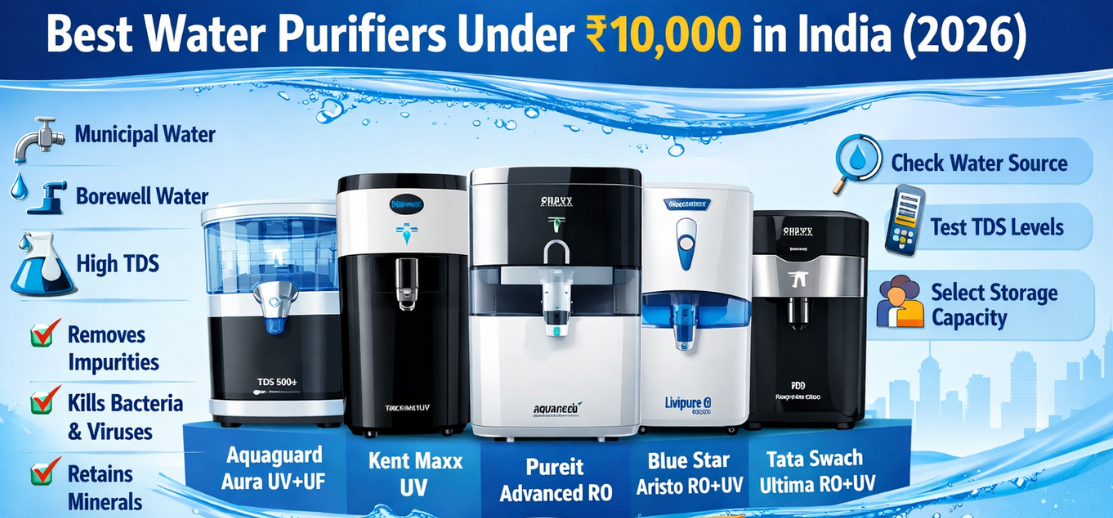
Clean drinking water is one of the most critical necessities in every Indian household. With increasing contamination from industrial waste, agricultural chemicals, bacteria, and heavy metals, relying on untreated tap water or borewell water can pose serious health risks. Investing in a reliable and affordable water purifier under ₹10,000 is a practical solution for families seeking safe drinking water without overspending.
In this comprehensive guide, we explore the best water purifiers under ₹10,000 in India, compare technologies such as RO, UV, UF, and gravity filtration, and help you select the ideal purifier for your household. This detailed article also includes comparison tables, expert buying advice, feature breakdowns, and frequently asked questions to ensure you make an informed decision.
Why Every Home Needs a Water Purifier
In many parts of India, water sources contain contaminants such as:
-
Dissolved salts and heavy metals
-
Bacteria and viruses
-
Chlorine and industrial pollutants
-
Pesticide residues
-
Sediments and rust
Boiling water removes some microorganisms but does not eliminate dissolved impurities or chemicals. A modern water purifier uses multiple purification technologies to remove contaminants while preserving essential minerals.
Key Benefits of Using a Water Purifier
-
Improved taste and odor
-
Removal of harmful microorganisms
-
Protection against waterborne diseases
-
Reduced chlorine and chemical contamination
-
Better health and digestion
Choosing the right purifier under ₹10,000 ensures safe drinking water without straining your budget.
Types of Water Purification Technologies
Before choosing a purifier, understanding purification technologies helps determine what suits your water source.
RO (Reverse Osmosis) Purifiers
RO technology uses a semi-permeable membrane to remove dissolved salts, heavy metals, and chemicals.
Best for:
-
Borewell water
-
High TDS water (above 300 ppm)
Advantages
-
Removes heavy metals
-
Reduces hardness
-
Eliminates chemical contaminants
Limitations
-
Requires electricity
-
Wastes some water during purification
UV (Ultraviolet) Purifiers
UV purifiers use ultraviolet light to kill bacteria and viruses.
Best for:
-
Municipal water with low TDS
Advantages
-
Fast purification
-
No change in taste
-
No water wastage
Limitations
-
Does not remove dissolved salts
UF (Ultrafiltration) Purifiers
UF uses hollow fiber membranes to filter bacteria and particles.
Best for:
-
Low TDS water
-
Gravity-based purifiers
Advantages
-
No electricity needed
-
Low maintenance
Gravity-Based Water Purifiers
These systems rely on activated carbon and UF membranes and work without electricity.
Best for:
-
Areas with frequent power cuts
-
Municipal water supply
Best Water Purifiers Under ₹10,000 in India
Below are some of the top-performing budget water purifiers offering excellent purification, durability, and value.
1. Aquaguard Aura UV + UF Water Purifier
Key Features
-
UV + UF purification
-
7-liter storage tank
-
Active copper technology
-
LED indicators
-
Wall mount design
Advantages
-
Excellent for municipal water
-
Compact and stylish design
-
Trusted brand reliability
Ideal For
Urban homes with low TDS tap water.
2. KENT Maxx UV Water Purifier
Key Features
-
UV purification
-
Activated carbon filter
-
7-liter storage capacity
-
Fully automatic operation
Advantages
-
Efficient bacterial removal
-
Transparent tank design
-
Low maintenance cost
Ideal For
Homes with municipal water supply and low TDS levels.
3. HUL Pureit Advanced Pro Mineral RO
Key Features
-
RO + mineral enrichment
-
7-stage purification
-
5-liter tank
-
TDS reduction technology
Advantages
-
Suitable for borewell water
-
Mineral enhancement
-
Compact wall-mounted design
Ideal For
Areas with high TDS water.
4. Blue Star Aristo RO + UV Water Purifier
Key Features
-
RO + UV purification
-
7-liter storage
-
Aqua taste booster
-
Triple-layer RO filter
Advantages
-
Removes heavy metals
-
Improves water taste
-
Reliable performance
Ideal For
Homes using mixed water sources.
5. Livpure Glo RO + UV + Mineralizer
Key Features
-
7-stage purification
-
Mineralizer technology
-
7-liter storage tank
-
LED display indicators
Advantages
-
Excellent purification efficiency
-
Mineral retention
-
Stylish design
Ideal For
Families requiring RO purification under ₹10,000.
6. Tata Swach Ultima Silver RO + UV
Key Features
-
RO + UV + Silver nanotechnology
-
8-stage purification
-
7-liter storage tank
Advantages
-
High purification performance
-
Durable filters
-
Competitive pricing
7. AO Smith X2 UV + UF Water Purifier
Key Features
-
UV + UF purification
-
5-stage filtration
-
Advanced alert system
Advantages
-
Energy efficient
-
Long filter life
-
Reliable brand quality
Comparison Table: Best Water Purifiers Under ₹10,000
| Model | Purification Type | Storage | Suitable Water | Price Range |
|---|---|---|---|---|
| Aquaguard Aura | UV + UF | 7 L | Municipal | ₹8,000–₹9,500 |
| Kent Maxx | UV | 7 L | Municipal | ₹7,000–₹9,000 |
| Pureit Advanced | RO | 5 L | Borewell | ₹8,500–₹10,000 |
| Blue Star Aristo | RO + UV | 7 L | Mixed | ₹9,000–₹10,000 |
| Livpure Glo | RO + UV | 7 L | Borewell | ₹8,500–₹10,000 |
| Tata Swach Ultima | RO + UV | 7 L | Mixed | ₹9,000–₹10,000 |
| AO Smith X2 | UV + UF | 7 L | Municipal | ₹8,000–₹9,500 |
How to Choose the Best Water Purifier Under ₹10,000
Selecting the right purifier requires evaluating several factors.
1. Check Water Source
The type of water supply determines the purification technology required.
| Water Source | Recommended Technology |
|---|---|
| Municipal Water | UV / UF |
| Borewell Water | RO |
| Mixed Supply | RO + UV |
2. Check TDS Level
TDS (Total Dissolved Solids) indicates dissolved impurities.
| TDS Level | Recommended Purifier |
|---|---|
| Below 200 ppm | UV or UF |
| 200–500 ppm | UV + UF |
| Above 500 ppm | RO |
3. Storage Capacity
Choose storage based on family size.
| Family Size | Recommended Tank |
|---|---|
| 1–3 Members | 5–6 L |
| 4–6 Members | 7–8 L |
| 6+ Members | 9–10 L |
4. Filter Replacement Cost
Annual filter replacement cost ranges between ₹1,500 – ₹4,000 depending on technology.
5. Installation and Maintenance
Look for brands offering:
-
Free installation
-
Easy service availability
-
Affordable replacement filters
Key Features to Look For
When selecting a water purifier, consider the following advanced features.
Multi-Stage Purification
Removes different types of contaminants in stages.
Mineral Retention Technology
Maintains essential minerals such as:
-
Calcium
-
Magnesium
-
Potassium
Auto Shut-Off
Stops purification when the tank is full.
Smart LED Indicators
Displays:
-
Filter change alerts
-
Power status
-
Tank level
Maintenance Tips for Water Purifiers
Proper maintenance ensures long-lasting performance.
Replace Filters on Time
Filters typically require replacement every 6–12 months.
Clean Storage Tank
Cleaning every 2–3 months prevents bacterial buildup.
Monitor Water Taste
A change in taste may indicate filter saturation.
Annual Service
Professional servicing improves efficiency and extends lifespan.
Advantages of Budget Water Purifiers
Affordable purifiers under ₹10,000 offer numerous benefits.
-
Cost-effective solution for clean water
-
Compact design suitable for apartments
-
Low power consumption
-
Simple maintenance
-
Effective purification for most households
Common Mistakes When Buying a Water Purifier
Avoid these mistakes to ensure the best purchase.
-
Ignoring TDS levels
-
Buying RO purifier unnecessarily
-
Overlooking filter replacement costs
-
Choosing insufficient storage capacity
-
Ignoring after-sales service availability
Future Trends in Water Purification
Modern purifiers are integrating advanced innovations.
Smart IoT Water Purifiers
Monitor water quality through smartphone apps.
Zero Water Waste RO Systems
New models reduce wastewater during purification.
Alkaline Water Technology
Balances pH levels for improved hydration.
Conclusion
Investing in the best water purifier under ₹10,000 ensures safe drinking water for your family without a heavy financial commitment. Whether your home uses municipal water, borewell water, or mixed supply, there are several high-quality purifiers that provide reliable purification, mineral retention, and durable performance.
By evaluating water source, purification technology, storage capacity, and maintenance cost, households can easily choose a purifier that delivers clean, healthy, and great-tasting drinking water every day.
FAQs
1. What is the best water purifier under ₹10,000?
Several excellent options include Livpure Glo, Pureit Advanced Pro, Kent Maxx, and Blue Star Aristo.
2. Is RO necessary for municipal water?
No. Municipal water typically requires UV or UF purification.
3. What is the ideal TDS level for drinking water?
The ideal range is 50–150 ppm.
4. How often should filters be replaced?
Typically every 6–12 months.
5. Does RO remove essential minerals?
Yes, but modern purifiers use mineralizers to restore minerals.
6. Which purifier works without electricity?
Gravity-based UF purifiers.
7. Is UV purifier safe?
Yes. UV effectively kills bacteria and viruses.
8. Can RO purifiers handle borewell water?
Yes, they are specifically designed for high TDS water.
9. What storage capacity is best?
For families, 7-liter storage is ideal.
10. Do water purifiers waste water?
RO purifiers may waste some water during purification.
11. Which purifier is best for apartments?
Compact UV or RO+UV models.
12. How long do RO membranes last?
Typically 2–3 years.
13. Do purifiers remove chlorine?
Yes, activated carbon filters remove chlorine.
14. Are copper-infused purifiers useful?
They may provide antimicrobial benefits.
15. Can water purifiers remove pesticides?
RO systems can remove many chemical contaminants.
16. What is UF filtration?
A membrane that filters bacteria and particles.
17. Is mineral water purifier better?
Yes, it maintains essential minerals.
18. What is sediment filter?
Removes sand, rust, and dirt particles.
19. Do purifiers improve taste?
Yes, especially those with activated carbon filters.
20. What maintenance cost should be expected?
Approximately ₹1,500–₹4,000 annually.
21. How much electricity does a purifier consume?
Usually 25–40 watts.
22. Can purifiers remove viruses?
Yes, UV and RO systems remove viruses.
23. Is tank cleaning necessary?
Yes, every 2–3 months.
24. Which purifier is best for hard water?
RO purifiers.
25. How long do water purifiers last?
Most last 5–8 years with proper maintenance.
For more information and to start using Roobai.com, visit our official website and download the app to stay updated on the best deals and offers. With Roobai.com, you can ensure that every shopping experience is not just an opportunity to shop but an opportunity to save big.