
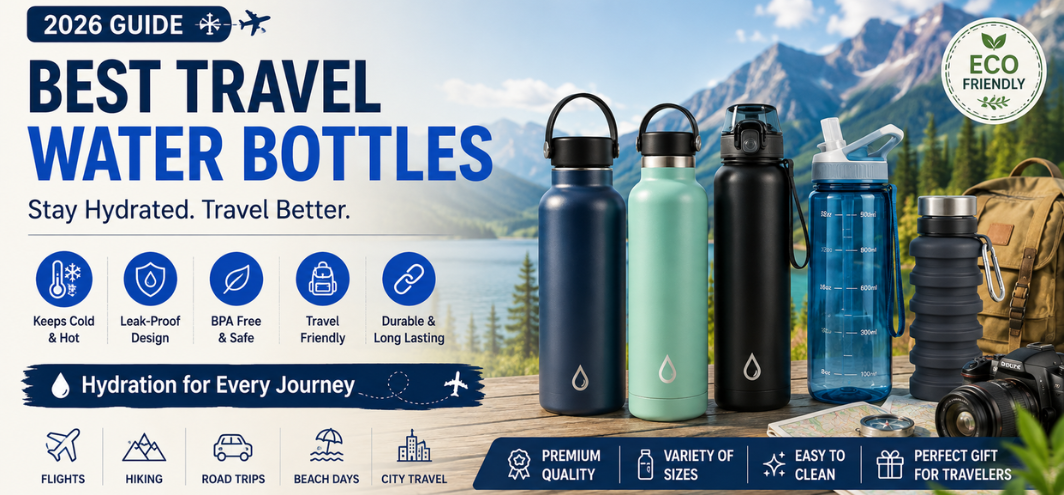
Travel becomes more convenient when we have reliable essentials that make every part of the journey easier. Among the simplest and most useful travel accessories, a water bottle deserves a permanent place in our luggage. Whether we are taking a short road trip, boarding a long-haul flight, hiking through the mountains, exploring a new city, commuting between destinations, or spending a day at the beach, having a suitable bottle allows us to carry water conveniently and stay prepared throughout the journey.
Choosing the best travel water bottle is not simply about selecting the largest bottle or the most attractive design. A travel bottle needs to balance capacity, portability, durability, leak resistance, insulation, weight, ease of cleaning, and drinking convenience. The ideal option for a backpacking trip may be completely different from the ideal bottle for a business trip or daily city travel.
Material also plays an important role. Stainless steel bottles are popular for durability and insulation, while lightweight plastic and Tritan-style bottles can be convenient for travelers who want to minimize luggage weight. Collapsible bottles are particularly useful when storage space is limited because they can be compressed when empty.
A well-designed travel water bottle should fit comfortably into our backpack or luggage, remain secure during transportation, and provide convenient access whenever we need a drink. Features such as wide-mouth openings, leak-proof lids, carry handles, insulation, measurement markings, and easy-clean construction can make a significant difference during real-world travel.
This guide explores the best travel water bottles, including different materials, sizes, designs, insulation options, travel situations, buying considerations, packing tips, maintenance advice, and frequently asked questions.
What Is a Travel Water Bottle?
A travel water bottle is a reusable drinking container designed to be carried during journeys, outdoor activities, commuting, and everyday travel.
Unlike a basic household bottle, a dedicated travel bottle is generally designed with portability and transportation in mind. It may include a secure lid, carry loop, handle, compact shape, insulated construction, or other features intended to make carrying and drinking easier.
Travel bottles are available in many forms, including:
- Stainless steel water bottles
- Insulated water bottles
- Lightweight plastic bottles
- Glass water bottles
- Collapsible water bottles
- Wide-mouth bottles
- Sports bottles
- Filter water bottles
- Straw bottles
- Leak-proof travel bottles
- Bottles with carrying handles
The best option depends on where we are going, how long we will be traveling, how much water we need, and how much weight we are willing to carry.
Why Should We Carry a Water Bottle While Traveling?
Carrying our own reusable bottle can make travel more convenient and organized.
1. Convenient Hydration
A reusable bottle allows us to carry water with us instead of depending entirely on finding a place to purchase a drink.
During long journeys, having water readily accessible can be particularly convenient.
2. Reusable Design
A reusable bottle can be used repeatedly throughout a trip and on future journeys.
This makes it a practical alternative to repeatedly purchasing single-use bottles.
3. Easy to Carry
Travel bottles are designed with portability in mind. Many feature handles, loops, or shapes that fit easily into backpacks and luggage compartments.
4. Temperature Control
Insulated bottles can help maintain the temperature of beverages for longer periods compared with conventional single-wall bottles.
5. Useful for Different Travel Styles
A suitable bottle can be used for:
- Air travel
- Road trips
- Hiking
- Camping
- Business travel
- City exploration
- Beach trips
- Gym sessions
- Cycling
- Daily commuting
Best Types of Travel Water Bottles
There is no single bottle that is perfect for every traveler. Understanding the major types helps us select a bottle according to our needs.
1. Best Stainless Steel Travel Water Bottles
Stainless steel is one of the most popular materials for reusable travel bottles.
A well-constructed stainless steel bottle can offer excellent durability and resistance to everyday wear. It is particularly suitable for travelers who frequently carry their bottle in backpacks or luggage.
Many stainless steel bottles are available with double-wall vacuum insulation, making them suitable for both cold and hot beverages where the manufacturer specifies that use.
Advantages of stainless steel bottles
- Excellent durability
- Resistant to many forms of everyday wear
- Available in insulated designs
- Suitable for frequent travel
- Usually easy to clean
- Premium appearance
- Suitable for repeated use
Best for
Stainless steel bottles are particularly suitable for frequent travelers, commuters, hikers, road-trip travelers, and people who want a durable long-term bottle.
2. Best Insulated Travel Water Bottles
Insulated bottles are designed to reduce heat transfer between the beverage and surrounding environment.
Double-wall vacuum insulation is commonly used in premium insulated bottles. This construction creates an insulating layer between the inner and outer walls.
Temperature retention varies according to the bottle, beverage, starting temperature, ambient conditions, lid design, and how frequently the bottle is opened.
Advantages
- Helps maintain beverage temperature
- Suitable for hot and cold drinks where supported
- Useful during outdoor activities
- Comfortable to hold because the exterior can remain relatively closer to ambient temperature
- Suitable for long journeys
For travelers visiting hot destinations, an insulated bottle can be particularly useful for keeping cold water more enjoyable during extended periods outdoors.
3. Best Lightweight Travel Water Bottles
When every gram matters, a lightweight bottle can be preferable to a heavy insulated model.
Lightweight bottles are particularly useful for:
- Backpacking
- Hiking
- Air travel
- Minimalist travel
- Day trips
- Long walking tours
The main advantage is reduced carrying weight. The trade-off may be lower insulation performance or reduced impact resistance depending on the material.
4. Best Collapsible Travel Water Bottles
Collapsible bottles are designed to reduce their size when they are empty.
This is useful when luggage and backpack space are limited.
Once the bottle is empty, we can collapse or fold it depending on the design, allowing it to occupy considerably less space than a rigid bottle.
Best for
- Backpackers
- Air travelers
- Minimalist travelers
- Festival visitors
- Day hikers
- Travelers with limited luggage space
A collapsible bottle is particularly useful when we expect to carry the bottle frequently but do not need it to remain full throughout the entire journey.
5. Best Plastic Travel Water Bottles
Plastic bottles can offer an excellent combination of low weight, affordability, and practicality.
Modern reusable bottles are available in a range of materials and designs. We should always follow the manufacturer's instructions regarding temperature limits, cleaning, dishwasher compatibility, and intended use.
Advantages
- Lightweight
- Generally affordable
- Easy to carry
- Available in many sizes
- Suitable for everyday travel
Plastic can be a practical choice when minimizing weight is more important than premium insulation.
6. Best Glass Travel Water Bottles
Glass bottles can provide a clean-tasting drinking experience and are easy to inspect visually.
However, they are generally heavier and more vulnerable to breakage than plastic or stainless steel.
Many travel-oriented glass bottles include protective silicone sleeves to provide additional grip and protection.
Best for
- Office travel
- Short trips
- Everyday commuting
- Users who prefer glass construction
Glass may be less suitable for rugged backpacking or situations where luggage is likely to experience significant impact.
7. Best Filter Water Bottles for Travel
Filter bottles combine water storage with filtration technology.
Depending on the specific product, filters may target particular contaminants or particles. We should never assume that every filter bottle makes any water source safe to drink.
Before using a filtration bottle during international travel, hiking, or outdoor activities, we should understand exactly what the filter is certified or designed to reduce and follow the manufacturer's replacement schedule.
Best for
- Outdoor travel
- Hiking
- Camping
- Certain international travel situations
- Travelers who need additional filtration capability
8. Best Wide-Mouth Water Bottles
Wide-mouth bottles have larger openings that make them convenient for:
- Adding ice
- Filling quickly
- Cleaning
- Adding fruit
- Using a bottle brush
- Pouring beverages
The trade-off is that some wide-mouth designs may be less convenient to drink from while walking compared with bottles equipped with a straw or narrow drinking spout.
9. Best Straw Water Bottles
Straw bottles allow us to drink without tilting the bottle significantly.
This can be useful while:
- Walking
- Cycling
- Exercising
- Driving
- Hiking
- Working
However, straw mechanisms can have additional components that require careful cleaning.
How to Choose the Best Travel Water Bottle
Selecting the right bottle requires us to evaluate several practical features.
Bottle Capacity
Capacity determines how much liquid we can carry at one time.
Common sizes include approximately:
- 350 ml
- 500 ml
- 600 ml
- 750 ml
- 1 litre
- 1.5 litres and larger
Choosing the right capacity
| Capacity | Best For |
|---|---|
| 350–500 ml | Short trips and commuting |
| 500–750 ml | Everyday travel |
| 750 ml–1 L | Hiking and long day trips |
| 1 L+ | Extended outdoor activities |
A larger bottle reduces the need for frequent refills but increases both its full weight and physical size.
For air travel, a smaller empty bottle can be especially convenient because airport security rules can restrict liquids carried through screening. We should check the current rules of the departure airport and airline rather than assuming that every location follows identical procedures.
Material
Material influences durability, weight, insulation, appearance, and maintenance.
| Material | Weight | Durability | Insulation | Best Use |
| Stainless Steel | Medium | Excellent | Excellent in insulated designs | Frequent travel |
| Plastic | Light | Good | Usually limited | Everyday use |
| Glass | Heavy | Moderate | Limited unless specially designed | Office and city travel |
| Flexible/Collapsible | Very light | Varies | Limited | Backpacking |
The best material depends on our travel priorities.
Leak-Proof Design
A leak-proof lid is one of the most important features of a travel bottle.
A bottle that leaks inside our backpack can damage clothing, documents, electronics, and other valuables.
We should look for:
- Secure lid threads
- Reliable seals
- Silicone gaskets where applicable
- Locking mechanisms
- Flip-top safety locks
- Durable closure systems
Before packing a bottle inside luggage, we should test it with water and keep it upright initially to confirm that the closure is secure.
Bottle Shape
A bottle should fit comfortably into our travel bag.
A tall narrow bottle may fit a backpack side pocket better than a wide bottle. On the other hand, a wider bottle may provide greater stability when placed on a table.
We should check:
- Diameter
- Height
- Base stability
- Handle position
- Compatibility with cup holders
- Backpack pocket dimensions
Weight
The bottle's empty weight is often overlooked.
An insulated stainless steel bottle may provide excellent temperature retention but weigh considerably more than a lightweight plastic or collapsible bottle.
For long hiking trips, empty weight becomes particularly important.
Insulation
If temperature retention matters, we should consider double-wall vacuum insulation.
For travelers spending several hours outdoors, insulation can provide greater convenience.
However, insulation generally adds weight and bulk, so it should be chosen according to our travel style.
Lid Type
The lid influences both convenience and leak resistance.
Common options include:
- Screw caps
- Flip tops
- Straw lids
- Chug lids
- Spout lids
- Handle lids
A screw cap is generally simple and reliable, while straw and flip-top designs can provide faster access while moving.
Ease of Cleaning
A bottle that is difficult to clean can become inconvenient very quickly.
We should look for:
- Wide openings
- Removable seals
- Simple lid construction
- Dishwasher compatibility where specified
- Minimal hidden cavities
Bottles with complicated drinking mechanisms may require more attention during cleaning.
How to Choose the Best Travel Water Bottle for Air Travel
Air travel presents unique considerations.
Before passing through airport security, we should check the current liquid restrictions at our departure airport. An empty reusable bottle can often be more convenient to carry through security than a full bottle, subject to the applicable airport rules.
After security, travelers may be able to refill their bottle using permitted water sources.
For flights, useful features include:
- Leak-resistant lid
- Lightweight construction
- Compact dimensions
- Carry handle
- Easy-clean opening
- Empty weight that is not excessive
A bottle that fits inside our personal item or backpack can be particularly convenient.
Best Travel Water Bottles for Road Trips
Road trips allow us to carry larger bottles because we are not subject to the same luggage constraints as air travelers.
A capacity between approximately 750 ml and 1 litre can be practical for many situations.
Features worth considering include:
- Cup-holder compatibility
- Large capacity
- Insulation
- Leak-proof lid
- Easy one-handed drinking
- Durable construction
A bottle that fits securely into a vehicle cup holder is especially convenient.
Best Travel Water Bottles for Hiking
Hiking requires a different balance between capacity, weight, durability, and accessibility.
A lightweight bottle can reduce the load we carry, while a larger capacity can reduce the frequency of refilling.
For longer hikes, we should consider our planned route, access to safe water, weather conditions, and total water requirements rather than relying on a bottle's capacity alone.
Useful features include:
- Lightweight construction
- Strong carry loop
- Durable body
- Leak-resistant closure
- Easy access
- Filter capability where appropriate
Best Travel Water Bottles for Backpacking
Backpacking places a premium on weight and packability.
A collapsible bottle can be useful because it takes up less space after use.
Alternatively, a lightweight rigid bottle can provide better durability and easier handling.
We should avoid carrying multiple unnecessarily heavy bottles simply because they look premium.
Best Travel Water Bottles for Business Trips
Business travelers usually prioritize convenience, appearance, and portability.
A slim stainless steel bottle can fit easily into a work bag while maintaining a professional appearance.
Useful features include:
- Compact shape
- Leak-proof design
- Minimalist appearance
- Moderate capacity
- Easy cleaning
- Insulation
A bottle with a narrow diameter can also fit more easily into laptop bags and office backpacks.
Best Travel Water Bottles for Beach Holidays
Beach travel exposes our belongings to sand, heat, and moisture.
A durable, corrosion-resistant bottle with a secure lid can be useful.
Insulation is particularly attractive for beach trips because it can help maintain cooler beverages.
We should also rinse the exterior and lid regularly if the bottle is exposed to saltwater or sand.
Best Travel Water Bottles for Camping
Camping often requires larger water capacity and durable construction.
Depending on the trip, we may prefer:
- Large-capacity bottles
- Stainless steel bottles
- Filter bottles
- Collapsible backup bottles
The bottle should be easy to clean and resistant to the conditions in which it will be used.
Best Travel Water Bottles for Family Trips
When traveling with a family, different capacities may be useful for different age groups.
We can select smaller bottles for children and larger bottles for adults.
Features such as:
- Carry handles
- Straw lids
- Leak-resistant closures
- Easy-to-clean components
- Durable construction
can make family travel easier.
Using different colors can also help family members identify their bottles quickly.
How to Pack a Water Bottle for Travel
Packing a water bottle correctly can prevent leaks and save space.
Before packing
- Empty the bottle completely.
- Rinse it if necessary.
- Allow the interior to dry.
- Check the lid and seal.
- Keep the bottle open until completely dry when storing.
Inside luggage
If the bottle must be packed:
- Keep it empty.
- Secure the lid separately if appropriate.
- Place it in an accessible location.
- Protect it from heavy objects.
- Use a dedicated pocket when available.
For insulated bottles, keeping them outside the main clothing compartment can make them easier to access.
How to Clean a Travel Water Bottle
Regular cleaning is essential for reusable bottles.
A basic cleaning routine includes:
- Empty the bottle.
- Separate removable components.
- Wash the bottle with suitable dish soap and water.
- Clean the lid carefully.
- Pay attention to seals and drinking openings.
- Rinse thoroughly.
- Allow every component to dry completely.
Bottle brushes can be useful for narrow openings and deep containers.
We should follow the manufacturer's cleaning instructions, especially for bottles containing filters, electronic components, special coatings, or insulated construction.
How Often Should We Clean a Travel Water Bottle?
A bottle used daily should generally be cleaned regularly rather than simply refilled repeatedly.
If we use the bottle for anything other than plain water, cleaning becomes even more important because beverages containing sugars, proteins, or other ingredients can leave residues.
We should also clean the lid and mouthpiece rather than focusing only on the bottle body.
How to Prevent Bottle Odors
Unpleasant odors often develop when moisture remains trapped inside the bottle or lid.
To reduce odors:
- Empty the bottle after use.
- Rinse it regularly.
- Dry it completely.
- Keep the lid open during storage.
- Clean removable seals.
- Avoid leaving beverages inside for extended periods.
- Follow the manufacturer's care instructions.
Travel Water Bottle vs Disposable Bottles
Reusable travel bottles offer several practical advantages for frequent travelers.
| Feature | Reusable Travel Bottle | Disposable Bottle |
| Reusability | Excellent | Limited |
| Durability | Usually high | Low |
| Long-term convenience | Excellent | Moderate |
| Insulation | Available | Usually limited |
| Custom capacity | Many choices | Limited |
| Travel suitability | Excellent | Convenient for one-time use |
A reusable bottle requires initial cleaning and maintenance, but it can become a reliable part of our travel kit.
Stainless Steel vs Plastic Travel Bottles
Both materials can be useful.
Stainless steel
Advantages:
- Durable
- Premium construction
- Excellent in insulated designs
- Suitable for frequent travel
Disadvantages:
- Heavier
- Can be more expensive
- May show dents after impact
Plastic
Advantages:
- Lightweight
- Affordable
- Easy to carry
- Available in many designs
Disadvantages:
- Generally less resistant to long-term wear than high-quality metal
- Usually provides less insulation
- Some materials can retain odors if not cleaned properly
Glass vs Stainless Steel Travel Bottles
Glass can provide excellent taste neutrality and visual clarity, but stainless steel generally offers greater durability for demanding travel.
For office use or short trips, glass can be practical. For hiking, camping, and adventure travel, stainless steel is usually more suitable because of its resistance to breakage.
What Makes the Best Travel Water Bottle?
The best travel bottle should combine several practical characteristics.
We should prioritize:
- Leak resistance
- Durability
- Appropriate capacity
- Comfortable portability
- Easy cleaning
- Suitable material
- Insulation when needed
- Reliable lid
- Useful carry handle
- Appropriate weight
- Travel-friendly dimensions
There is no reason to pay for features that do not match our travel habits.
For example, a highly insulated 1-litre stainless steel bottle may be excellent for a road trip but unnecessarily heavy for a minimalist backpacker.
Travel Water Bottle Size Guide
| Travel Situation | Recommended Capacity |
| Short city walk | 350–500 ml |
| Office commute | 500–750 ml |
| Day trip | 600–1,000 ml |
| Hiking | 750 ml–1 L+ |
| Road trip | 750 ml–1.5 L |
| Backpacking | Lightweight 500 ml–1 L |
| Family travel | Multiple sizes |
| Beach day | 750 ml–1 L |
The correct size depends on access to safe refill points, weather, activity level, travel duration, and the weight we are comfortable carrying.
Travel Water Bottle Buying Checklist
Before buying a bottle, we can evaluate the following:
-
Check the bottle capacity.
-
Compare empty weight.
-
Check the material.
-
Verify leak-resistant construction.
-
Examine the lid design.
-
Check insulation if required.
-
Measure the bottle diameter.
-
Confirm backpack or cup-holder compatibility.
-
Check cleaning instructions.
-
Verify dishwasher compatibility if important.
-
Check whether replacement lids or parts are available.
-
Consider a carry handle.
-
Check whether the bottle is collapsible if space is limited.
-
Review warranty information where applicable.
-
Choose a capacity appropriate for the journey.
Advantages of Using the Best Travel Water Bottles
The right travel bottle can provide several benefits:
- Convenient access to water
- Easy transportation
- Reusable design
- Better organization
- Reduced dependence on single-use containers
- Temperature retention with insulated models
- Improved portability
- Multiple capacity choices
- Useful outdoor functionality
- Easy integration into travel bags
Potential Disadvantages of Travel Water Bottles
Travel bottles also have some limitations.
Additional Weight
Large stainless steel bottles can become heavy when full.
Cleaning Requirements
Reusable bottles require regular cleaning.
Space Requirements
Rigid bottles occupy space even when empty.
Potential Leakage
Poorly designed or improperly closed lids can leak.
Maintenance
Filters, seals, straws, and other components may need cleaning or replacement.
Choosing the correct bottle design can minimize these disadvantages.
Best Travel Water Bottle Features by Traveler
| Traveler | Most Important Features |
| Backpacker | Lightweight, collapsible, durable |
| Hiker | Capacity, durability, portability |
| Business traveler | Compact, leak-proof, professional design |
| Road traveler | Large capacity, insulation, cup-holder fit |
| Family traveler | Multiple sizes, easy-clean lids |
| Beach traveler | Insulation, durability, secure lid |
| Fitness traveler | Straw, grip, portability |
| Minimalist traveler | Lightweight, collapsible design |
| Outdoor traveler | Durable, insulated or filter-capable |
| Frequent flyer | Lightweight, compact, leak-resistant |
Common Travel Water Bottle Mistakes to Avoid
Choosing a Bottle That Is Too Large
A huge bottle may look convenient but can become uncomfortable when carried for several hours.
Ignoring Empty Weight
The bottle becomes heavier when filled, so its starting weight matters.
Choosing a Difficult-to-Clean Lid
Complex lids can require more maintenance.
Ignoring Leakage
A bottle that leaks can cause significant problems inside luggage.
Buying Without Checking Dimensions
A bottle may not fit the side pocket of our backpack or the cup holder in our vehicle.
Overlooking Refill Access
Capacity should be selected according to how frequently we can refill the bottle.
Assuming Every Filter Bottle Purifies Every Water Source
Filtration capabilities differ significantly. We should always check the exact manufacturer's specifications.
How to Choose the Best Travel Water Bottle for Hot Weather
Hot climates can make insulation particularly useful.
For warm-weather travel, we can prioritize:
- Double-wall insulation
- Secure lid
- Comfortable grip
- Appropriate capacity
- Durable exterior
- Easy cleaning
A larger capacity may reduce the frequency of refills, but we should balance this against the additional weight.
How to Choose a Travel Water Bottle for Cold Weather
Cold-weather travelers may prioritize insulated construction to help prevent beverages from becoming cold too quickly.
If using a bottle for hot beverages, we should verify that the manufacturer specifically supports hot-liquid use. Not every insulated bottle or lid is designed for hot drinks.
We should also consider whether the lid is safe and comfortable for the intended beverage temperature.
How to Choose a Travel Water Bottle for Long Journeys
For long journeys, durability and capacity become increasingly important.
We should consider:
- How frequently we can refill
- How much water we realistically need
- Whether the bottle fits our bag
- Whether insulation is useful
- Whether the bottle can be cleaned easily
- How much empty weight we are willing to carry
A reliable medium-to-large bottle can be more practical than carrying several small containers.
How to Choose a Travel Water Bottle for International Travel
International travel can involve airports, hotels, trains, buses, walking tours, and outdoor activities.
A versatile bottle should therefore be:
- Lightweight enough for luggage
- Leak-resistant
- Easy to clean
- Easy to refill
- Compact enough for a day bag
- Durable enough for repeated transportation
If we travel to destinations where water quality varies, we should research local drinking-water guidance and choose an appropriate filtration solution where necessary.
Final Guide to Choosing the Best Travel Water Bottles
The best travel water bottle is not necessarily the largest, most expensive, or most feature-packed model. The right choice depends on our destination, travel style, luggage limitations, expected usage, and personal preferences.
For frequent travelers, stainless steel insulated bottles can provide an excellent combination of durability and temperature retention. For backpackers and hikers, lightweight bottles can reduce the burden of carrying additional equipment. For travelers who prioritize compact storage, collapsible bottles can be extremely convenient. Glass bottles may appeal to users who prefer glass construction, while filter bottles can provide additional functionality when their specific filtration capabilities match the intended water source.
Capacity should be chosen carefully. A larger bottle provides more water between refills but becomes heavier when full. A smaller bottle is easier to carry but may require more frequent refilling.
The lid deserves just as much attention as the bottle body. Leak resistance, easy cleaning, reliable seals, and comfortable drinking access can make a significant difference during everyday travel.
We should also consider where the bottle will be used. A bottle designed for office commuting does not necessarily need the rugged construction required for hiking or camping. Similarly, a bottle that is ideal for a road trip may be unnecessarily heavy for air travel.
Ultimately, the best travel water bottle is one that fits naturally into our routine, remains reliable throughout the journey, and provides convenient access to water wherever our travels take us.
FAQs
1. What is the best water bottle for travel?
The best travel water bottle depends on our needs. Insulated stainless steel bottles are excellent for durability and temperature retention, while lightweight and collapsible bottles are better for travelers prioritizing portability.
2. What size water bottle is best for travel?
A 500–750 ml bottle is a versatile choice for many travelers. Longer outdoor trips may benefit from a 750 ml to 1-litre bottle or larger capacity.
3. Are stainless steel water bottles good for travel?
Yes. Stainless steel bottles are durable and widely available in insulated designs, making them suitable for frequent travel, hiking, road trips, and everyday use.
4. Are insulated water bottles worth it for travel?
Yes, particularly when we want beverages to remain cooler or warmer for longer. They are especially useful for outdoor travel and long journeys.
5. Are collapsible water bottles good for travel?
Yes. Collapsible bottles are particularly useful when luggage space is limited because they can take up less space when empty.
6. Can we take a water bottle on an airplane?
Airport liquid-security rules vary by location. An empty reusable bottle can be more convenient during security screening, after which we may be able to refill it where permitted. We should always check the current rules of our departure airport.
7. What is the best material for a travel water bottle?
Stainless steel, plastic, glass, and flexible materials all have advantages. Stainless steel is excellent for durability, plastic for low weight, glass for users who prefer glass construction, and collapsible materials for compact storage.
8. Are plastic travel bottles safe to use?
Reusable plastic bottles can be suitable for travel when they are made for the intended use and maintained according to the manufacturer's instructions.
9. What makes a water bottle leak-proof?
A secure lid, reliable seals, properly fitted gaskets, and quality construction all contribute to leak resistance.
10. What is the best water bottle for hiking?
A durable, lightweight bottle with an appropriate capacity and secure closure is generally suitable for hiking. Longer hikes may require additional capacity or an appropriate water-filtration solution.
11. What is the best travel water bottle for hot weather?
An insulated bottle can be a strong choice for hot-weather travel because it can help maintain cooler beverage temperatures for longer.
12. What is the best travel bottle for backpacking?
Lightweight or collapsible bottles are particularly useful for backpacking because they minimize the weight and space required in the backpack.
13. Are glass water bottles good for travel?
Glass bottles can be excellent for office and city travel, but they are generally heavier and more vulnerable to breakage than stainless steel or plastic alternatives.
14. Are filter water bottles useful for international travel?
They can be useful in specific situations, but filtration performance varies by product. We should check exactly which contaminants the filter is designed and certified to reduce rather than assuming it makes every water source safe.
15. How often should we clean a travel water bottle?
A reusable bottle should be cleaned regularly, particularly when used daily or with beverages other than plain water. Lids, seals, straws, and mouthpieces should also be cleaned.
16. How do we stop a water bottle from smelling?
Regular cleaning, thorough rinsing, complete drying, and cleaning the lid and seals can help prevent odors.
17. Can we put hot water in a stainless steel travel bottle?
Some stainless steel bottles are designed for hot beverages, but we should verify the manufacturer's instructions for both the bottle and lid before using hot liquids.
18. Is a wide-mouth water bottle better for travel?
Wide-mouth bottles are convenient for filling, cleaning, and adding ice, but some travelers may prefer narrow drinking openings for easier drinking while moving.
19. Are straw bottles good for travel?
Straw bottles can be convenient for walking, exercising, cycling, and driving. Their additional components should be cleaned carefully.
20. What capacity is best for a road trip?
A 750 ml to 1-litre bottle is a practical starting point for many road trips, although the ideal capacity depends on access to refills and the duration of the journey.
21. What is the lightest type of travel water bottle?
Flexible or collapsible bottles can be extremely lightweight, while lightweight plastic bottles can also provide a good balance between low weight and rigidity.
22. Do stainless steel bottles keep water cold?
Insulated stainless steel bottles can maintain cold beverage temperatures for extended periods, although actual performance depends on construction, starting temperature, ambient conditions, and usage.
23. Should we buy a 1-litre water bottle for travel?
A 1-litre bottle can be useful for long outdoor activities, but it may be unnecessarily heavy for short city trips. We should choose capacity according to our travel conditions.
24. What should we look for in the best travel water bottle?
We should consider capacity, material, weight, leak resistance, lid design, insulation, durability, dimensions, cleaning requirements, and portability.
25. What are the best travel water bottles for different types of travel?
For frequent travel, an insulated stainless steel bottle is a strong all-purpose option. For backpacking, a lightweight or collapsible bottle is preferable. For road trips, a larger insulated bottle can be useful. For business travel, a compact leak-resistant bottle works well, while outdoor travelers may prefer durable bottles with suitable filtration or insulation features.