
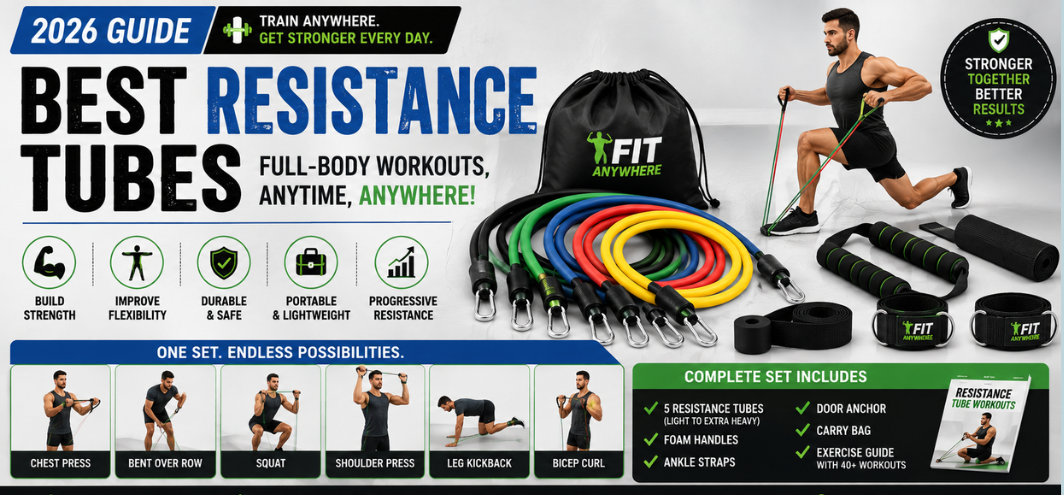
Resistance tubes have become one of the most versatile pieces of fitness equipment for people who want effective workouts at home, in the gym, while traveling, or outdoors. Whether we are building strength, improving flexibility, increasing muscle endurance, recovering from injury, or adding variety to our training routine, the best resistance tubes provide a compact and effective way to perform hundreds of exercises without bulky equipment.
Unlike traditional dumbbells or barbells, resistance tubes create constant tension throughout an exercise. This allows muscles to remain engaged during both the lifting and returning phases of movement. Resistance tubes are suitable for beginners starting a fitness journey, intermediate users building strength, and advanced athletes incorporating resistance-based training into their workouts.
Modern resistance tube sets include multiple resistance levels, comfortable handles, ankle straps, door anchors, protective sleeves, and stackable resistance options. Choosing the right set depends on resistance level, material quality, durability, portability, handles, accessories, weight capacity, and workout goals.
In this comprehensive guide, we explore everything about the best resistance tubes, including types, benefits, exercises, resistance levels, buying tips, maintenance, safety guidelines, comparisons, and frequently asked questions.
What Are Resistance Tubes?
Resistance tubes are elastic fitness bands made from natural latex or synthetic elastic materials with attached handles or connection points. They create resistance when stretched, allowing us to perform strength-training and mobility exercises using our own body movements.
Unlike flat resistance bands, resistance tubes have a cylindrical design and are commonly used with handles, door anchors, ankle straps, or attachment systems.
Common Uses of Resistance Tubes
-
Full-body workouts
-
Strength training
-
Home fitness
-
Muscle toning
-
Rehabilitation exercises
-
Stretching routines
-
Yoga support exercises
-
Pilates workouts
-
Functional fitness
-
Athletic conditioning
Resistance tubes are lightweight, portable, and suitable for training almost every major muscle group.
Why Should We Use Resistance Tubes?
Resistance tubes provide several advantages that make them suitable for both home and gym workouts.
1. Full-Body Strength Training
A single resistance tube can be used for exercises targeting:
-
Chest
-
Back
-
Shoulders
-
Arms
-
Legs
-
Glutes
-
Core
-
Hips
This makes them an efficient all-in-one workout tool.
2. Portable Fitness Equipment
Resistance tubes occupy very little space.
We can easily carry them inside:
-
Gym bags
-
Suitcases
-
Backpacks
-
Office bags
-
Travel luggage
This makes them ideal for workouts while traveling.
3. Progressive Resistance
Most resistance tube sets include multiple resistance levels that allow us to gradually increase workout intensity.
Instead of purchasing heavier weights, we can switch to stronger tubes or combine multiple tubes.
4. Constant Muscle Tension
Resistance increases as the tube stretches, providing continuous tension during movement.
This characteristic makes resistance tubes useful for many controlled strength exercises.
5. Suitable for All Fitness Levels
Beginners can start with lighter resistance.
Intermediate and advanced users can combine tubes for higher resistance.
Best Types of Resistance Tubes
Choosing the correct type depends on our workout style.
1. Resistance Tubes with Handles
These are the most popular resistance tubes.
Features include:
-
Comfortable foam handles
-
Interchangeable resistance tubes
-
Metal clips
-
Door anchors
-
Ankle straps
Best for: General fitness, home workouts, strength training.
2. Stackable Resistance Tube Sets
Stackable systems allow multiple tubes to be attached simultaneously.
Benefits
-
Adjustable resistance.
-
Progressive training.
-
Suitable for beginners and advanced users.
-
One set replaces multiple weights.
Best for: Strength progression and muscle building.
3. Heavy Resistance Tubes
Heavy tubes provide greater resistance for advanced workouts.
Best for
-
Squats
-
Deadlift variations
-
Chest press
-
Rows
-
Shoulder press
-
Athletic strength training
4. Light Resistance Tubes
Light tubes provide lower resistance for mobility and rehabilitation exercises.
Best for
-
Warm-ups
-
Stretching
-
Recovery exercises
-
Shoulder mobility
-
Beginner workouts
5. Fabric-Covered Resistance Tubes
Some resistance tubes include a protective sleeve surrounding the elastic core.
Advantages
-
Improved durability.
-
Protection against abrasion.
-
Reduced snapping risk if damaged.
-
Better comfort during exercises.
6. Resistance Tubes with Ankle Straps
Designed for lower-body workouts.
Exercises include:
-
Kickbacks
-
Hip abduction
-
Hip extension
-
Leg curls
-
Glute exercises
7. Door Anchor Resistance Tubes
Door anchors allow upper-body exercises without a gym machine.
Examples include:
-
Lat pulldowns
-
Chest press
-
Rows
-
Triceps pushdowns
-
Shoulder exercises
This greatly expands workout possibilities at home.
Best Resistance Tubes for Home Workouts
Home workouts benefit from versatile equipment.
A complete resistance tube set can replace multiple gym machines for many exercises.
Ideal Home Workout Features
| Feature | Benefit |
|---|---|
| Multiple resistance levels | Progressive workouts |
| Comfortable handles | Better grip |
| Door anchor | More exercise options |
| Ankle straps | Lower-body exercises |
| Carrying bag | Easy storage |
| Durable latex tubes | Long-lasting performance |
Best Resistance Tubes for Strength Training
Strength training requires durable tubes with sufficient resistance.
Recommended Features
-
Heavy resistance options.
-
Stackable tubes.
-
Reinforced clips.
-
Strong handles.
-
Durable connectors.
-
Protective sleeve where available.
Exercises include:
-
Chest press
-
Rows
-
Squats
-
Deadlifts
-
Shoulder press
-
Biceps curls
-
Triceps extensions
Best Resistance Tubes for Muscle Building
Muscle-building workouts require progressive overload.
Resistance tube sets allow gradual increases by combining multiple bands.
Upper Body Muscle Exercises
-
Chest fly
-
Chest press
-
Shoulder press
-
Upright row
-
Lateral raise
-
Front raise
-
Biceps curl
-
Hammer curl
-
Triceps pushdown
Lower Body Muscle Exercises
-
Squats
-
Romanian deadlifts
-
Lunges
-
Glute kickbacks
-
Hip thrusts
-
Calf raises
-
Side steps
Best Resistance Tubes for Beginners
Beginners should prioritize versatility over maximum resistance.
Features Beginners Should Look For
-
Light resistance tubes.
-
Medium resistance tubes.
-
Comfortable handles.
-
Exercise guide.
-
Door anchor.
-
Easy attachment clips.
A beginner set should allow gradual progression.
Best Resistance Tubes for Women
Resistance tubes are suitable for every fitness level regardless of gender.
Many women use resistance tubes for:
-
Glute workouts
-
Leg workouts
-
Pilates
-
Home fitness
-
Upper-body toning
-
Stretching
Important considerations remain fit, resistance level, and workout goals rather than marketing labels.
Best Resistance Tubes for Men
Men often use resistance tubes for:
-
Strength training
-
Muscle building
-
Athletic conditioning
-
Home gym workouts
-
Functional fitness
Heavy and stackable resistance options may be useful depending on training intensity.
Best Resistance Tubes for Glute Workouts
Glute-focused workouts benefit from ankle straps and heavier lower-body resistance.
Popular Glute Exercises
-
Glute kickbacks
-
Standing hip extension
-
Hip abduction
-
Squats
-
Lateral walks
-
Donkey kicks
-
Romanian deadlifts
Resistance tubes allow multiple glute exercises without gym machines.
Best Resistance Tubes for Shoulder Exercises
Shoulders require controlled movement.
Exercises include:
-
Shoulder press
-
Lateral raise
-
Front raise
-
Reverse fly
-
External rotation
-
Internal rotation
Lighter resistance often works well for mobility exercises.
Best Resistance Tubes for Arms
Resistance tubes can target:
Biceps
-
Biceps curl
-
Hammer curl
-
Concentration curl
Triceps
-
Overhead extension
-
Pushdown
-
Kickback
Forearms
-
Wrist curl
-
Reverse curl
-
Grip exercises
Best Resistance Tubes for Chest Workouts
A door anchor expands chest-training options.
Exercises include:
-
Chest press
-
Chest fly
-
Incline chest press
-
Standing press
-
Push-up resistance variation
Best Resistance Tubes for Back Workouts
Resistance tubes can target multiple back muscles.
Back Exercises
-
Bent-over row
-
Seated row
-
Lat pulldown
-
Straight-arm pulldown
-
Face pull
Maintaining controlled posture is important during pulling exercises.
Best Resistance Tubes for Leg Workouts
Leg exercises include:
-
Squats
-
Lunges
-
Deadlifts
-
Leg curls
-
Calf raises
-
Side lunges
-
Hip abduction
-
Hip extension
Heavy resistance tubes provide greater lower-body challenge.
Best Resistance Tubes for Core Exercises
Core exercises include:
-
Wood chop
-
Pallof press
-
Standing rotation
-
Crunch variation
-
Russian twist variation
-
Bicycle resistance variation
Controlled movement is more important than speed.
Best Resistance Tubes for Stretching
Resistance tubes can assist flexibility routines.
Stretching Uses
-
Hamstrings
-
Hip flexors
-
Shoulders
-
Chest
-
Calves
-
Back
-
Ankles
Light resistance is often preferable for stretching assistance.
Best Resistance Tubes for Rehabilitation Exercises
Resistance tubes are frequently incorporated into rehabilitation-style exercise programs under professional guidance.
Common movements include:
-
Shoulder mobility
-
Knee strengthening
-
Hip strengthening
-
Ankle mobility
-
Rotator cuff exercises
Exercises should always match individual rehabilitation recommendations.
Resistance Tube Resistance Levels Explained
Most resistance tubes use color-coded resistance.
| Resistance Level | Best Use |
|---|---|
| Light | Warm-ups, stretching, beginners, mobility |
| Medium | General fitness and toning workouts |
| Heavy | Strength training and muscle building |
| Extra Heavy | Advanced athletes and lower-body exercises |
Manufacturers use different color systems, so always check the stated resistance rather than relying on color alone.
How to Choose the Best Resistance Tubes
Choosing resistance tubes involves several important factors.
1. Material Quality
Most resistance tubes use natural latex or synthetic elastic materials.
Look for
-
Durable construction.
-
Smooth finish.
-
Consistent elasticity.
-
Reinforced connection points.
-
Quality protective coating where available.
2. Resistance Levels
A good set should provide multiple resistance options.
This allows progression without purchasing additional equipment.
3. Handle Comfort
Handles should provide:
-
Comfortable grip.
-
Sweat resistance.
-
Secure attachment.
-
Durable foam or rubber covering.
4. Connection Hardware
Metal clips are commonly used.
Check:
-
Clip strength.
-
Connector durability.
-
Corrosion resistance.
-
Smooth attachment.
5. Weight Capacity
Resistance tubes should support intended training loads according to manufacturer recommendations.
6. Accessories Included
Many complete sets include:
-
Door anchor.
-
Ankle straps.
-
Handles.
-
Carry bag.
-
Exercise guide.
7. Portability
Choose lightweight equipment if frequent travel is important.
Resistance Tubes vs Resistance Bands
Although similar, they differ in design.
| Feature | Resistance Tubes | Flat Resistance Bands |
|---|---|---|
| Shape | Round tube | Flat band |
| Handles | Usually included | Usually no handles |
| Door anchor | Common | Less common |
| Strength training | Excellent | Excellent |
| Mobility | Good | Excellent |
| Portability | Excellent | Excellent |
Both are useful; the choice depends on exercise preference.
Resistance Tubes vs Dumbbells
| Feature | Resistance Tubes | Dumbbells |
|---|---|---|
| Weight | Very light | Heavy |
| Portability | Excellent | Limited |
| Resistance | Elastic tension | Fixed weight |
| Storage | Compact | Requires space |
| Exercise variety | Very high | High |
Many home gyms combine both.
Resistance Tubes vs Gym Machines
Resistance tubes provide portability and versatility.
Gym machines provide fixed movement paths and heavier resistance options.
Resistance tubes can replicate many machine movements using a door anchor and controlled positioning.
How to Use Resistance Tubes Safely
Safety should always come first.
Before Every Workout
Check:
-
Cracks.
-
Tears.
-
Fraying.
-
Handle damage.
-
Clip damage.
-
Anchor wear.
Never use damaged tubes.
Use Proper Anchors
Door anchors should be positioned according to manufacturer instructions.
Ensure the door is fully closed and stable before applying resistance.
Avoid Excessive Stretching
Do not stretch tubes beyond manufacturer recommendations.
Overstretching can shorten equipment lifespan.
Maintain Control
Never allow the tube to snap back uncontrollably.
Return slowly to the starting position.
How to Clean Resistance Tubes
Cleaning helps maintain durability.
Cleaning Steps
-
Wipe after workouts.
-
Use mild soap and water if needed.
-
Dry completely.
-
Avoid prolonged sunlight exposure.
-
Store away from heat.
Follow manufacturer care instructions.
How to Store Resistance Tubes
Proper storage extends equipment life.
Storage Tips
-
Keep dry.
-
Avoid sharp objects.
-
Avoid extreme temperatures.
-
Store loosely coiled.
-
Keep clips dry.
Advantages of Resistance Tubes
Major benefits include:
-
Portable workout equipment
-
Progressive resistance.
-
Full-body exercise variety.
-
Lightweight design.
-
Suitable for home gyms.
-
Easy storage.
-
Multiple resistance levels.
-
Useful for strength training.
-
Supports stretching and mobility.
-
Compatible with many workout styles.
Potential Disadvantages of Resistance Tubes
Resistance Changes With Stretch
Elastic resistance increases as the tube stretches.
Requires Anchoring for Some Exercises
Upper-body exercises may need a secure anchor point.
Durability Depends on Care
Improper storage or overstretching can shorten lifespan.
Limited Maximum Resistance
Some advanced strength athletes may eventually require heavier equipment for specific goals.
Resistance Tube Workout Ideas
Upper Body Routine
-
Chest Press
-
Shoulder Press
-
Bent Row
-
Biceps Curl
-
Triceps Extension
Lower Body Routine
-
Squats
-
Lunges
-
Deadlifts
-
Glute Kickbacks
-
Calf Raises
Core Routine
-
Wood Chop
-
Pallof Press
-
Standing Twist
-
Crunch Variation
Resistance Tube Buying Checklist
Before purchasing resistance tubes, check:
-
Resistance levels included
-
Tube material quality
-
Weight capacity
-
Handle comfort
-
Metal clip quality
-
Door anchor included
-
Ankle straps included
-
Carry bag included
-
Warranty information
-
Exercise guide included
-
Protective sleeve available
-
Storage convenience
-
Suitable resistance progression
Best Resistance Tube Features by User Type
| User Type | Recommended Features |
|---|---|
| Beginner | Light and medium resistance set with handles |
| Intermediate | Multiple stackable resistance levels |
| Advanced | Heavy-duty stackable resistance tubes |
| Traveler | Compact set with carry bag |
| Home gym user | Complete kit with door anchor and ankle straps |
| Strength training | Heavy resistance and reinforced clips |
| Rehabilitation exercises | Light resistance with smooth tension |
Common Mistakes When Buying Resistance Tubes
Avoid these mistakes:
-
Choosing only one resistance level.
-
Ignoring weight capacity.
-
Buying poor-quality clips.
-
Choosing uncomfortable handles.
-
Ignoring protective sleeves.
-
Overstretching tubes.
-
Using damaged tubes.
-
Anchoring incorrectly.
-
Leaving tubes exposed to heat or sunlight.
-
Ignoring manufacturer instructions.
What Makes the Best Resistance Tubes?
The best resistance tubes combine:
-
Durable latex or synthetic construction
-
Multiple resistance levels.
-
Comfortable ergonomic handles.
-
Reinforced clips.
-
Door anchor compatibility.
-
Ankle straps.
-
Strong weight rating.
-
Portable storage bag.
-
Smooth elastic resistance.
-
Reliable long-term durability.
The ideal resistance tube set should support everything from mobility exercises to challenging full-body strength workouts.
Final Guide to Choosing the Best Resistance Tubes
The best resistance tubes are among the most versatile fitness tools for home workouts, strength training, rehabilitation exercises, stretching, and athletic conditioning. A quality resistance tube set provides progressive resistance, portability, and the flexibility to perform hundreds of upper-body, lower-body, and core exercises without requiring bulky gym equipment.
For beginners, a complete set with light, medium, and heavy resistance levels offers room to progress gradually. Intermediate users benefit from stackable tubes that allow adjustable resistance, while advanced athletes may prefer heavy-duty tubes with reinforced connectors and higher resistance options.
Durability should always be a priority. High-quality resistance tubes use strong elastic materials, reinforced attachment points, comfortable handles, and reliable metal clips that withstand repeated stretching. Accessories such as door anchors, ankle straps, carrying bags, and exercise guides add versatility and make home workouts more effective.
Safety is equally important. We should inspect resistance tubes before every workout, avoid overstretching them beyond manufacturer recommendations, and use secure anchor points during exercises. Proper cleaning and storage can also help extend the lifespan of the equipment.
Whether we are building muscle, improving mobility, increasing endurance, or creating a portable home gym, the right resistance tube set offers a convenient and effective solution for full-body training.
FAQs
1. What are resistance tubes used for?
Resistance tubes are used for strength training, stretching, mobility exercises, rehabilitation, muscle toning, and full-body workouts.
2. Are resistance tubes better than resistance bands?
Both are useful. Resistance tubes typically include handles and accessories, making them more versatile for strength-training exercises.
3. Can resistance tubes build muscle?
Yes. Progressive resistance tube workouts can support muscle-strengthening exercises when combined with appropriate training volume and progression.
4. Are resistance tubes good for beginners?
Yes. Beginners can start with light resistance and gradually progress to stronger tubes.
5. What resistance level should beginners use?
Light or medium resistance is generally a practical starting point, depending on the exercise and individual fitness level.
6. Can resistance tubes replace dumbbells?
Resistance tubes can provide an effective alternative for many exercises, although they create elastic tension rather than fixed-weight resistance.
7. Are resistance tubes good for home workouts?
Yes. They are lightweight, portable, and suitable for a wide variety of home exercises.
8. Can resistance tubes be used for leg workouts?
Yes. Squats, lunges, glute kickbacks, hip abductions, and many other lower-body exercises can be performed with resistance tubes.
9. Are resistance tubes good for glute workouts?
Yes. Resistance tubes with ankle straps are commonly used for glute-focused exercises.
10. Can resistance tubes be used for chest exercises?
Yes. Door anchors allow chest press and chest fly variations.
11. Are resistance tubes suitable for rehabilitation exercises?
They are frequently used in rehabilitation programs under appropriate professional guidance.
12. How long do resistance tubes last?
Their lifespan depends on material quality, usage frequency, storage conditions, and maintenance.
13. Can resistance tubes snap?
Any elastic equipment can wear over time. Regular inspection helps identify damage before use.
14. How do we clean resistance tubes?
Wipe them with a soft cloth and mild soap if necessary, then dry completely before storage.
15. Can resistance tubes be used every day?
Yes, provided workouts allow appropriate recovery for the muscles being trained.
16. Are stackable resistance tubes worth buying?
Yes. Stackable systems allow progressive resistance by combining multiple tubes.
17. Can resistance tubes help with stretching?
Yes. They can assist stretches for the shoulders, hamstrings, hips, calves, and other muscle groups.
18. What accessories should a resistance tube set include?
Useful accessories include handles, ankle straps, door anchors, a carrying bag, and multiple resistance tubes.
19. Are heavy resistance tubes good for strength training?
Yes. Heavy-duty resistance tubes are commonly used for advanced strength workouts.
20. Can resistance tubes be used for pull exercises?
Yes. Rows, pulldowns, face pulls, and other pulling exercises can be performed with resistance tubes.
21. Are resistance tubes portable?
Yes. They are compact enough to carry in backpacks, gym bags, or luggage.
22. What is the difference between light and heavy resistance tubes?
Heavier tubes require greater force to stretch, making them suitable for stronger muscle groups or advanced workouts.
23. Can resistance tubes be used for core exercises?
Yes. Rotational presses, wood chops, Pallof presses, and standing core exercises work well with resistance tubes.
24. Are resistance tubes safe for seniors?
They can be appropriate for many seniors when exercises and resistance levels are selected according to individual ability and any medical guidance.
25. What are the best resistance tubes overall?
The best resistance tubes offer multiple resistance levels, durable construction, ergonomic handles, reinforced clips, useful accessories, and reliable performance for a wide variety of workouts.