
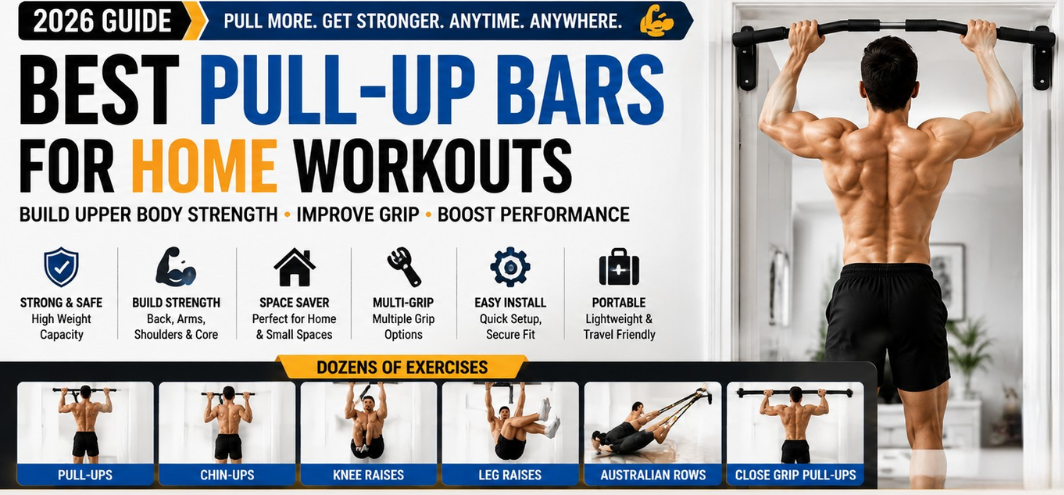
A pull-up bar is one of the most effective pieces of equipment we can add to a home gym. It allows us to perform a wide range of upper-body, core, grip strength, and bodyweight exercises without requiring bulky machines or expensive gym memberships. Whether we are training for muscle growth, improving functional fitness, building back strength, or simply starting a home workout routine, the best pull up bars for home provide a versatile solution for full-body training.
Unlike traditional gym equipment that occupies significant floor space, home pull-up bars come in several compact designs, including doorway pull-up bars, wall-mounted pull-up bars, ceiling-mounted pull-up bars, freestanding power towers, and portable pull-up stations. Each style offers different benefits depending on available space, wall strength, workout intensity, and fitness goals.
Choosing the right pull-up bar involves much more than selecting the cheapest option. We need to consider weight capacity, mounting style, grip positions, construction material, safety, installation method, adjustability, comfort, and compatibility with our home space.
A well-built pull-up bar can support dozens of exercises beyond pull-ups, including chin-ups, hanging leg raises, knee raises, muscle-up progressions, Australian rows, suspension training, resistance band workouts, and stretching routines.
This comprehensive guide covers everything about the best pull-up bars for home, including types, features, installation methods, workout benefits, buying tips, maintenance advice, safety considerations, comparison tables, FAQs, and expert recommendations.
What Is a Pull-Up Bar?
A pull-up bar is a horizontal exercise bar designed for bodyweight pulling exercises. It supports movements where we lift our body toward the bar using upper-body strength.
The primary exercises performed on a pull-up bar include:
-
Pull-ups
-
Chin-ups
-
Neutral-grip pull-ups
-
Hanging leg raises
-
Knee raises
-
Toes-to-bar
-
Dead hangs
-
Scapular pull-ups
-
Muscle-up progressions
-
Australian rows (with suitable setup)
Pull-up bars are popular because they require minimal space while offering excellent training variety.
Why Should We Buy a Pull-Up Bar for Home?
Adding a pull-up bar to a home gym provides multiple fitness benefits.
1. Full Upper Body Training
Pull-up bars allow us to train:
-
Back muscles
-
Shoulders
-
Biceps
-
Forearms
-
Grip strength
-
Core muscles
2. Compact Home Gym Equipment
Most pull-up bars occupy very little space compared to weight machines.
3. Supports Multiple Exercises
A single pull-up bar supports dozens of bodyweight exercises.
4. Suitable for Beginners and Advanced Users
Resistance bands can assist beginners, while advanced athletes can perform weighted pull-ups.
5. Cost-Effective Home Fitness Equipment
One pull-up bar can replace multiple upper-body exercise machines for many users.
Best Types of Pull-Up Bars for Home
There are several types of pull-up bars available for home workouts.
|
Pull-Up Bar Type |
Best For |
|---|---|
| Doorway Pull-Up Bar | Small apartments and rental homes. |
| Wall-Mounted Pull-Up Bar | Dedicated home gyms and garages. |
| Ceiling-Mounted Pull-Up Bar | High ceilings and maximum stability. |
| Freestanding Power Tower | Full-body bodyweight workouts. |
| Portable Pull-Up Bar | Travel and temporary setups. |
| Multi-Grip Pull-Up Bar | Training multiple grip variations. |
Each design suits different home environments.
1. Best Doorway Pull-Up Bars
Doorway pull-up bars are among the most popular home fitness accessories.
They rest on or attach to a door frame without requiring a dedicated gym room.
Advantages
-
Easy installation.
-
Compact storage.
-
Affordable.
-
Suitable for apartments.
-
Minimal permanent installation.
Best For
-
Home workouts.
-
Beginners.
-
Small spaces.
-
Rental homes.
-
Temporary setups.
Things to Check
-
Door frame width compatibility.
-
Weight capacity.
-
Padding on contact points.
-
Grip positions.
-
Frame protection.
2. Best Wall-Mounted Pull-Up Bars
Wall-mounted pull-up bars attach directly to a wall using mounting hardware.
Advantages
-
Excellent stability.
-
Higher weight capacity.
-
Multiple grip options.
-
Suitable for advanced training.
Best For
-
Home gyms.
-
Garages.
-
Strength training.
-
Calisthenics.
Installation Requirements
-
Solid concrete or brick wall.
-
Proper mounting bolts.
-
Correct installation height.
3. Best Ceiling-Mounted Pull-Up Bars
Ceiling-mounted pull-up bars hang from ceiling joists or concrete ceilings.
Advantages
-
Maximum body clearance.
-
Excellent stability.
-
Suitable for muscle-up progressions.
-
Supports suspension trainers.
Best For
-
Garage gyms.
-
Basement gyms.
-
High ceilings.
Before Buying
-
Ceiling strength.
-
Joist spacing.
-
Mounting hardware compatibility.
4. Best Freestanding Pull-Up Bars (Power Towers)
Power towers combine several workout stations.
Exercises Supported
-
Pull-ups.
-
Chin-ups.
-
Dips.
-
Knee raises.
-
Push-ups.
-
Bodyweight rows.
Advantages
-
No drilling required.
-
Multiple workout stations.
-
Suitable for full-body workouts.
Best For
-
Beginners.
-
Families.
-
Home gyms.
-
Apartments with floor space.
5. Best Multi-Grip Pull-Up Bars
Multi-grip bars include several grip positions.
Grip Variations
-
Wide grip.
-
Close grip.
-
Neutral grip.
-
Hammer grip.
-
Angled grip.
Benefits
Different grips emphasize different muscles and reduce repetitive strain.
Benefits of Pull-Up Bars for Home Workouts
Build Upper Body Strength
Pull-ups engage multiple muscles simultaneously.
Primary Muscles Worked
|
Muscle Group |
Role During Pull-Ups |
|---|---|
| Latissimus dorsi | Primary pulling muscle. |
| Biceps | Elbow flexion. |
| Forearms | Grip strength. |
| Rear shoulders | Shoulder stability. |
| Core | Body stabilization. |
| Trapezius | Upper back support. |
Improve Grip Strength
Dead hangs and pull-ups strengthen:
-
Fingers.
-
Wrists.
-
Forearms.
-
Grip endurance.
Develop Core Stability
Hanging exercises require constant abdominal engagement.
Core Exercises
-
Hanging knee raises.
-
Hanging leg raises.
-
Windshield wipers.
-
Toes-to-bar.
-
L-sits.
Support Bodyweight Fitness
Pull-up bars are foundational equipment for calisthenics.
Best Pull-Up Bars by Workout Type
|
Workout Style |
Recommended Pull-Up Bar |
|---|---|
| Strength training | Wall-mounted bar. |
| Bodybuilding | Multi-grip wall bar. |
| Calisthenics | Ceiling-mounted bar. |
| Apartment workouts | Doorway pull-up bar. |
| Family fitness | Power tower. |
| HIIT workouts | Multi-grip doorway bar. |
| Functional fitness | Freestanding station. |
How to Choose the Best Pull-Up Bar for Home
1. Weight Capacity
Weight capacity is one of the most important buying considerations.
|
User Type |
Recommended Capacity |
|---|---|
| Beginners | 100–120 kg minimum. |
| Intermediate lifters | 120–150 kg. |
| Weighted pull-ups | 150 kg or higher. |
Always follow manufacturer specifications.
2. Grip Positions
A versatile pull-up bar includes multiple grip options.
Wide Grip
Targets upper back.
Neutral Grip
Comfortable shoulder position.
Close Grip
Greater biceps involvement.
Hammer Grip
Natural wrist alignment.
3. Material
Common materials include:
|
Material |
Advantages |
|---|---|
| Steel | Excellent durability and strength. |
| Powder-coated steel | Rust resistance and grip texture. |
| Chrome steel | Smooth finish and durability. |
Steel construction is generally preferred for home pull-up bars.
4. Grip Padding
Grip padding influences comfort.
Foam Grips
Comfortable during longer workouts.
Textured Steel Grips
Better durability and grip.
Choose according to preference.
5. Installation Method
Different homes support different mounting methods.
|
Installation Type |
Tools Required |
|---|---|
| Doorway | Usually minimal tools. |
| Wall-mounted | Drill and mounting hardware. |
| Ceiling-mounted | Drill and anchors. |
| Freestanding | Assembly tools. |
Best Pull-Up Bars for Beginners
Beginners should prioritize safety and versatility.
Important Features
-
Multiple grips.
-
Comfortable handles.
-
Stable construction.
-
Suitable weight capacity.
-
Easy installation.
Resistance bands can assist beginners during pull-ups.
Best Pull-Up Bars for Calisthenics
Calisthenics requires additional exercise space.
Useful features include:
-
High clearance.
-
Strong steel construction.
-
Wide grip spacing.
-
Suspension trainer compatibility.
Exercises include:
-
Pull-ups.
-
Muscle-up progressions.
-
Front lever progressions.
-
Back lever practice.
-
Hanging core exercises.
Best Pull-Up Bars for Apartments
Apartment users often need non-permanent equipment.
Ideal Features
-
Doorway mounting.
-
Compact storage.
-
Minimal wall damage.
-
Lightweight design.
Measure doorway dimensions before purchasing.
Best Pull-Up Bars for Garage Gyms
Garage gyms provide more installation flexibility.
Recommended options:
-
Wall-mounted pull-up bars.
-
Ceiling-mounted bars.
-
Freestanding power towers.
These designs typically support more advanced workouts.
Best Pull-Up Bars for Small Spaces
Small-space solutions include:
-
Doorway bars.
-
Foldable wall-mounted bars.
-
Compact power towers.
-
Portable pull-up stations.
Choose equipment that can be removed or folded when not in use.
Best Pull-Up Bars With Dip Station
Some stations combine pull-ups and dips.
Exercises
-
Pull-ups.
-
Chin-ups.
-
Dips.
-
Knee raises.
-
Push-ups.
-
Rows.
Ideal for full-body bodyweight workouts.
Best Pull-Up Bars for Heavy Users
Heavier users should prioritize:
-
Higher weight capacity.
-
Thick steel tubing.
-
Reinforced mounting plates.
-
Strong hardware.
-
Stability during dynamic movement.
Exercises You Can Perform With a Pull-Up Bar
Upper Body Exercises
-
Pull-ups.
-
Chin-ups.
-
Commando pull-ups.
-
Archer pull-ups.
-
Neutral pull-ups.
-
Wide pull-ups.
Core Exercises
-
Hanging knee raises.
-
Hanging leg raises.
-
Toes-to-bar.
-
L-sits.
-
Windshield wipers.
Grip Exercises
-
Dead hangs.
-
One-arm hang progressions.
-
Towel hangs.
Mobility Exercises
-
Shoulder hangs.
-
Lat stretches.
-
Spine decompression hangs.
Pull-Up Variations and Muscles Worked
|
Exercise |
Main Muscles |
|---|---|
| Wide Pull-Up | Upper back, lats. |
| Chin-Up | Biceps and lats. |
| Neutral Pull-Up | Lats, shoulders, forearms. |
| Commando Pull-Up | Back and core. |
| Dead Hang | Grip and shoulders. |
| Hanging Leg Raise | Core and hip flexors. |
Pull-Up Bar Workout for Beginners
Warm-Up
-
Shoulder circles.
-
Band pull-aparts.
-
Arm swings.
-
Scapular activation.
Workout
|
Exercise |
Sets |
|---|---|
| Dead Hang | 3 × 20–30 seconds. |
| Scapular Pull-Ups | 3 × 8. |
| Band-Assisted Pull-Ups | 3 × 5–8. |
| Negative Pull-Ups | 3 × 5. |
| Hanging Knee Raises | 3 × 10. |
Intermediate Pull-Up Workout
-
Pull-ups.
-
Chin-ups.
-
Neutral grip pull-ups.
-
Hanging leg raises.
-
L-sit holds.
-
Dead hangs.
Train 2–3 times weekly with adequate recovery.
Advanced Pull-Up Workout
-
Weighted pull-ups.
-
Archer pull-ups.
-
Chest-to-bar pull-ups.
-
Explosive pull-ups.
-
Muscle-up progressions.
-
Toes-to-bar.
-
Front lever progressions.
Only progress gradually.
How to Install a Pull-Up Bar Safely
Doorway Installation
-
Measure doorway width.
-
Check frame condition.
-
Install according to instructions.
-
Test stability before use.
Wall Installation
-
Use structural wall.
-
Install into suitable wall material.
-
Use manufacturer-approved hardware.
Ceiling Installation
-
Locate structural support.
-
Follow installation instructions carefully.
-
Test before full bodyweight use.
Pull-Up Bar Safety Tips
-
Inspect before every workout.
-
Check mounting hardware regularly.
-
Do not exceed weight limits.
-
Keep the surrounding area clear.
-
Avoid swinging excessively on doorway bars unless designed for dynamic use.
-
Use proper grip technique.
Doorway Pull-Up Bar vs Wall-Mounted Pull-Up Bar
|
Feature |
Doorway Bar |
Wall Bar |
|---|---|---|
| Installation | Easy | Permanent |
| Stability | Good | Excellent |
| Weight Capacity | Moderate | Higher |
| Space Needed | Minimal | Dedicated wall |
| Portability | Excellent | None |
Ceiling Pull-Up Bar vs Power Tower
|
Feature |
Ceiling Bar |
Power Tower |
|---|---|---|
| Pull-Up Space | Excellent | Good |
| Dips | No | Yes |
| Leg Raises | Yes | Yes |
| Footprint | Small | Larger |
| Installation | Permanent | Assembly only |
Best Pull-Up Bars by Fitness Goal
|
Fitness Goal |
Recommended Bar |
|---|---|
| Muscle building | Wall-mounted multi-grip. |
| Weight loss | Doorway pull-up bar. |
| Calisthenics | Ceiling-mounted bar. |
| Core strength | Power tower. |
| Apartment workouts | Portable doorway bar. |
| Family fitness | Power tower station. |
How to Maintain a Pull-Up Bar
Regular maintenance helps improve safety.
Maintenance Checklist
-
Tighten bolts.
-
Inspect grips.
-
Check padding.
-
Clean sweat regularly.
-
Inspect for rust.
-
Check wall anchors.
-
Replace damaged foam grips.
Common Mistakes When Buying Pull-Up Bars
1. Ignoring Weight Capacity
Always check manufacturer specifications.
2. Buying Without Measuring Space
Measure doorway, wall width, and ceiling height.
3. Ignoring Grip Width
Grip positions affect workout variety.
4. Poor Installation
Improper installation can reduce safety.
5. Buying Weak Construction
Choose durable steel construction for longevity.
Pull-Up Bar Buying Checklist
Before purchasing, check:
-
Weight capacity.
-
Doorway compatibility.
-
Wall or ceiling strength.
-
Grip positions.
-
Steel construction.
-
Rust-resistant finish.
-
Comfortable grips.
-
Installation hardware.
-
Available workout space.
-
Warranty coverage.
Advantages of Home Pull-Up Bars
-
Compact home gym equipment.
-
Full upper-body training.
-
Supports bodyweight workouts.
-
Improves grip strength.
-
Suitable for all fitness levels.
-
Affordable long-term fitness investment.
-
Minimal maintenance.
-
Multiple exercise variations.
-
Supports resistance bands and suspension training.
-
Excellent for calisthenics.
Potential Disadvantages
-
Some models require installation.
-
Doorway compatibility varies.
-
Ceiling height may limit movement.
-
Power towers require floor space.
-
Poor installation may reduce stability.
What Makes the Best Pull-Up Bars for Home?
The best pull-up bars for home combine:
-
Strong steel construction
-
High weight capacity
-
Multiple grip positions
-
Comfortable handles
-
Secure installation
-
Durable finish
-
Stability during workouts
-
Space-efficient design
-
Easy maintenance
-
Compatibility with different exercises
The ideal pull-up bar depends on our available space, training goals, installation preferences, and workout intensity.
Final Thoughts on Choosing the Best Pull-Up Bars for Home
A home pull-up bar is one of the most versatile pieces of strength-training equipment we can own. It supports everything from beginner-assisted pull-ups to advanced calisthenics progressions while requiring very little space.
For apartments and rental homes, doorway pull-up bars offer excellent portability and convenience. For dedicated home gyms, wall-mounted and ceiling-mounted pull-up bars provide greater stability and support for advanced training. Power towers are ideal for users who want an all-in-one bodyweight workout station without drilling into walls.
When choosing a pull-up bar, prioritize weight capacity, installation safety, grip options, steel construction, durability, and compatibility with your workout space rather than focusing only on price or appearance.
With proper installation and regular maintenance, a high-quality pull-up bar can become a long-lasting foundation for strength training, muscle building, grip development, core workouts, and functional fitness at home.
FAQs
1. What is the best pull-up bar for home workouts?
The best home pull-up bar depends on available space and training goals. Doorway bars are ideal for compact homes, while wall-mounted bars offer greater stability for strength training.
2. Are doorway pull-up bars safe?
Yes, when installed correctly and used within the manufacturer's weight limit.
3. Can pull-up bars damage door frames?
Some doorway bars can leave marks if installed incorrectly. Using protective padding and following installation instructions helps reduce the risk.
4. Which pull-up bar is best for apartments?
Doorway pull-up bars are usually the most apartment-friendly option because they require minimal permanent installation.
5. What muscles do pull-ups work?
Pull-ups primarily train the back, shoulders, biceps, forearms, grip muscles, and core.
6. Can beginners use a pull-up bar?
Yes. Beginners can start with dead hangs, band-assisted pull-ups, and negative pull-ups.
7. What is the difference between pull-ups and chin-ups?
Pull-ups use an overhand grip, while chin-ups use an underhand grip, typically involving more biceps.
8. How much weight should a pull-up bar hold?
Choose a pull-up bar with a weight rating comfortably above the intended user's body weight and any additional training load.
9. Are wall-mounted pull-up bars stronger than doorway bars?
Generally, properly installed wall-mounted bars provide higher stability and weight capacity.
10. Can we do core workouts on a pull-up bar?
Yes. Hanging leg raises, knee raises, toes-to-bar, and L-sits are excellent core exercises.
11. Is a ceiling-mounted pull-up bar good for calisthenics?
Yes. Ceiling-mounted bars often provide better clearance for advanced movements.
12. Can pull-up bars help build muscle?
Yes. Pull-ups are an effective compound bodyweight exercise for upper-body muscle development.
13. What is a multi-grip pull-up bar?
A multi-grip pull-up bar provides several hand positions, allowing different pull-up variations.
14. Do pull-up bars require drilling?
Doorway models often do not. Wall-mounted and ceiling-mounted bars generally require drilling.
15. Can heavier users use pull-up bars?
Yes, provided the bar's weight capacity supports the user safely.
16. What exercises besides pull-ups can we do?
Chin-ups, dead hangs, hanging leg raises, knee raises, rows, and resistance-band exercises are common options.
17. How often should we train pull-ups?
Two to three sessions per week is a common approach for many strength-training programs, with appropriate recovery.
18. Can children use home pull-up bars?
Only under appropriate supervision and with equipment suitable for their size and ability.
19. Are foam grips better than steel grips?
Foam grips improve comfort, while textured steel grips often provide greater durability.
20. What height should a pull-up bar be installed?
Install the bar high enough for a full hang while leaving sufficient head clearance, following the manufacturer's guidance.
21. Can pull-up bars rust?
Steel bars can rust over time if the protective coating is damaged or they are exposed to moisture.
22. How do we maintain a pull-up bar?
Inspect bolts, clean grips, check mounting hardware, and tighten components regularly.
23. Is a power tower better than a pull-up bar?
A power tower offers additional workout stations, while a dedicated pull-up bar uses less space.
24. What is the best pull-up bar for small spaces?
A compact doorway pull-up bar is usually the best solution for small apartments or limited workout areas.
25. What should we look for when buying a pull-up bar?
Prioritize weight capacity, grip positions, steel construction, installation method, safety, durability, and compatibility with your home space.