
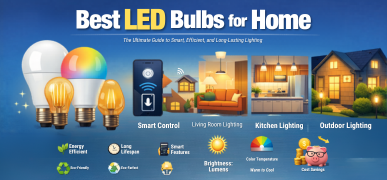
Lighting defines the character, efficiency, and comfort of every home. Choosing the best LED bulbs for home use is no longer just about brightness—it is about energy savings, longevity, ambiance, and smart functionality. We present a comprehensive guide that empowers you to make informed decisions while transforming your living spaces with precision lighting.
Why LED Bulbs Are the Best Choice for Modern Homes
LED (Light Emitting Diode) technology has revolutionized home lighting by offering exceptional efficiency and durability. Unlike traditional incandescent or CFL bulbs, LEDs consume significantly less electricity and last exponentially longer.
Key Advantages of LED Bulbs
- Energy Efficiency: Uses up to 80–90% less power
- Long Lifespan: Lasts up to 25,000–50,000 hours
- Eco-Friendly: Free from toxic materials like mercury
- Instant Brightness: No warm-up time
- Low Heat Emission: Safer and more efficient
We recommend LED bulbs as the default lighting solution for all residential applications.
Types of LED Bulbs for Different Home Needs
Selecting the right LED bulb depends on the purpose of each room. Understanding the types ensures optimal performance and comfort.
1. Standard A-Shape LED Bulbs
These are the most common bulbs used in homes.
- Ideal for living rooms, bedrooms, and general lighting
- Available in multiple wattages and brightness levels
- Compatible with most fixtures
2. LED Tube Lights
Designed for larger spaces requiring uniform lighting.
- Perfect for kitchens, offices, and garages
- Provides wide coverage and consistent brightness
3. Smart LED Bulbs
Advanced lighting solutions controlled via apps or voice.
- Features include color changing, dimming, scheduling
- Compatible with smart home systems
4. Decorative LED Bulbs
Used to enhance aesthetics and interior design.
- Includes filament bulbs, vintage styles, and colored bulbs
- Suitable for cafés, dining areas, and accent lighting
Key Factors to Consider Before Buying LED Bulbs
Choosing the best LED bulb requires evaluating multiple technical and functional aspects.
Brightness (Lumens, Not Watts)
Brightness is measured in lumens. Higher lumens mean brighter light.
| Lumens | Equivalent Wattage | Usage |
|---|---|---|
| 450 | 40W | Soft lighting |
| 800 | 60W | General lighting |
| 1600 | 100W | Bright spaces |
Color Temperature (Kelvin Scale)
- 2700K–3000K: Warm white (cozy ambiance)
- 4000K–4500K: Neutral white (balanced lighting)
- 5000K–6500K: Cool daylight (bright and sharp)
Energy Rating
Look for high energy efficiency ratings to maximize savings.
CRI (Color Rendering Index)
A higher CRI (80+) ensures colors appear more natural and vibrant.
Compatibility
Ensure bulbs match your fixtures and dimmers if applicable.
Best LED Bulbs for Different Rooms in Your Home
Living Room Lighting
We recommend warm white LED bulbs (2700K–3000K) to create a relaxing environment. Smart bulbs add flexibility for mood settings.
Bedroom Lighting
Soft, dimmable LEDs provide comfort and improve sleep quality. Avoid harsh white lights.
Kitchen Lighting
Bright, neutral white LEDs (4000K) enhance visibility for cooking and cleaning.
Bathroom Lighting
Cool white LEDs (5000K) offer clarity for grooming tasks.
Outdoor Lighting
Weather-resistant LED bulbs ensure durability and security.
Top Features to Look for in High-Quality LED Bulbs
Dimmability
Allows control over brightness for different moods.
Smart Integration
Supports voice assistants and mobile apps for automation.
Flicker-Free Technology
Reduces eye strain and improves comfort.
Wide Beam Angle
Ensures even distribution of light.
Energy Savings and Cost Efficiency
LED bulbs dramatically reduce electricity bills. While the initial cost may be higher, the long-term savings outweigh the investment.
Cost Comparison
| Type | Lifespan | Energy Usage | Cost Efficiency |
|---|---|---|---|
| Incandescent | 1,000 hrs | High | Low |
| CFL | 8,000 hrs | Medium | Moderate |
| LED | 25,000+ hrs | Low | High |
Smart LED Bulbs: The Future of Home Lighting
Smart LED bulbs provide unmatched convenience and control.
Benefits
- Remote control via smartphone
- Voice commands
- Custom schedules
- Color customization
These bulbs are ideal for modern smart homes seeking automation and efficiency.
Common Mistakes to Avoid When Buying LED Bulbs
- Choosing based on watts instead of lumens
- Ignoring color temperature
- Buying incompatible bulb bases
- Overlooking dimmer compatibility
- Selecting low CRI bulbs
Avoiding these ensures optimal performance and satisfaction.
Installation and Maintenance Tips
Installation
- Turn off power before installation
- Use compatible fixtures
- Avoid overtightening
Maintenance
- Clean regularly to maintain brightness
- Use surge protectors
- Replace damaged bulbs immediately
Environmental Benefits of LED Lighting
LED bulbs contribute to sustainability by:
- Reducing carbon emissions
- Lowering energy consumption
- Eliminating hazardous waste
Switching to LEDs supports a greener and cleaner environment.
How to Choose the Best LED Bulb Brand
Look for brands that offer:
- Warranty (2–5 years)
- Certified quality standards
- High customer reviews
- Proven durability
Conclusion: Upgrade Your Home with the Best LED Bulbs
We emphasize that choosing the right LED bulbs transforms your home into a more efficient, comfortable, and visually appealing space. By focusing on brightness, color temperature, energy efficiency, and smart features, you can achieve the perfect lighting setup for every room.
FAQs
General Questions
- What are LED bulbs?
LED bulbs are energy-efficient lighting devices using light-emitting diodes. - How long do LED bulbs last?
Typically 15,000 to 50,000 hours. - Are LED bulbs safe?
Yes, they emit less heat and contain no harmful chemicals. - Do LED bulbs save money?
Yes, significantly through reduced energy consumption. - Can LED bulbs be recycled?
Yes, they are environmentally friendly.
Technical Questions
- What is lumen?
A unit measuring brightness. - What is Kelvin?
A unit measuring color temperature. - What is CRI?
Color Rendering Index measures color accuracy. - Are LEDs dimmable?
Only if specified. - Do LEDs flicker?
High-quality LEDs are flicker-free.
Usage Questions
- Which LED is best for bedroom?
Warm white (2700K–3000K). - Which LED is best for kitchen?
Neutral white (4000K). - Can LEDs be used outdoors?
Yes, if weatherproof. - Do LEDs work with inverters?
Yes, they consume less power. - Are smart LEDs worth it?
Yes, for automation and control.
Buying Questions
- What watt LED replaces 60W?
About 8–10W LED. - Are expensive LEDs better?
Usually higher quality and longer lifespan. - Which brand is best?
Choose certified and trusted brands. - How to check LED quality?
Look for lumens, CRI, and warranty. - Do LEDs lose brightness over time?
Very slowly compared to other bulbs.
Advanced Questions
- Can LED bulbs change color?
Smart LEDs can. - Are LEDs compatible with all fixtures?
Not always—check specifications. - Do LEDs emit UV radiation?
No. - Can LEDs be repaired?
Generally not; replacement is recommended. - What is beam angle?
The spread of light from the bulb.