
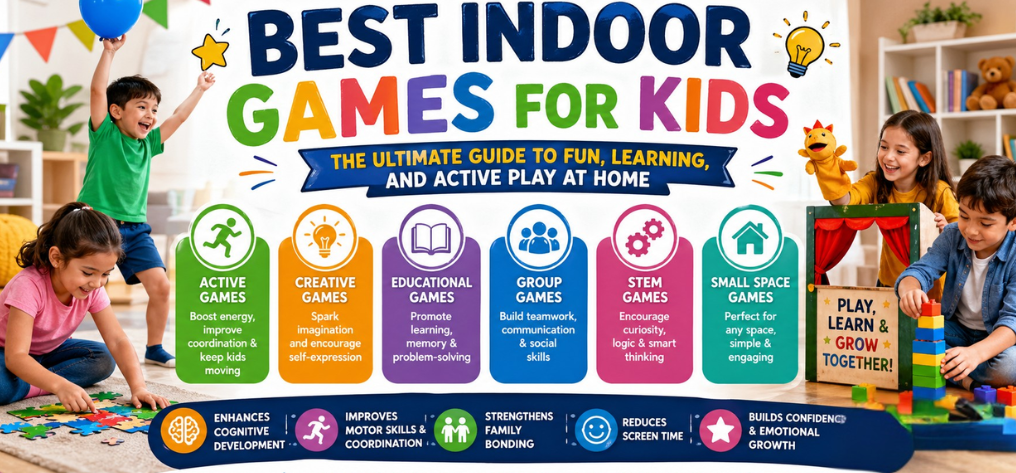
Indoor games for kids are not just a way to pass time—they are powerful tools for creativity, physical activity, cognitive development, and emotional bonding. We present a comprehensive, deeply detailed, and expertly curated guide to the best indoor games for kids that transform any indoor space into a dynamic playground of imagination and growth.
Why Indoor Games Are Essential for Kids’ Development
Indoor games provide a structured yet flexible environment where children can explore, learn, and engage without limitations. They help build motor skills, problem-solving abilities, communication skills, and creativity.
Core benefits include:
- Enhanced cognitive development
- Improved coordination and motor skills
- Stronger family bonding
- Encouragement of independent thinking
- Reduced screen time with meaningful engagement
We focus on activities that combine fun with developmental value, ensuring every moment contributes to a child’s growth.
Top Active Indoor Games for Kids That Boost Energy
1. Indoor Treasure Hunt – Adventure at Home
Treasure hunts create excitement, curiosity, and problem-solving challenges.
How to play:
- Hide clues around the house
- Use riddles or puzzles
- Lead kids to a final “treasure”
Benefits:
- Boosts critical thinking
- Encourages exploration
- Keeps kids physically active indoors
2. Balloon Volleyball – Safe and Energetic
A simple game using a balloon and a makeshift net.
Why it works:
- Safe for indoor play
- Improves hand-eye coordination
- Encourages teamwork and movement
3. Musical Chairs – Classic Indoor Fun
A timeless game that delivers laughter and excitement.
Key features:
- Easy setup with chairs and music
- Builds quick reflexes
- Highly engaging for groups
4. Indoor Obstacle Course – Physical Challenge
Create a course using pillows, chairs, and toys.
Benefits:
- Develops strength and agility
- Encourages creative problem-solving
- Keeps kids actively engaged
Creative Indoor Games That Spark Imagination
5. Role-Playing Games – Imagination Unleashed
Children take on roles like doctors, teachers, or superheroes.
Advantages:
- Builds social and communication skills
- Encourages storytelling
- Enhances emotional intelligence
6. DIY Craft Challenges – Creative Expression
Set tasks like building with paper, clay, or recycled materials.
Why it matters:
- Improves fine motor skills
- Encourages innovation
- Builds confidence through creation
7. Puppet Shows – Storytelling in Action
Kids create puppets and perform stories.
Key benefits:
- Boosts creativity and confidence
- Improves language skills
- Encourages team collaboration
Educational Indoor Games That Promote Learning
8. Memory Card Game – Brain Booster
A simple matching game that strengthens memory and focus.
Why it’s effective:
- Enhances concentration
- Improves visual recognition
- Suitable for all ages
9. Puzzle Solving – Logical Thinking
Jigsaw puzzles and logic games develop problem-solving skills.
Benefits:
- Builds patience
- Enhances spatial awareness
- Encourages independent thinking
10. Math Bingo – Learning Through Play
A fun way to practice numbers.
Highlights:
- Combines education with excitement
- Reinforces basic math skills
- Keeps learning interactive
Quiet Indoor Games for Calm Engagement
11. Reading Challenge – Knowledge Expansion
Set reading goals with rewards.
Why it works:
- Improves vocabulary and comprehension
- Encourages independent learning
- Builds focus and discipline
12. Drawing and Coloring – Artistic Development
Simple yet powerful activity.
Benefits:
- Enhances creativity
- Improves hand control
- Provides relaxation
13. Board Games – Strategic Thinking
Classic board games offer structured entertainment.
Advantages:
- Develop planning skills
- Encourage healthy competition
- Strengthen family bonding
Group Indoor Games for Kids and Friends
14. Simon Says – Listening Skills Game
A leader gives commands with “Simon says”.
Benefits:
- Improves listening and attention
- Encourages quick reactions
- Fun for all ages
15. Charades – Acting and Guessing
Players act out words while others guess.
Why it’s popular:
- Encourages creativity
- Builds confidence
- Highly interactive
16. Freeze Dance – Music and Movement
Dance until the music stops.
Key features:
- Combines fun and physical activity
- Improves balance and control
- Keeps energy levels high
STEM-Based Indoor Games for Smart Learning
17. Building Blocks Challenges – Engineering Skills
Kids build structures with blocks.
Benefits:
- Enhances problem-solving
- Encourages spatial thinking
- Builds engineering mindset
18. Science Experiments – Hands-On Learning
Simple experiments like volcano eruptions.
Why it matters:
- Sparks curiosity
- Teaches scientific concepts
- Encourages exploration
19. Coding Games – Digital Skills
Introduce basic coding through games.
Advantages:
- Develops logical thinking
- Prepares kids for future skills
- Encourages creativity in technology
Indoor Games for Small Spaces
20. Shadow Tag – Minimal Space Fun
Use light to create shadows and tag them.
Benefits:
- Requires no equipment
- Encourages movement
- Works in small areas
21. Paper Toss – Simple and Fun
Throw paper balls into a basket.
Why it works:
- Improves aim and coordination
- Easy setup
- Quick and engaging
22. Balance Challenge – Stability Game
Walk along a line or balance objects.
Key advantages:
- Improves balance and control
- Builds focus
- Safe and effective
Indoor Games for Different Age Groups
| Age Group | Recommended Games |
|---|---|
| 3–5 years | Coloring, Balloon Games |
| 6–8 years | Treasure Hunt, Memory Games |
| 9–12 years | Charades, Puzzle Solving |
| Teens | Board Games, Strategy Games |
How to Choose the Best Indoor Games for Kids
We focus on selecting games based on:
- Age appropriateness
- Skill development goals
- Available space
- Group size
- Energy level of kids
Choosing the right game ensures maximum engagement and learning value.
Tips to Create the Perfect Indoor Game Environment
- Keep rules simple and clear
- Rotate games to maintain interest
- Encourage team participation
- Ensure safe play areas
- Mix active and calm games
Conclusion
Indoor games for kids offer a powerful combination of entertainment, education, and development. With the right mix of activities, we create an environment where children thrive physically, mentally, and emotionally. Every game becomes an opportunity for growth, joy, and meaningful connection.
FAQs
1. What are the best indoor games for kids?
Treasure hunt, balloon volleyball, and charades.
2. Which indoor game is best for learning?
Memory games and puzzles.
3. What games improve brain development?
Puzzle solving and coding games.
4. Which indoor game requires no equipment?
Simon Says.
5. What are fun group games for kids?
Charades and musical chairs.
6. Which game improves creativity?
Role-playing and drawing.
7. What is a quiet indoor activity?
Reading and coloring.
8. Which game improves memory?
Matching card games.
9. What is a safe indoor physical game?
Balloon volleyball.
10. Which game is best for small spaces?
Paper toss.
11. What games improve communication?
Role-playing and charades.
12. Which indoor game is educational?
Math bingo.
13. What is a fun game for toddlers?
Coloring and simple puzzles.
14. Which game improves teamwork?
Obstacle course.
15. What is the easiest indoor game?
Simon Says.
16. Which game builds confidence?
Puppet shows.
17. What is a creative indoor game?
DIY crafts.
18. Which game improves coordination?
Balloon games.
19. What is a fast-paced indoor game?
Freeze dance.
20. Which game is best for siblings?
Treasure hunt.
21. What indoor games reduce screen time?
Board games and crafts.
22. Which game is best for rainy days?
Obstacle course.
23. What is a STEM indoor game?
Building blocks.
24. Which game improves focus?
Puzzle solving.
25. What is the most fun indoor game?
Charades.