
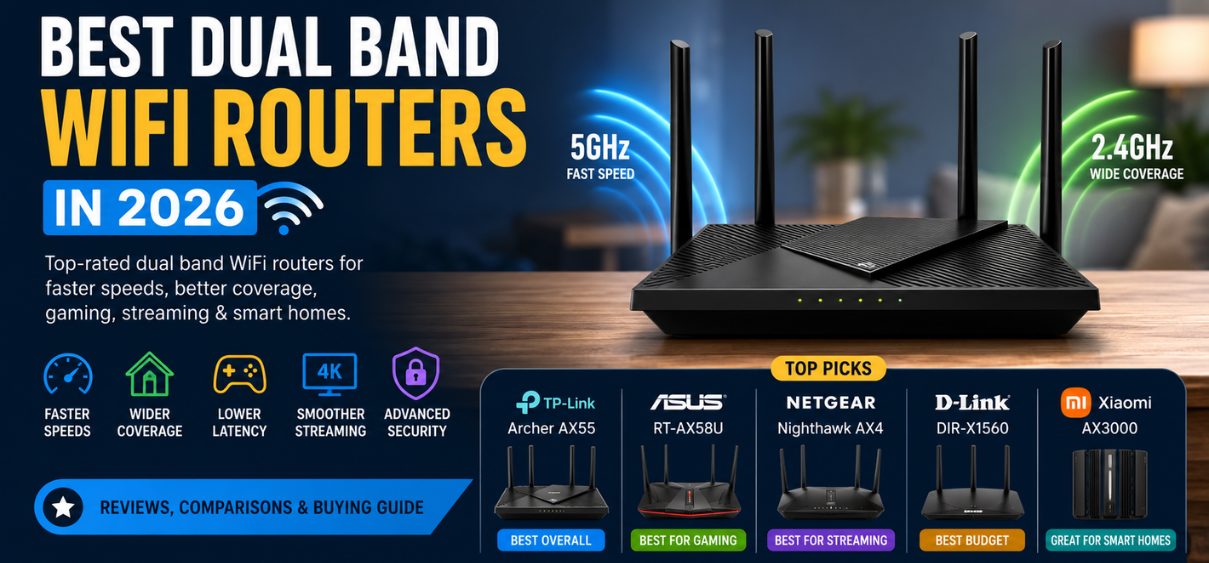
Best Dual Band WiFi Routers in 2026
A reliable internet connection has become an essential part of modern life. Whether we are working remotely, streaming 4K content, attending online classes, playing competitive games, or managing smart home devices, a high-performance WiFi router is the foundation of a seamless digital experience.
Among the various networking solutions available today, dual band WiFi routers remain the most popular choice because they offer the ideal balance between affordability, speed, range, and stability. By operating on both the 2.4GHz and 5GHz frequency bands, these routers reduce congestion, improve performance, and provide a better user experience across multiple devices.
In this comprehensive guide, we explore the best dual band WiFi routers in 2026, compare their features, discuss how dual-band technology works, and help you choose the right model for your specific requirements.
Top Dual Band WiFi Routers Comparison Table
| Router Model | WiFi Standard | Speed | Coverage | Best For |
|---|---|---|---|---|
| TP-Link Archer AX55 | WiFi 6 | AX3000 | Large Homes | Overall Performance |
| ASUS RT-AX58U | WiFi 6 | AX3000 | Large Homes | Gaming |
| Netgear Nighthawk AX4 | WiFi 6 | AX3000 | Medium-Large Homes | Streaming |
| TP-Link Archer C80 | WiFi 5 | AC1900 | Medium Homes | Value for Money |
| ASUS RT-AC86U | WiFi 5 | AC2900 | Large Homes | Heavy Usage |
| D-Link DIR-X1560 | WiFi 6 | AX1500 | Small-Medium Homes | Budget Users |
| Tenda RX3 | WiFi 6 | AX1800 | Apartments | Affordable WiFi 6 |
| Xiaomi Router AX3000 | WiFi 6 | AX3000 | Medium Homes | Smart Homes |
Why Choose a Dual Band WiFi Router?
Dual band routers transmit wireless signals over two separate frequency bands:
2.4GHz Band
- Wider coverage area
- Better wall penetration
- Ideal for smart devices
- Supports older devices
- Suitable for basic browsing
5GHz Band
- Faster speeds
- Lower latency
- Reduced interference
- Better for gaming
- Ideal for HD and 4K streaming
By intelligently distributing devices across both frequencies, dual-band routers provide significantly better performance than traditional single-band routers.
Best Overall Dual Band Router: TP-Link Archer AX55
The TP-Link Archer AX55 stands out as one of the best dual-band routers available today.
Key Features
- WiFi 6 technology
- AX3000 speeds
- OFDMA support
- Beamforming technology
- WPA3 security
- Gigabit Ethernet ports
Advantages
- Excellent speed performance
- Strong signal coverage
- Easy mobile app setup
- Future-ready networking
Best For
- Families
- Work-from-home users
- Multiple connected devices
- 4K streaming households
Best Dual Band Router for Gaming: ASUS RT-AX58U
Gamers require low latency and stable connectivity. The ASUS RT-AX58U delivers exceptional gaming performance.
Gaming Features
- Adaptive QoS
- Gaming acceleration
- MU-MIMO support
- AiProtection security
- WiFi 6 support
Why Gamers Love It
Competitive online gaming demands consistent performance. This router minimizes lag spikes and maintains stable connections during intense multiplayer sessions.
Best Budget Dual Band Router: D-Link DIR-X1560
Users looking for affordable WiFi 6 performance should consider the D-Link DIR-X1560.
Highlights
- Affordable pricing
- WiFi 6 support
- Dual-band operation
- WPA3 security
- Easy setup
Ideal Users
- Students
- Small families
- Apartment residents
- First-time WiFi 6 buyers
Best Dual Band Router for Large Homes
Large homes require powerful antennas and advanced signal management.
Recommended models include:
- ASUS RT-AX58U
- TP-Link Archer AX55
- ASUS RT-AC86U
- Netgear Nighthawk AX4
These routers offer:
- Extended coverage
- Beamforming technology
- Multiple antennas
- Better signal penetration
Best Dual Band Router for Streaming
Modern streaming services require reliable bandwidth.
Requirements for Smooth Streaming
- Minimum buffering
- Stable connections
- High throughput
- Strong coverage
Recommended Routers
- TP-Link Archer AX55
- Netgear Nighthawk AX4
- ASUS RT-AX58U
- Xiaomi AX3000
These models can easily handle:
- Netflix 4K
- YouTube 4K
- Disney+ streaming
- Live sports
- IPTV services
Understanding WiFi Standards
WiFi 5 (802.11ac)
Benefits include:
- High-speed connectivity
- Affordable pricing
- Mature technology
- Wide compatibility
WiFi 6 (802.11ax)
Advantages include:
- Faster speeds
- Better efficiency
- Improved battery life
- Reduced network congestion
- Better multi-device performance
For most buyers in 2026, WiFi 6 routers provide better long-term value.
Features to Consider Before Buying a Dual Band Router
Internet Speed Compatibility
Choose a router that can fully utilize your ISP plan.
Suggested Router Categories
| Internet Speed | Recommended Router |
| Up to 100 Mbps | AC1200 |
| 100-300 Mbps | AC1900 |
| 300-500 Mbps | AX1800 |
| 500 Mbps+ | AX3000 |
Coverage Area
Consider:
- Number of floors
- Wall thickness
- Home size
- Device density
Larger homes benefit from high-power routers or mesh systems.
Number of Devices
Modern households often connect:
- Smartphones
- Laptops
- Smart TVs
- Security cameras
- Gaming consoles
- Smart speakers
Choose routers supporting MU-MIMO and OFDMA technologies.
Security Features
Essential security technologies include:
- WPA3 encryption
- Firewall protection
- Guest network support
- Parental controls
- Firmware updates
Dual-Band vs. Single-Band Routers
| Feature | Single Band | Dual Band |
| Speed | Lower | Higher |
| Interference | High | Low |
| Coverage | Moderate | Better |
| Streaming | Limited | Excellent |
| Gaming | Average | Superior |
| Device Support | Basic | Advanced |
Dual-band routers are the preferred choice for modern households.
Dual-Band vs. Tri-Band Routers
| Feature | Dual Band | Tri Band |
| Cost | Affordable | Expensive |
| Home Usage | Excellent | Excellent |
| Device Handling | Very Good | Outstanding |
| Gaming | Great | Better |
| Business Usage | Good | Excellent |
For most homes, dual-band routers provide the best value.
Best Dual Band Router Brands
TP-Link
Known for affordability, reliability, and user-friendly setup.
ASUS
Popular among gamers and power users.
Netgear
Offers premium performance and advanced features.
D-Link
Excellent balance between cost and functionality.
Xiaomi
Strong value proposition with modern hardware.
Tenda
Budget-friendly WiFi 6 solutions.
How to Improve Router Performance
Follow these best practices:
- Place the router centrally
- Elevate the router position
- Update firmware regularly
- Use WPA3 security
- Reduce wireless interference
- Reboot periodically
- Optimize channel settings
Common WiFi Problems and Solutions
Slow Internet
Possible causes:
- Router overload
- ISP issues
- Poor placement
Frequent Disconnects
Possible causes:
- Firmware issues
- Signal interference
- Hardware problems
Weak Coverage
Solutions:
- Better placement
- Range extender
- Mesh network
Who Should Buy a Dual Band WiFi Router?
A dual-band router is ideal for:
- Home users
- Remote workers
- Students
- Streamers
- Gamers
- Small businesses
- Smart home owners
Final Verdict
The best dual-band WiFi router depends on your budget, internet speed, home size, and usage requirements. For most users, the TP-Link Archer AX55 offers the best overall balance of performance, speed, coverage, and value. Gamers may prefer the ASUS RT-AX58U, while budget-conscious buyers can confidently choose the D-Link DIR-X1560 or Tenda RX3.
Investing in a quality dual-band router ensures smoother streaming, faster downloads, improved gaming performance, stronger coverage, and a better online experience for years to come.
FAQs
1. What is a dual band WiFi router?
A router that operates on both 2.4GHz and 5GHz frequencies.
2. Is dual band better than single band?
Yes, it offers better speed and less interference.
3. Which band is faster?
The 5GHz band.
4. Which band has longer range?
The 2.4GHz band.
5. Is WiFi 6 worth buying?
Yes, especially for future-proofing your network.
6. Can dual band routers support gaming?
Yes, they are excellent for gaming.
7. How many devices can a dual band router support?
Most support dozens of devices simultaneously.
8. What is MU-MIMO?
A technology that serves multiple devices at once.
9. What is OFDMA?
A WiFi 6 feature that improves efficiency.
10. Is WPA3 necessary?
Yes, it provides stronger security.
11. Do dual band routers reduce lag?
Yes, especially on the 5GHz band.
12. Are dual band routers good for streaming?
Yes, they are ideal for HD and 4K streaming.
13. Can I use a dual band router with fiber internet?
Yes.
14. What speed router do I need for 300 Mbps internet?
An AX1800 or better router.
15. Which router brand is most reliable?
TP-Link, ASUS, and Netgear are highly reliable.
16. Do dual band routers improve coverage?
Generally, yes.
17. Can smart devices connect to dual band routers?
Yes.
18. How often should I update firmware?
Whenever updates become available.
19. Are external antennas better?
They often provide improved coverage.
20. Can I use a dual band router in an office?
Absolutely.
21. Is dual band enough for smart homes?
Yes, for most smart homes.
22. What is beamforming?
Technology that directs signals toward devices.
23. Can dual band routers replace mesh systems?
For smaller homes, yes.
24. How long does a router last?
Typically 4–6 years.
25. Which dual band router is best overall?
TP-Link Archer AX55 remains one of the strongest overall choices.