
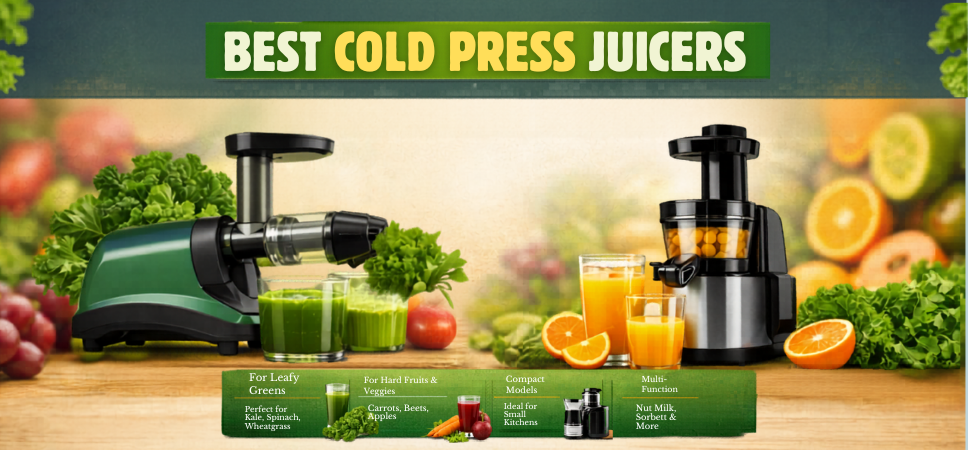
Fresh juice prepared with a cold press juicer delivers vibrant flavor, dense nutrition, and superior texture compared to high-speed alternatives. By slowly crushing and pressing fruits and vegetables, this technology preserves enzymes, minimizes oxidation, and extracts more liquid with noticeably drier pulp. We rely on precision augers, low-RPM motors, and fine strainers to produce clean, smooth juice that stays fresh longer and tastes richer with every glass.
This detailed guide presents the best cold press juicers, essential performance factors, design advantages, maintenance practices, and expert selection advice for households committed to daily, nutrient-rich juicing.
What Makes a Cold Press Juicer Superior
A cold press juicer (also called a masticating juicer) uses a slow rotating auger to crush produce against a strainer, squeezing juice without heat buildup.
Key characteristics include:
- Low speed (40–120 RPM) for minimal oxidation
- Higher juice yield from the same ingredients
- Drier pulp indicating efficient extraction
- Quiet operation suitable for any time of day
- Ability to juice leafy greens, herbs, and wheatgrass
- Longer juice freshness due to reduced air incorporation
Essential Features of the Best Cold Press Juicers
Low RPM Motor
Slow rotation preserves nutrients and prevents heat damage.
Strong Auger Design
Heavy-duty augers made from food-grade materials crush dense produce effectively.
Fine Stainless Steel Strainer
Ensures smooth juice with minimal fiber.
Reverse Function
Prevents clogging and keeps extraction continuous.
Wide Feed Chute
Reduces chopping time by allowing larger pieces.
BPA-Free Construction
Safe, durable materials for daily use.
Types of Cold Press Juicers
Horizontal Cold Press Juicers
- Excellent for leafy greens and wheatgrass
- Multi-purpose use (nut milk, sorbet)
- Slightly larger footprint
Vertical Cold Press Juicers
- Compact design
- Faster feeding and extraction
- Ideal for modern kitchens
Best Cold Press Juicers by Usage Category
Cold Press Juicer for Leafy Greens
Designed to extract maximum juice from spinach, kale, mint, coriander, and wheatgrass.
Ideal for: Green detox juices and herbal blends.
Cold Press Juicer for Hard Fruits and Vegetables
Strong auger processes carrots, beets, apples, and pomegranate effortlessly.
Ideal for: Mixed fruit-vegetable juices.
Compact Cold Press Juicer for Small Kitchens
Space-saving vertical design with powerful performance.
Ideal for: Apartments and compact counters.
Multi-Function Cold Press Juicer
Supports nut milk, frozen desserts, and smoothies in addition to juice.
Ideal for: Versatile healthy kitchens.
Comparison Table of Cold Press Juicer Types
| Feature | Horizontal Model | Vertical Model | Compact Model | Multi-Function |
|---|---|---|---|---|
| Best For | Greens, wheatgrass | Mixed produce | Small kitchens | Nut milk, sorbet |
| Footprint | Large | Medium | Small | Medium |
| RPM | 40–80 | 60–100 | 60–100 | 40–90 |
| Juice Yield | Very High | High | High | Very High |
| Noise | Very Low | Low | Low | Low |
| Cleaning | Moderate | Easy | Easy | Moderate |
Performance Benchmarks for Quality Cold Press Juicers
- Pulp exits nearly dry
- Juice appears rich, dense, and foam-free
- No heating of components during use
- Smooth extraction of fibrous greens
- Continuous flow without clogging
How to Choose the Right Cold Press Juicer
For Daily Green Juices
Select a horizontal model with strong auger pressure.
For Mixed Fruits and Vegetables
Choose a vertical cold press juicer with wide feed chute.
For Limited Kitchen Space
Opt for a compact vertical design.
For Advanced Use
Pick a multi-function model capable of nut milk and frozen treats.
Advantages of Cold Press Juicing at Home
- Maximum nutrient retention
- Better taste and natural color
- Longer juice shelf life (up to 24–48 hours refrigerated)
- Minimal foam and separation
- Efficient extraction from herbs and greens
- Quiet, peaceful operation
Design Elements That Improve Usability
- Anti-drip spout
- Ergonomic assembly and disassembly
- Cleaning brush included
- Stable anti-skid base
- Transparent containers for monitoring pulp
Maintenance Practices for Longevity
- Rinse parts immediately after juicing
- Use brush to clean mesh thoroughly
- Avoid dishwasher for certain parts if not recommended
- Dry components completely before storage
- Do not overload feed chute
Common Mistakes to Avoid
- Feeding very large chunks without chopping
- Ignoring reverse function during clogging
- Allowing pulp to dry inside strainer
- Running machine continuously for long durations
- Using hard seeds without removal
Cold Press Juicer vs Centrifugal Juicer
| Feature | Cold Press | Centrifugal |
| Speed | Slow | Very Fast |
| Nutrient Retention | Excellent | Moderate |
| Foam | Minimal | Noticeable |
| Noise | Low | High |
| Greens Juicing | Excellent | Poor |
| Juice Shelf Life | Long | Short |
Juicing Performance Tests You Can Try
- Juice spinach and mint for smooth green output
- Extract pomegranate with minimal residue
- Juice carrots and observe pulp dryness
- Check foam level in apple juice
- Store juice for 24 hours and observe separation
Durability and Warranty Expectations
High-quality cold press juicers typically offer 2–10 years motor warranty and long operational life with proper care.
Energy Efficiency and Quiet Operation
Low RPM motors consume less electricity and produce very little sound, making them ideal for daily routines.
Expert Recommendation
A vertical cold press juicer with reverse function, BPA-free parts, 60–80 RPM motor, and fine stainless steel strainer provides the perfect balance of performance, convenience, and nutrition for most homes.
FAQs
- What RPM is best?
40–80 RPM. - Can it juice wheatgrass?
Yes, efficiently. - Is cleaning difficult?
No, with brush and rinse. - Does it preserve nutrients?
Yes, exceptionally well. - Can I make nut milk?
Yes, in multi-function models. - Is juice foam-free?
Mostly, yes. - Can I juice pomegranate?
Yes. - How long does juice last?
Up to 48 hours refrigerated. - Is noise low?
Very low. - What is reverse function?
Prevents clogging. - Are parts BPA-free?
In quality models, yes. - Can kids operate it?
With supervision. - Does it heat juice?
No. - Can I juice herbs?
Yes. - Can it handle carrots?
Yes. - What indicates good extraction?
Dry pulp. - How often to clean?
After every use. - Is dishwasher safe?
Check manufacturer guidance. - Can it crush ice?
No. - Is it slow?
Yes, intentionally. - What fruits not suitable?
Bananas, avocados. - How long does it last?
Many years. - Is assembly complex?
No. - Does it consume much power?
Very little. - Is it worth the investment?
Yes for daily juicing.